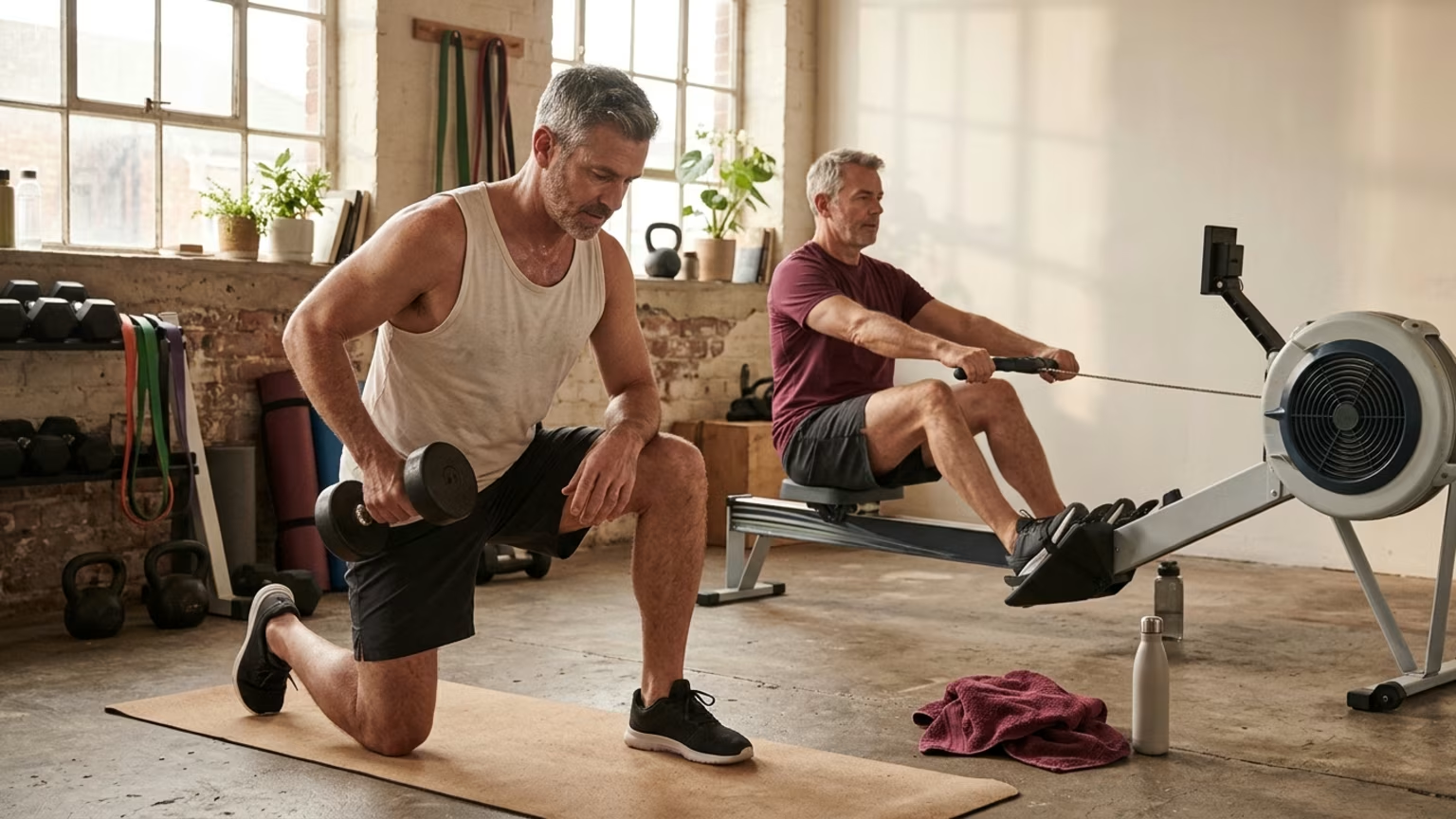

A response to The Post’s midlife exercise coverage: why strength and cardio belong together, without turning expert opinion into a fixed training ratio.





On October 31, 2026, The Post published an article credited to Peta Bee of The Times examining whether people in midlife should prioritize weights or cardio.
This is news coverage bringing several research threads together, not a newly issued clinical guideline. The Post’s account does not provide the Swedish study’s sample size or testing schedule. It also does not provide the full methods of the exercise review or explain the mortality estimate’s adjustment factors.
The glucose finding applies to the reviewed twice-weekly strength-only programs. It should not become a sweeping claim that resistance training has no metabolic value. The mortality relationship is an association rather than a guaranteed reduction in any individual’s risk.
The article also states that researchers have not established a definitive cardio-to-strength ratio. Its suggested age-related split is an expert’s rough guide, not a research-settled prescription. The coverage does not establish that combined training is superior for every outcome or training schedule.
Finally, the reporting is not specific to gay men or to men over 35 as a distinct research population. Its relevance to this audience is practical: different health goals deserve attention rather than a single exercise winner.
For a man over 35, the most useful question is not which form of exercise deserves permanent priority. It is whether his routine gives both strength and aerobic fitness a place.
That changes how you assess an existing schedule. Instead of judging it only by how many sessions you complete, look at what those sessions are intended to support. A routine can be consistent while remaining concentrated on one kind of fitness.
The broad application from Sardeli’s interpretation is to include both resistance training and aerobic activity. That is a direction for planning rather than a demand to rebuild your entire week or copy someone else’s allocation.
The Post connects resistance training with muscle and bone maintenance. For someone who values strength or a muscular appearance, those are legitimate reasons to keep it in the picture.
The glucose-regulation result does not make those goals less worthwhile. It changes the question from whether lifting is useful to whether lifting alone addresses everything you want from exercise.
That distinction matters when fitness advice turns one disappointing outcome into a verdict on an entire activity. Evaluate strength work against its relevant goals. Then give aerobic fitness its own place rather than asking one training mode to stand in for both.
Our guide to fitting resistance work and aerobic activity into the same routine offers a separate place to examine programming choices. The news here supplies the reason to think across both categories, not a complete personal schedule.
Sardeli’s metabolic-health interpretation and Lang’s discussion of cardiorespiratory fitness make the case for aerobic activity without referring to a particular physique. That is a useful distinction for readers whose fitness decisions are closely tied to how they look.
You do not need to stop caring about visible muscle or body composition. The editorial takeaway is to give health outcomes their own standing rather than making appearance the sole test of whether a routine is worthwhile.
If weights already dominate your training, the practical question is where aerobic activity belongs alongside them. If aerobic exercise is your preferred mode, the corresponding question is where resistance work belongs. Neither preference needs to become an identity that rules out the other.
A useful starting point is to describe your current routine in plain language. Identify which activities are intended as resistance training and which provide aerobic exercise. Then notice whether one category is absent or repeatedly left out.
This is an audit of coverage, not a scorecard for effort. The response to a missing category need not be a more demanding version of everything you already do. The first planning decision is whether both kinds of activity have a realistic place.
Keep that conversation separate from claims about an ideal body. Someone interested in size may approach the balance differently from someone whose main interest is daily energy. The shared point is to account for both strength and aerobic fitness rather than assume that success in one settles the other.
For personal programming or questions about glucose regulation, a qualified clinician or exercise professional can relate the broad findings to your circumstances. A news article is a starting point for that conversation rather than an individual assessment.
The Swedish study’s reported age finding is easy to turn into an alarming headline. Westerståhl’s interpretation offers a more useful reading: physical performance changes with age and activity remains worthwhile.
Treat the reported age as a population-level observation rather than a diagnosis of your current abilities. It does not tell you what you should be able to lift or how fit you should feel today. Nor does it create a birthday after which exercise stops being worth the effort.
For someone returning after time away, the practical message is that maintaining or rebuilding an active routine still has a purpose. For someone already training, the message is to keep that effort connected to a broad set of goals rather than demand permanent immunity from aging.
This is also a reason to choose a plan that fits an adult life. Work and relationships may both deserve space alongside training. The objective is to make room for the two exercise categories, not to turn every available hour into a fitness obligation.
A routine can support ambition without becoming a referendum on whether you are aging correctly. Wanting to stay capable is enough reason to train; looking unchanged is not a condition of success.
For gay men, the value of this coverage does not require a special biological claim. It comes from translating the evidence without assuming that everyone wants the same physique or expression of masculinity.
Wanting more visible muscle is a valid preference. So is caring more about energy or a less training-centered daily life. None of those priorities needs to be treated as the standard against which every other gay man should be measured.
Keep the training decision specific: strength and aerobic fitness deserve attention within the life you want to lead. Appearance can remain part of that life without becoming the only reason exercise counts.
Sexual wellbeing also deserves its own evidence-led conversation rather than being folded into a promise about a particular workout mix. Readers interested in that subject can turn to our discussion of exercise in the context of male sexual health. That keeps adjacent concerns connected without pretending they are interchangeable outcomes.
The same editorial discipline applies to tracking progress. If appearance matters to you, it can be discussed alongside capability rather than replacing it. Our coverage of tracking body-composition changes alongside strength addresses that separate question.
The useful shift is from choosing a winning exercise identity to recognizing distinct goals. You can care about how you look while giving aerobic fitness a place. You can enjoy cardio while treating strength as relevant to your future.
Keep both resistance training and aerobic activity in your routine, using their different purposes to guide planning rather than treating either as a complete substitute for the other.
Reducing midlife exercise to a body ideal repeats the limits of generic men's health advice; GayFitLab brings gay social and sexual-health context to research-led fitness coverage. Its editorial guidance helps men 35+ assess conflicting training messages while making room for appearance and confidence, rather than setting a preferred look or style of masculinity.
Stay connected for research-led guidance on fitness, body composition, skin, grooming, vitality, sexual wellbeing, relationships and healthy aging. Clear ideas for gay men 35+ who want to look good, feel strong and age with confidence.



Build habits and systems that support clear thinking, steady energy and long term capacity throughout a demanding career.
explore the Blog