
Experts highlight squats for lower-body strength and everyday function. Here is how to place them within a broader routine without anti-aging hype.





On October 23, 2026, the Las Vegas Review-Journal published “Experts say this is the best exercise to support healthy aging,” featuring squats and broader strength training. The piece reported expert views rather than results from a new clinical trial.
There is also relevant evidence beyond the newspaper’s expert interviews. A 2025 systematic review and meta-analysis summarized by PEDro included 30 randomized trials and 2,009 participants with diabetes. It reported improvements in muscle strength, HbA1c and BMI in both middle-aged and older-adult subgroups.
That finding gives the body-composition discussion a more specific foundation. The review examined resistance training and measured health outcomes rather than relying only on expert opinion. Some secondary outcomes differed between the age groups.
The Review-Journal does not identify the squat studies it describes or provide their samples and effect sizes. Its broader statements about metabolic health and mortality also lack specific study details. The coverage therefore does not establish that squats are uniquely superior to other exercises.
The PEDro review concerns people with diabetes and resistance training broadly. It is not evidence that squats alone produce the same metabolic or body-composition results in all adults. Neither source establishes a particular appearance change or an extension of lifespan from doing squats.
The assembled evidence is not specific to gay men. It also does not identify age 35 as a biological threshold for these benefits. Applying the coverage to gay men over 35 is an editorial choice about relevant health priorities, not a finding about a distinct study population.
For a man over 35, the useful message is less about crowning a winning exercise and more about giving lower-body strength a place in everyday life. The experts’ emphasis is on maintaining physical capacity through a combination of strength and aerobic activity. Squats are one accessible expression of that approach.
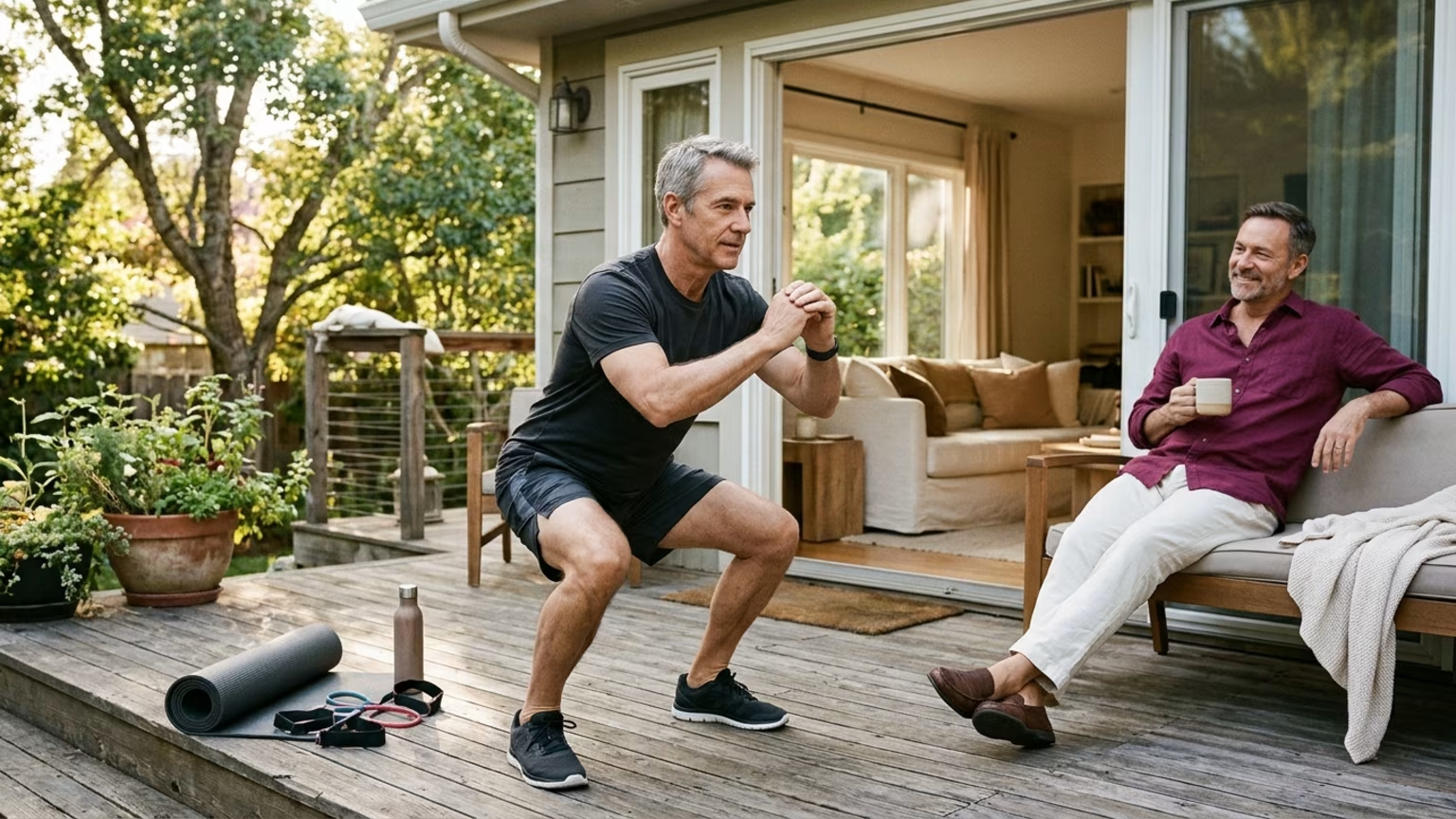
Start with the purpose of the movement rather than its reputation. In this coverage, squats matter because the experts connect lower-body strength with mobility and everyday function. That gives the exercise a role beyond how demanding it looks in a gym.
For an appearance-conscious reader, that is an additional goal rather than a competing one. Wanting stronger-looking legs and wanting to move confidently belong in the same health conversation. There is no need to make either ambition more respectable by dismissing the other.
A useful planning question is: does the routine give lower-body strength deliberate attention? That keeps the focus on the capacity being trained rather than on performing a particular version of a squat for its own sake.
The clearest agreement among the seven experts was about combining aerobic exercise and strength training. The practical response is to preserve that combination when deciding where squats belong.
A squat-focused headline is not a reason to remove aerobic activity from a routine. The Review-Journal’s guidance also does not suggest replacing training for other muscle groups with squats. Its featured movement sits within a broader exercise plan.
For readers reviewing their schedules, the task is therefore one of placement rather than replacement. GayFitLab’s coverage of strength training within limited available time offers a related planning topic. Keep the distinction clear: organizing a routine is a separate decision from accepting a headline’s claim about the “best” exercise.
The Review-Journal quotes trainer Allison Goldsmith recommending chair squats for people who need a modification. Her description makes the movement concrete:
These are Goldsmith’s reported instructions, not a requirement to perform the movement without assistance. The article also advises using support when needed for balance and working through a controlled range of motion while maintaining form.
The same coverage recommends beginning with body-weight squats before adding resistance. In practical terms, its progression starts with the movement itself rather than with a demand to load it immediately.
For someone choosing between versions, the useful distinction is how the exercise fits their current movement and support needs. A chair-based version should not be treated as an embarrassing substitute. Adaptability is part of the reason the experts featured squats in the first place.
The newspaper advises people with knee or back problems to consult a doctor or physical therapist before doing squats. It specifically flags new or sharp pain and pain with swelling.
That advice takes priority over the appeal of an accessible exercise. A movement can be widely useful without being appropriate in the same form for every person. When pain or a health concern makes the choice personal, qualified assessment belongs ahead of a generic exercise recommendation.
This is also where the article’s emphasis on controlled movement and support has practical value. The editorial takeaway is to match the exercise to the person rather than treating completion of a standard-looking squat as the objective.
Body composition deserves a precise conversation. The PEDro review reported improvements in BMI among participants with diabetes who undertook resistance training. The Review-Journal’s experts discussed strength training within a wider picture of metabolic health and physical function.
For a reader interested in looking good, the practical move is to name the desired outcome clearly. Lower-body strength is one aim. A change in appearance is another. Keeping them distinct makes it easier to judge whether a piece of exercise advice actually addresses the question being asked.
That does not require abandoning physique goals or pretending they are superficial. It means resisting the temptation to turn a functional exercise recommendation into a promise of youth. Our framework for body-image-aware physique goals addresses that separate editorial conversation.
A useful exercise does not need an anti-aging sales pitch to deserve a place in a routine.
The most relevant application to health span is a change in emphasis: view lower-body strength as a capacity worth practicing rather than an occasional aesthetic project. That interpretation follows the experts’ focus on mobility and independence.
When reviewing an existing routine, look at the overall arrangement. Is there aerobic activity alongside strength work? Does lower-body training have a place? Is the chosen squat version consistent with the source’s emphasis on control and appropriate support?
Those questions translate the coverage into a planning discussion without turning it into a rigid program. They also leave room for different bodies and priorities. For a wider editorial perspective, GayFitLab’s healthy-aging coverage connects this subject with the broader goal of maintaining a full life as the years advance.
Treat squats as an adaptable option for lower-body strength within a routine that retains aerobic activity and other strength work, with qualified guidance when pain or health concerns affect the choice.
A squat headline becomes misleading when it sells youth instead of describing strength. GayFitLab addresses that confusion through research-led fitness and body-composition coverage for gay men 35+, offering clear distinctions between credible evidence and marketing so that looking attractive need not mean chasing unrealistic anti-aging promises.
Stay connected for research-led guidance on fitness, body composition, skin, grooming, vitality, sexual wellbeing, relationships and healthy aging. Clear ideas for gay men 35+ who want to look good, feel strong and age with confidence.




Build habits and systems that support clear thinking, steady energy and long term capacity throughout a demanding career.
explore the Blog