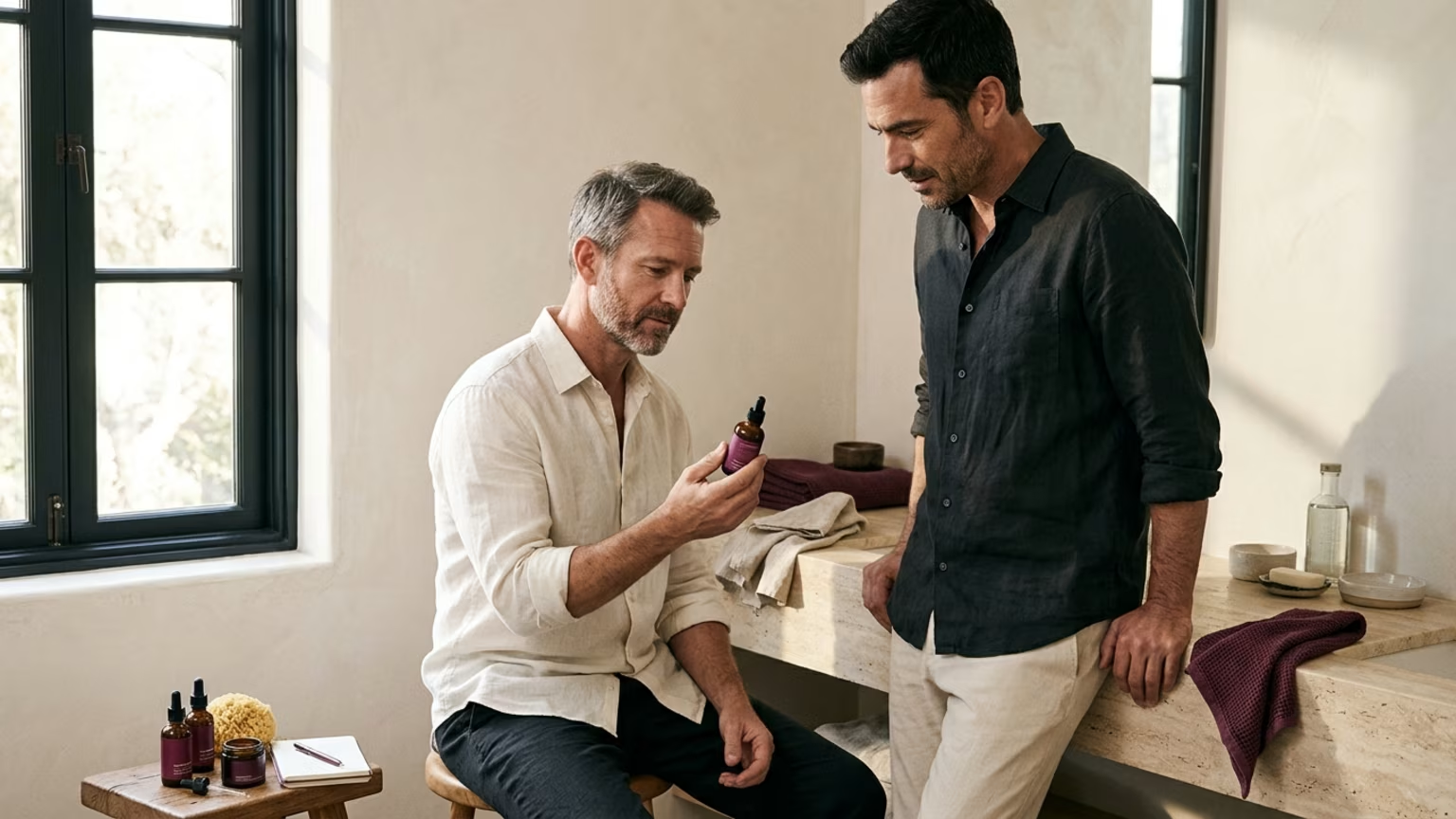

An evidence check on longevity skincare: company-reported studies, biological-aging claims and practical skincare priorities for gay men over 35.





On November 2, 2026, the Los Angeles Times published a feature examining the science and commercial claims behind longevity skincare; the page was updated November 3.
The interesting shift is not simply another promise of fewer wrinkles. In the Los Angeles Times feature, Dr. Wong of SHA Wellness Clinic describes skin longevity as preserving skin function and resilience over time. That framing includes barrier support and collagen architecture alongside cellular repair and immune balance.
Protection against ultraviolet radiation, pollution and chronic inflammation also belongs within that definition. The ambition is broader than changing how a face looks in a photograph. It asks how well skin continues to function.
Peptides fit into this conversation because they can act as biological signals, according to Dr. Wong. OneSkin’s co-founders told the newspaper that the company screened more than 900 peptides over five years before identifying its proprietary OS-01 peptide. They frame the ingredient as targeting cellular senescence.
That research history helps explain the company’s approach. It is not itself a consumer outcome. The useful editorial distinction is between the process used to select an ingredient and the benefit demonstrated by the finished product.
The evidence described in the feature has several boundaries. The OS-01 and RLX-201 findings are company representatives’ accounts of particular studies. They do not establish that peptides or longevity skincare deliver the same results as entire categories.
The newspaper described a 2023 OS-01 study in experimental human skin models and also discussed a split-face study. It did not provide the split-face study’s participant count or effect size. Its RLX-201 coverage did not provide clinical effect sizes or independent replication.
The OS-01 BODY trial involved older women. It does not establish equivalent results for men or younger adults across different skin types, and it supplies no gay-male-specific evidence. The reported findings also leave questions about durability beyond the study periods.
Biological-age claims drawn from experimental skin models should not become claims that a cream makes someone younger throughout the body or extends lifespan. In its October 20, 2026 article, Dermatology Times argues that a laboratory marker change does not by itself establish better skin function or long-term health. It calls for validated outcomes and evidence of human target engagement alongside durable benefits, acceptable safety and independent replication.
Ingredient performance also needs qualification. Dr. Wong says peptide effects depend on the particular peptide and formulation, including concentration and stability, plus its ability to penetrate skin. He says peptides have not been shown to outperform established ingredients such as retinoids and daily photoprotection.
For exosomes and other complex biological materials, he finds insufficient evidence that ordinary home skincare preserves their activity or adds benefit over established ingredients. He also says products marketed as stem-cell skincare rarely contain living human stem cells. Dermatology Times cites the FDA’s consumer alert stating that there are currently no FDA-approved exosome products; that warning does not assign every cosmetic using exosome-related language the same regulatory status.
For a man over 35, the useful response is to give each part of a skincare routine a clear job. Protection, hydration and a change in visible appearance are different goals. A meaningful result in one category deserves attention without being promoted into a claim about all the others.
This keeps appearance and health span in the same conversation without confusing them. You can care about looking polished while asking for precise evidence. Neither interest requires treating normal aging as a personal failure.
Before evaluating a longevity-branded product, identify the result that interests you. Is it hydration? Better barrier function? A change in fine lines? Greater firmness?
Those questions lead to different kinds of evidence. The OneSkin reporting includes barrier and hydration measures alongside participants’ assessments of appearance. The Re-Q Health reporting includes assessments of firmness and other skin-quality features alongside a separate tissue-model finding.
Keep those outcomes in their own lanes when reading product descriptions. A claim about a laboratory signal should direct you toward the relevant laboratory methods. A claim about visible appearance should direct you toward the clinical assessment and what participants actually experienced.
That is also a useful starting point for matching skincare to an actual concern. A specific goal makes a claim easier to evaluate than the broad promise of younger skin.
The American Academy of Dermatology places sun protection at the foundation of anti-aging skincare. It recommends broad-spectrum, water-resistant sunscreen with SPF 30 or higher for exposed skin when outdoors. That is a more established reference point than the emerging biological-aging claims described in the feature.
The AAD also recognizes retinoids as an option for fine lines and wrinkles. Its guidance notes that they may irritate skin and calls for a gentle approach with sun protection. Decisions about an individual retinoid or an irritation problem belong with a qualified dermatologist rather than a product ranking.
In practical terms, a longevity launch does not require rebuilding an existing routine around its terminology. Keep established care separate from an optional purchase made for a defined cosmetic goal. The new product should have a clear purpose rather than becoming a substitute for the foundation.
For readers who prefer fewer moving parts, a more selective grooming routine offers a useful editorial direction. The aim is coherence rather than a shelf organized around every new scientific phrase.
Dermatology Times’ evidence standards translate into practical questions for a product page or a conversation with a dermatologist:
These questions turn a vague claim into something concrete. They also help distinguish the scientific interest of a result from its relevance to a purchase.
A product can have an interesting mechanism and still need clearer clinical evidence. The buying decision should follow the outcome you value and the evidence available for that outcome. Scientific vocabulary is context, not a replacement for the result.
The health-span implication is a matter of priorities rather than adding another product step. Use the established guidance to organize protection. Use product-specific clinical outcomes to assess an aesthetic purchase. Keep biological research in view without asking a skincare label to carry the meaning of healthy aging.
There is no need to dismiss an improvement in hydration because it is less dramatic than cellular rejuvenation. Hydration is a legitimate outcome when that is the goal. The same applies to a visible change that matters to you.
For gay men 35+, this approach leaves room for style and confidence without prescribing one acceptable face or one relationship with aging. Some readers will value visible refinement. Others will want a straightforward routine with fewer decisions.
The practical standard stays consistent: define the benefit before choosing the product. That gives promising research a fair hearing while keeping the daily routine attached to a clear purpose.
Keep established sun protection at the center of your routine and judge longevity-branded skincare by demonstrated skin outcomes rather than promises of biological rejuvenation.
Skin-barrier function and hydration give longevity skincare measurable goals; GayFitLab brings research-led context to skin and grooming choices for gay men 35+. For readers faced with beauty marketing dressed as biological science, its editorial guidance separates useful aesthetic evidence from promotional claims while treating the wish to look attractive as a valid concern.
Stay connected for research-led guidance on fitness, body composition, skin, grooming, vitality, sexual wellbeing, relationships and healthy aging. Clear ideas for gay men 35+ who want to look good, feel strong and age with confidence.





Build habits and systems that support clear thinking, steady energy and long term capacity throughout a demanding career.
explore the Blog

