
Harvard Health's report links several fitness capacities with longevity in older adults. Here's how men over 35 can put balance beside cardio and strength.





On November 3, 2026, Harvard Health published a report examining which fitness qualities were associated with longevity in older adults. It summarized a study published August 10, 2026, in JAMA Network Open.
Harvard Health reports the following findings:
The assessment covered more than a person's preferred form of exercise. According to Harvard's report, researchers measured cardiorespiratory fitness with a two-minute march in place. Strength testing used 30-second hand-weight curls and chair stands.
Balance and agility were assessed with a one-leg stand and an eight-foot up-and-go test. Two reaching tests measured flexibility. Together, those assessments created a picture of performance across several physical capacities.
The distinction between physical activity and physical fitness is useful here. What someone does for exercise and what they demonstrate during testing are different questions. This study focused on measured performance across several domains rather than treating one exercise category as a complete description of fitness.
Harvard's interpretation also resists naming a winner. Its summary says no single fitness type stood out as the most important for longevity. Balance and agility appeared comparably important to cardiovascular fitness and muscle strength in the reported findings.
That is the useful editorial shift: balance belongs in the conversation, not off to the side as an afterthought. A ranking of associations is less useful for planning than recognizing the range of abilities the study assessed.
Harvard cautions that these were observational associations. The findings do not establish that improving test performance extends life. The 61% figure describes a comparison between groups with different combined scores, not a promised reduction from changing your workout.
Participants were tested only once. Harvard also notes that people who enrolled and completed testing may have been healthier than average. Their results therefore need to be read in the context of who participated and how fitness was assessed.
The two-minute march may not be an ideal measure of cardiovascular fitness. Better balance could also reflect lower frailty or better overall health rather than independently causing longer survival. Those issues complicate any attempt to turn the strongest association into the best exercise prescription.
The participants were at least 65, so the study does not directly establish the same mortality associations for men in their 30s, 40s or 50s. Its flexibility finding does not show that flexibility lacks value for comfort or other movement goals. The reported results also do not supply an exact weekly training schedule.
For a man over 35, the practical response is to review the breadth of his routine. Keep lower-body strength and balance in view alongside cardio rather than making one favorite activity carry every fitness goal.
This is a question of priorities rather than reinvention. Looking good can remain part of the brief. The useful adjustment is to give physical capabilities a place beside appearance goals instead of expecting either one to describe the whole picture.
Cardiorespiratory fitness was part of the combined score associated with better survival in Harvard's report. It also appeared among the individual capacities associated with longevity. The attention given to balance should not erase that part of the finding.
If cardio already has a place in your routine, the report offers a reason to look beside it rather than replace it. Ask whether your plan also gives deliberate attention to lower-body strength and balance. That is a more faithful reading than turning the results into another contest between endurance training and lifting.
The editorial recommendation is breadth: retain the part of your routine you value while checking which other capacities receive little attention.
Harvard reports that lower-body strength followed balance and agility among the strongest associations. Chair stands were one of the study's strength assessments. That makes lower-body performance a concrete part of this discussion rather than an abstract reference to being stronger.
For your own planning, distinguish an interest in muscular appearance from the range of strength capacities your routine addresses. Both can matter. Upper-body goals do not need to disappear for lower-body work to receive a deliberate place.
GayFitLab's broader coverage of strength and body composition provides a place to think about those goals together. The point is not to rank bodies or preferred looks. It is to avoid letting one visible outcome become the only definition of progress.
Balance was not incidental to this study's assessment. It was measured directly and grouped with agility among the capacities showing the strongest associations with longevity, according to Harvard.
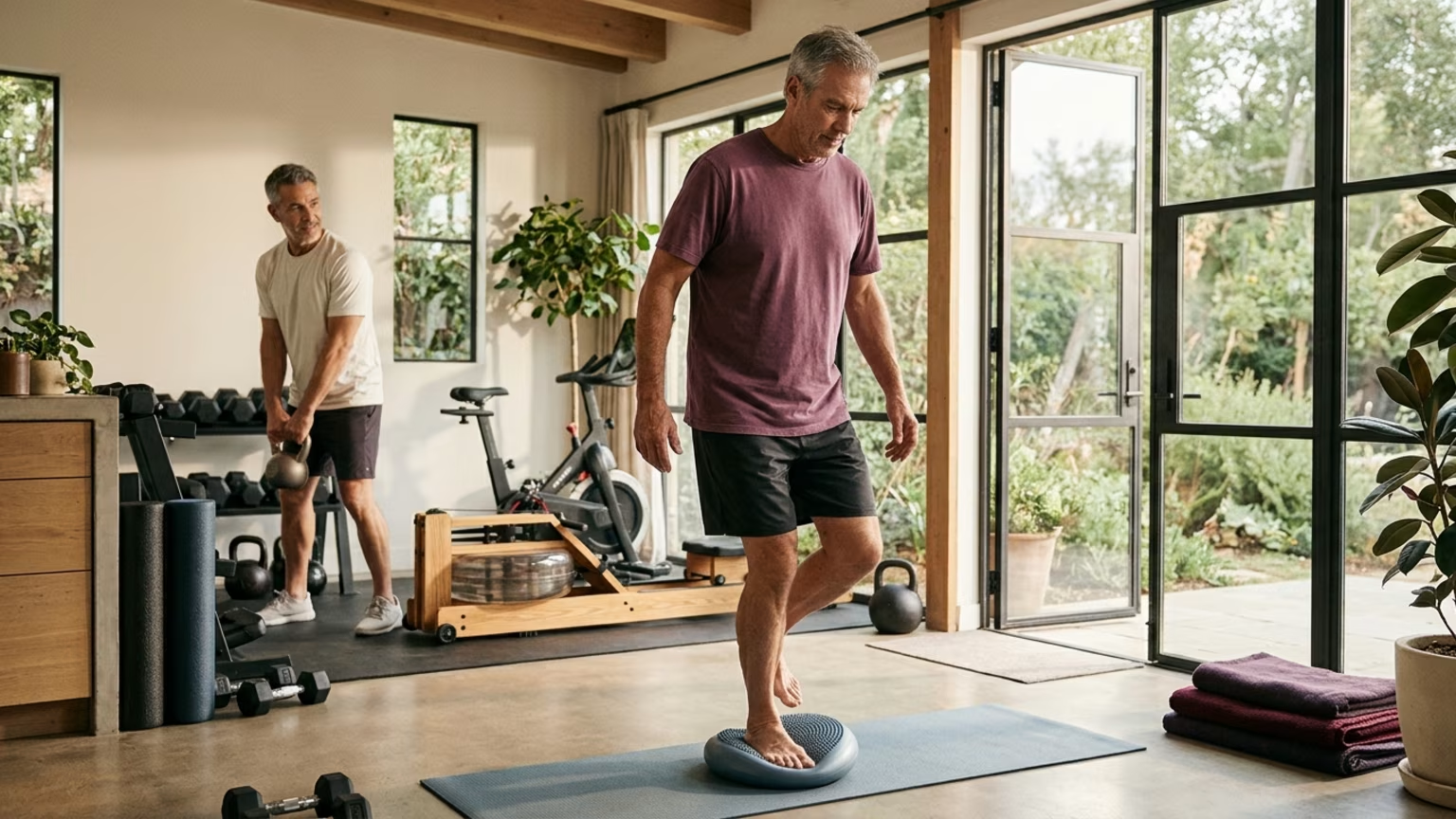
Harvard describes a single-leg stance as both a way to assess and practice balance. Its practical advice is to do it near a counter, sturdy chair or wall for support if needed. That is the specific balance practice supported by this report.
In a routine review, the useful question is whether balance receives any deliberate attention at all. It need not become a competitive test or another score to display. Giving it a named place among your priorities is a clearer response to the findings than simply adding more of whichever training you already prefer.
The flexibility result deserves careful interpretation without becoming a referendum on stretching. If flexibility matters to your movement goals, keep that purpose visible rather than judging every activity by whether it appeared in a mortality association.
The same principle applies to appearance. You can care about muscular shape without presenting it as a survival measure. You can value a broad range of physical abilities without making appearance irrelevant.
For gay men over 35, that distinction leaves room for adult priorities to coexist. A routine can reflect the wish to look attractive and feel capable without requiring one ideal body or expression of masculinity. The research offers a reason to broaden the performance side of that picture, not to dismiss the aesthetic side.
Use the capacities in the report as headings for a review: cardio, strength and balance/agility. Ask where your routine gives each one attention. Keep flexibility connected to its own purpose rather than folding every goal into a single longevity score.
That review does not have to become a home version of the study's test battery. The more useful editorial question is whether your attention is distributed across the abilities you value. A test result and a training priority serve different purposes.
A less obsessive approach to training data fits that distinction. For exercise decisions that need to account for personal health conditions or physical limitations, seek individual guidance from a qualified healthcare or exercise professional.
A broader routine need not become a project that takes over your calendar. Start by identifying what deserves a place rather than treating every reported test as a separate obligation. The organizing idea is coverage across capacities, not accumulating tasks.
For readers balancing fitness with work and relationships, a flexible approach to consistency offers a useful planning perspective. Decide which fitness goals matter to you and give them explicit space. Keep that discussion separate from comparisons with someone else's body or schedule.
There is no need to make this an argument against your favorite activity. Keep what you enjoy while making a conscious decision about the parts of fitness that otherwise receive little attention.
Use Harvard's report to review the breadth of your routine, keeping cardio and lower-body strength alongside balance practice rather than letting any single fitness goal stand in for the whole picture.
Strength, cardio and balance performance give healthy-aging goals a concrete focus; GayFitLab places that evidence within practical editorial for gay men 35+. When generic men's health advice omits gay social and sexual-health context, the publication connects fitness with confidence and relationships without assuming a standard body type or way of expressing masculinity.
Stay connected for research-led guidance on fitness, body composition, skin, grooming, vitality, sexual wellbeing, relationships and healthy aging. Clear ideas for gay men 35+ who want to look good, feel strong and age with confidence.


Build habits and systems that support clear thinking, steady energy and long term capacity throughout a demanding career.
explore the Blog

