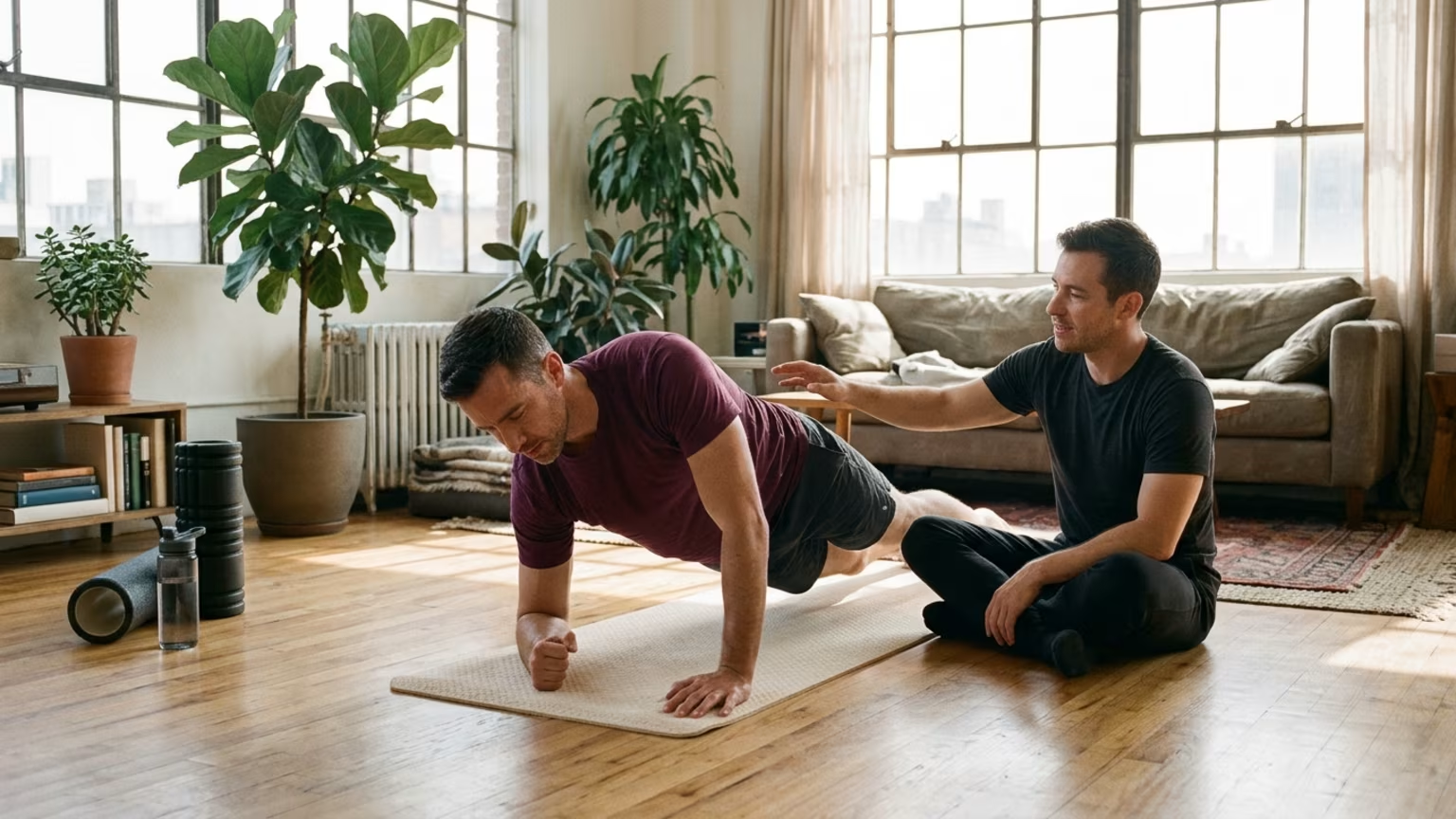

A New York Times report makes the case for brief, focused core work. Here is how to read the advice and fit it into training after 35.





The New York Times published “For a Stronger Core, You Only Need 10 Minutes” on October 31, 2026. The piece reports EXOS performance director Joel Sanders’s view that a focused 10 to 12 minutes of core work can be effective.
This is expert coaching advice reported in a newspaper, not a trial result. The reporting provides neither a fully specified exercise sequence nor measured strength gains from a tested 10-minute routine. The duration is therefore a suggested session length rather than an established minimum dose.
The report also does not establish changes in abdominal definition or weight loss. It identifies no specific longevity benefit from this short block and no effect particular to gay men or adults over 35. Those boundaries leave a useful question: how might a focused piece of trunk training fit an ordinary adult schedule?
Sanders directly challenges the idea that core training needs 100 crunches or an intense burning sensation. His alternative standard is the quality of the work. A session does not become a better expression of his advice simply because the repetition count is higher.
He also notes that the core is engaged in everyday movement and contains many small muscles. The article distinguishes his approach to core volume from the training volume used for larger muscle groups such as the glutes or quadriceps.
There is a caution behind that distinction. A Mayo performance specialist quoted in the article warns about excessive repetitions and fatigue. The reporting links excessive repetitions with injury risk and fatigue with a reduced ability to support posture.
The practical shift is away from treating exhaustion as the assignment. Under Sanders’s approach, the question is whether the movement is being performed well. An uncomfortable finish is not the standard he proposes for judging useful core work.
For a man over 35, the immediate value is a smaller scheduling question: is there room for focused core work within the training time already available? That is more actionable than deciding whether to start an entirely new fitness project. The reported advice gives trunk work a defined place without asking it to become the whole plan.
If your calendar is crowded, think of this as an addition to an existing routine rather than another major commitment. The editorial takeaway is about making room for a specific kind of training. It is not about making every available minute feel demanding.
Start with the shape of the week you can realistically maintain. GayFitLab’s guide to building a workable strength-training schedule offers a broader planning frame. Within that frame, a short core block can be considered on its own terms: its purpose and the quality of its execution.
Sanders’s advice for people new to exercise is to engage the front, back and sides of the body. That is the clearest practical organizing principle in the reporting. It directs attention toward coverage of the trunk rather than repeating one movement until it becomes exhausting.
For those beginners, he suggests six to ten repetitions or no more than 30 seconds per exercise while prioritizing technique. Keep the audience attached to those numbers: they are his beginner guidance. They are not a universal target for every exercise or training goal.
The useful planning question is therefore broader than “How many abdominal repetitions did I do?” It is whether the selected work addresses the areas Sanders names and whether technique remains the priority. A qualified exercise professional can help translate those principles into exercise choices for an individual routine.
For personal decisions involving an injury or health condition, seek guidance from a qualified clinician. The general coaching ideas here are a starting point for understanding the reporting rather than an individualized exercise prescription.
The article’s distinction between stability and power gives a short session a clearer purpose. Holding a position or moving slowly and under control is presented as stability-oriented work. Dynamic full-body movement is presented as a way to train power.
Those are different jobs. A quiet-looking movement is not automatically less relevant because it lacks a dramatic finish. Equally, a dynamic movement should be understood through its intended role rather than treated as a more impressive version of a hold.
Rotational medicine-ball slams are the article’s example of the power category. The useful lesson is the category distinction, not an instruction to add that exercise to every routine. When discussing exercise selection with a qualified professional, ask which role each movement is intended to serve.
That question makes the session easier to describe: the goal is no longer just “do abs.” It becomes a discussion about trunk stability or power transfer. Those are the functions the reporting puts at the center of core training.
A focused core block belongs within a broader activity plan. The advice concerns trunk work rather than training all major muscle groups. Keep your overall strength-training plan in view when deciding where this smaller piece belongs.
There is also a separate policy development worth distinguishing from the newspaper advice. HHS says it is developing a 2027 supplement to the current Physical Activity Guidelines for Americans. The planned guidance focuses on step counts and muscle-strengthening activity and is described as an addition to the current guidelines rather than a replacement.
The HHS announcement and Sanders’s coaching advice operate at different levels. One concerns the development of public physical-activity guidance. The other concerns how to approach a focused piece of training.
For your own planning, keep that difference in scale. Use the short-session idea to think about where trunk work fits, while retaining a wider view of activity. GayFitLab’s framework for combining strength, mobility and cardio provides a broader place to organize that discussion.
Wanting to look good and wanting to remain physically capable are compatible priorities. Neither requires turning every exercise into a test of whether your body looks young enough. A core session can have a clearly stated training purpose without carrying the entire meaning of fitness or attractiveness.
For a gay reader who values appearance, this is not an argument for caring less about it. It is an argument for giving a particular piece of exercise a particular job. The relevant question here is how trunk training fits your goals and available time, not whether it meets a preferred body type or expression of masculinity.
That is a calmer way to use a fitness headline. Take the practical idea seriously, identify what it is meant to train and place it within the life you already have.
Treat a brief core block as a focused addition to your broader routine, using Sanders’s emphasis on technique and trunk coverage rather than chasing more repetitions or a stronger burn.
Trunk stability and power transfer give core training a purpose centered on capability; GayFitLab translates fitness evidence into practical guidance for gay men 35+. For readers facing youth-focused media that can frame normal aging as social decline, its editorial coverage puts strength and appearance within a fuller view of confidence and healthy aging.
Stay connected for research-led guidance on fitness, body composition, skin, grooming, vitality, sexual wellbeing, relationships and healthy aging. Clear ideas for gay men 35+ who want to look good, feel strong and age with confidence.




Build habits and systems that support clear thinking, steady energy and long term capacity throughout a demanding career.
explore the Blog

