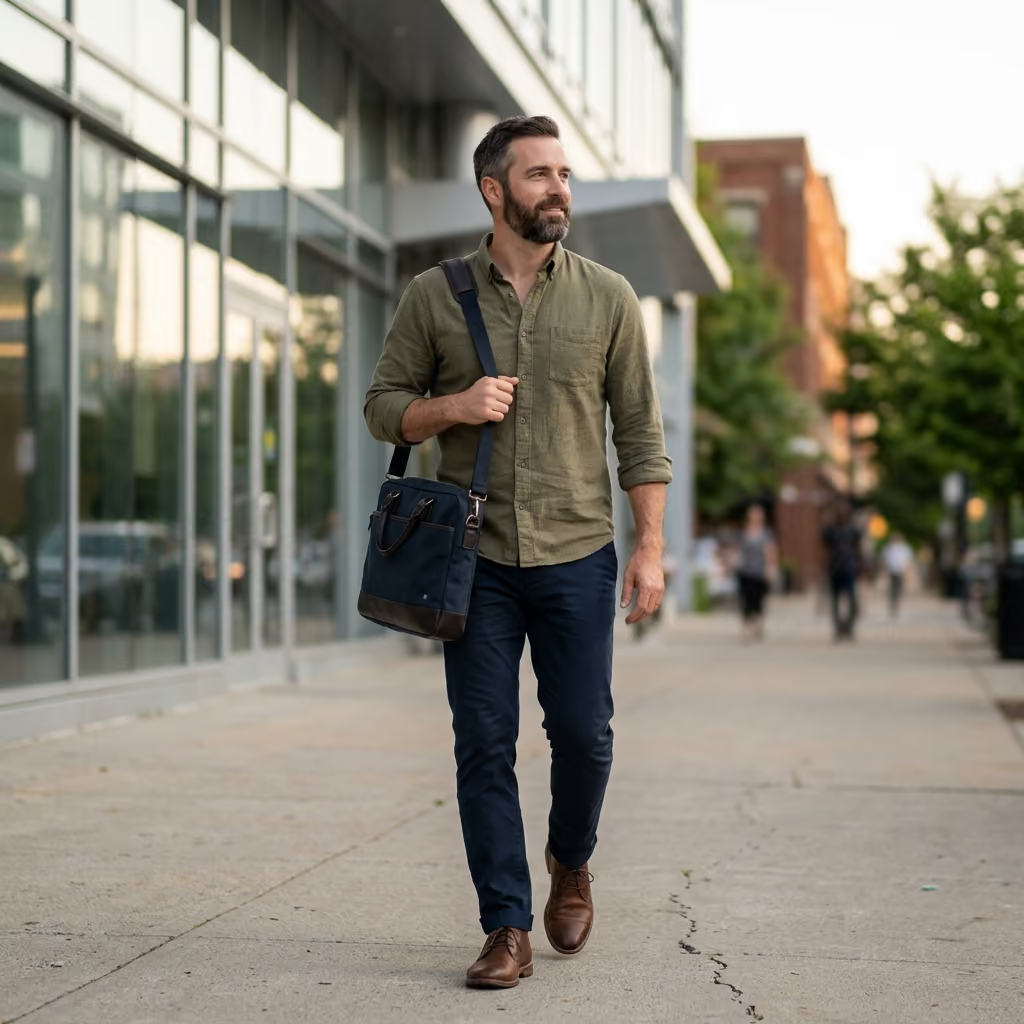

A crowded social calendar cannot replace genuine emotional nourishment, but identifying your relationship needs and practicing deeper communication helps build meaningful bonds.





If you are in immediate danger, call 911. For 24/7 support, call or text 988 and press 1 for the Veterans Crisis Line, or text 838255.
Most people assume that loneliness is an empty calendar. They picture quiet evenings, unanswered messages, and solitary weekends. The reality of modern adulthood is often the exact opposite.
You can attend dinners three nights a week, maintain active group chats, and remain deeply, chronically lonely. You can leave a crowded room feeling hollow. The solution is rarely adding more contacts, attending more parties, or forcing yourself into new clubs. When your schedule is packed but your emotional tank is dry, the real work lies in transforming social activity into genuine nourishment.
Popular culture treats social life as a numbers game. It measures connection through contact frequency, follower counts, and weekend plans. Epidemiological data paints a very different picture.
According to the Centers for Disease Control and Prevention (CDC), loneliness is a subjective state. The agency defines it as a gap between the connection a person wants and the connection they experience. You can be surrounded by friends and still experience profound isolation.
Structural isolation and felt loneliness are two distinct issues. Social isolation refers to an objective lack of ties, contact, or tangible support. A person living in a remote area might be isolated without feeling lonely.
A person with a crowded calendar can feel isolated while constantly talking to others. The CDC reports that roughly one in three American adults experiences loneliness. An advisory from the U.S. Surgeon General suggests that half of adults experience these feelings.
Global data from the World Health Organization shows that one in six people worldwide experiences loneliness. The agency reports that loneliness is associated with roughly 871,000 deaths every year. This translates to approximately 100 deaths every hour across the globe.
The physical toll of chronic disconnection is severe. The CDC links persistent loneliness and isolation to higher risks of cardiovascular disease, stroke, type 2 diabetes, depression, anxiety, dementia, and premature mortality. Research shows social isolation is associated with a 50 percent higher risk of dementia, a 29 percent higher risk of heart disease, and a 32 percent higher risk of stroke.
These health risks do not vanish simply because you have five hundred contacts in your phone. Research from the Organisation for Economic Co-operation and Development (OECD) shows that social network size correlates only weakly with perceived relationship quality and loneliness.
A 2025 study on daily social interactions found that emotional closeness and the absence of stressful interactions predicted lower loneliness, whereas total contact volume did not. Daily diary studies published by researchers examining social interactions show that perceived responsiveness from others reduces depressed mood and loneliness far more than high transaction volume.
Social connection requires three specific dimensions to be protective:
Structure refers to the number and formal variety of relationships you maintain. This includes partners, family, coworkers, gym buddies, and casual acquaintances. Structure provides the raw framework for interaction, but structure alone does not create emotional security.
Function describes the practical and psychological utility of those ties. Functional ties provide tangible help, advice, crisis support, or shared interests. You might have friends who help you move or discuss work, yet never ask about your emotional health.
Quality reflects whether an interaction feels emotionally safe, reciprocal, and responsive. It measures whether you can speak candidly without performance. High-quality ties allow you to feel seen and valued for who you are, rather than for the social role you play.
In your twenties, social life often thrives on convenience, shared proximity, and entertainment. Proximity does the heavy lifting. You bond over late nights, shared apartments, early career struggles, and weekend routines.
After 35, the mechanics of male friendship shift dramatically. Careers demand more focus, domestic priorities change, and personal energy becomes a finite resource. Many men find that their old social circles begin to thin out or become purely transactional.
When you pass 35, the tolerance for shallow interactions tends to drop. You have sat through hundreds of group dinners and small-talk conversations. If those exchanges never evolve, they start feeling like unpaid labor.
This shift is not a personal failure or a sign of cynicism. It is a predictable stage of adult psychological maturation. As time feels more scarce, your nervous system craves depth over breadth.
Long-term epidemiological research confirms that relationship depth matters more as we age. Archival findings from the Harvard Study of Adult Development show that relationship satisfaction at age 50 was a stronger predictor of midlife physical health than cholesterol levels. The research demonstrated that warm, supportive bonds protected both physical vitality and cognitive function over decades.
A crowded calendar that delivers no authentic intimacy creates a specific type of chronic stress. You expend energy managing social appearances while remaining completely unsupported. Building resilience after 35 requires reallocating your energy from broad social management to intentional, high-nourishment connections. For more on building long-term vitality, review our resources on healthy aging and longevity.
Gay men face specific cultural dynamics that can accelerate the feeling of being socially full yet emotionally empty. Urban gay culture is exceptionally good at creating social structure. There are sports leagues, circuit events, charity galas, dinner groups, and endless happy hours.
You can build a huge network in a single season. Yet gay community architecture often blends friendship, sexual attraction, professional networking, and aesthetic validation into the same spaces.
When social spaces double as arenas for status evaluation, authentic connection becomes difficult. Many gay men carry early memories of rejection or hiding their identity. In response, they develop an armor of social competence.
You learn to be witty, fit, stylish, generous, and easy to be around. You become the life of the table or the reliable host. This social performance protects you from rejection, but it prevents real connection.
If people only ever interact with your curated presentation, you remain unseen. You know they like the entertaining, successful version of you. You do not know if they would care for the tired, anxious, or uncertain version.
This creates a dynamic where being surrounded by peers makes you feel more alone. You are present, but your actual experience is hidden behind a polished exterior.
Generational differences also shape how gay men connect in midlife. Many men over 35 navigate the loss of historical community spaces while balancing modern digital apps.
Apps provide constant contact but little emotional responsiveness. Messages remain short, reactive, and logistical. To build genuine security, gay men must intentionally create spaces where appearance and status are not prerequisites for conversation. For more on navigating these relationship dynamics, check out our guide to confidence and relationships.
The connection gap is the mathematical difference between the emotional intimacy you desire and the emotional intimacy your current interactions provide. When this gap is wide, you feel drained after socializing.
To diagnose why your social life feels hollow, examine the five core components of social nourishment.
When a social circle provides only logistical company, these five needs go unmet. You end up playing out predictable patterns that feel productive on the surface while leaving you isolated.
Review these six patterns to see where your social energy is currently going.
This man attends every dinner, cocktail party, and group vacation. He is on every guest list and appears in every group photo. Yet conversations never move beyond travel plans, real estate, culture, and gossip. He returns home to an empty apartment feeling invisible because nobody asked how he was actually doing.
This man organizes the events, pays the bills upfront, makes the reservations, and keeps the group together. He is universally admired and appreciated for his logistical effort. Because he is always in the organizer role, nobody thinks to check on him or host him in return.
Everyone calls this man when their relationship ends, their career hits a wall, or they need life advice. He listens patiently and offers thoughtful support. When his own life hits a difficult stretch, his phone remains silent because others assume he has everything handled.
This man is in eight active group chats that ping all day with memes, headlines, and quick banter. He spends hours reacting to digital chatter. Despite constant screen interaction, he has not had an uninterrupted, face-to-face conversation about something that matters to him in two months.
This man takes deep pride in never asking for help. He never mentions financial stress, medical worries, or dating loneliness. He shows up strong, polished, and fully self-contained. He craves deep connection but gives his friends zero openings to show him care or practical support.
This man has separate friend groups for fitness, work, nightlife, and culture. In each circle, he displays only the fragment of himself that matches the group norm. Because he never integrates these pieces, no single person in his life knows the complete picture of who he is.
When you realize your social life is emotionally thin, the default impulse is to hunt for new friends. You might join new clubs, download new apps, or accept every invitation that comes your way.
This approach usually fails. Adding more shallow acquaintances to an already overwhelming schedule only increases your fatigue. The more effective strategy is learning to deepen the relationships you already have.
You do not need to replace your entire network. You need to change how you participate in your current circles.
Intimacy is not an all-or-nothing switch. It is a gradual progression of mutual trust. If you reveal your deepest trauma to a casual acquaintance over drinks, you will likely create discomfort.
Healthy intimacy follows a structured progression:
Many adult friendships stall permanently at Level 2 or Level 3. You can spend five years working out next to someone or attending the same monthly dinner while remaining at Level 2.
Moving from Level 2 to Level 4 does not require grand emotional confessions. It requires calibrated disclosure.
During routine interactions, consciously ask questions that invite real answers. Notice the difference between standard small talk and calibrated inquiries:
When you ask a more direct question, you create permission for the other person to drop their social mask. If they step through that door and answer honestly, match their openness with your own authentic experience.
Intimacy is built just as much through how you handle good news as how you handle bad news. Groundbreaking relationship research led by Dr. Shelly Gable demonstrates that the way a person responds to another's positive events strongly predicts relationship quality.
Gable and her colleagues identified four distinct response styles to good news:
Active-constructive responses signal that another person's success is safe with you. When your friends realize you celebrate their victories without jealousy or competition, emotional safety deepens rapidly.
Group settings are natural environments for humor, status displays, and broad entertainment. They are terrible environments for emotional disclosure. If your entire social life happens in groups of six or more, your relationships will naturally stay shallow.
Identify two or three people in your existing groups whom you genuinely admire or feel comfortable around. Invite them into one-on-one settings.
A quiet walk, a casual lunch, or a gym session creates the space required for candid conversation. Private conversations reduce the pressure to perform for an audience.
If you are trapped in the role of the helper or the host, break the cycle by making a modest request.
Independence is often a defense mechanism masquerading as strength. When you never ask for help, you deny your friends the opportunity to show up for you.
Start with low-stakes requests:
Pay close attention to how they respond. Friends who care about you will welcome the chance to support you. If someone consistently avoids helping while always taking your support, you have discovered an unreciprocated tie. Learn more about navigating boundaries across our community resources.
A healthy adult social life functions like an investment portfolio. Expecting every friend to provide deep psychological validation, career networking, fitness accountability, and late-night fun is unrealistic. Dissatisfaction often comes from asking a casual companion to provide intimate emotional support.
Map your current connections across six functional categories:
When you audit your network, you might realize you have twenty companions, thirty weak ties, zero growth ties, and only one intimate tie. That structure explains why you feel exhausted yet lonely.
The goal is not to cut off your companions or create dramatic confrontations. You simply stop expecting companions to meet needs they cannot fulfill. You protect your time by saying no to low-value group obligations, redirecting that energy toward developing intimate and support ties.
Conduct a regular weekly connection audit using these diagnostic questions:
This audit is not about scoring your friends. It is about understanding where your emotional energy goes and taking responsibility for how you show up. Explore more tools on our GayFitLab resources index.
Solitude and loneliness are completely different physiological and psychological states. Solitude is the chosen state of being alone without feeling disconnected. It is restorative, quiet, and necessary for self-reflection.
Loneliness is the painful awareness of unmet connection needs.
Many men who maintain frantic calendars do so because they fear solitude. Being alone with their thoughts feels threatening, so they fill every evening with plans.
They mistake any quiet evening for loneliness. In doing so, they exhaust themselves with shallow social commitments, preventing the true rest that solitude provides.
Learning to enjoy solitude is often a prerequisite for building deep relationships. When you are comfortable being alone, you stop choosing friends out of sheer panic.
You no longer accept one-sided or performative relationships just to avoid a quiet Saturday night. You become selective about who gets your time.
Persistent loneliness is not always solved through behavioral changes or conversation adjustments. If you consistently try to connect with others but find yourself paralyzed by severe social anxiety, past trauma, or feelings of unworthiness, clinical support is a valuable tool.
A comprehensive Cochrane review of loneliness interventions found that cognitive approaches, which address negative social expectations and fears of rejection, were more effective than programs that merely provided social contact opportunities. A 2025 rapid systematic review confirmed that psychological therapy and structured social interventions produce significant reductions in loneliness across adult populations.
Therapists trained in cognitive behavioral therapy, acceptance and commitment therapy, or attachment-focused modalities can help you dismantle the protective behaviors that keep people at a distance. If you are experiencing persistent depression, panic, hopelessness, or thoughts of self-harm, reach out for professional help immediately.
If you or someone you know is in crisis, support is available:
If you are managing mental health challenges or past relationship injuries, work with a licensed clinician to address underlying attachment patterns and build safety within your relationships.
While epidemiological and psychological research on social connection has advanced significantly, several scientific limitations remain important to understand.
First, much of the broad data linking loneliness to mortality and chronic disease relies on observational cohort studies. These studies demonstrate clear statistical associations and elevated risk profiles. They do not prove that loneliness directly causes specific physical conditions in every individual. Unmeasured factors such as socioeconomic status, genetic vulnerability, baseline health behaviors, and environmental stressors also influence these outcomes.
Second, scientific measurement tools for loneliness vary across published literature. Some major studies use single-item self-report questions, while others use standardized psychometric tools like the UCLA Loneliness Scale.
This variation explains why prevalence estimates range from one in three adults in CDC surveillance data to nearly half of adults in other national surveys. These numbers should be understood as reflections of widespread social strain rather than absolute, static measures.
Third, intervention research shows that what resolves loneliness for one demographic may not work for another. While psychological interventions addressing social cognition show the strongest overall evidence base, individual responses vary based on personality, neurodivergence, culture, and life stage.
Finally, research focusing specifically on midlife and older gay men remains smaller in scale than general population studies. Many community dynamics, minority stress factors, and non-traditional family structures require deeper investigation. Readers should apply evidence-based principles thoughtfully, adapting them to their specific life circumstances rather than expecting instant results.
A full calendar will never cure an empty heart, but intentional, honest participation in the relationships you already have will change everything.
Stay connected for research-led guidance on fitness, body composition, skin, grooming, vitality, sexual wellbeing, relationships and healthy aging. Clear ideas for gay men 35+ who want to look good, feel strong and age with confidence.


Build habits and systems that support clear thinking, steady energy and long term capacity throughout a demanding career.
explore the Blog