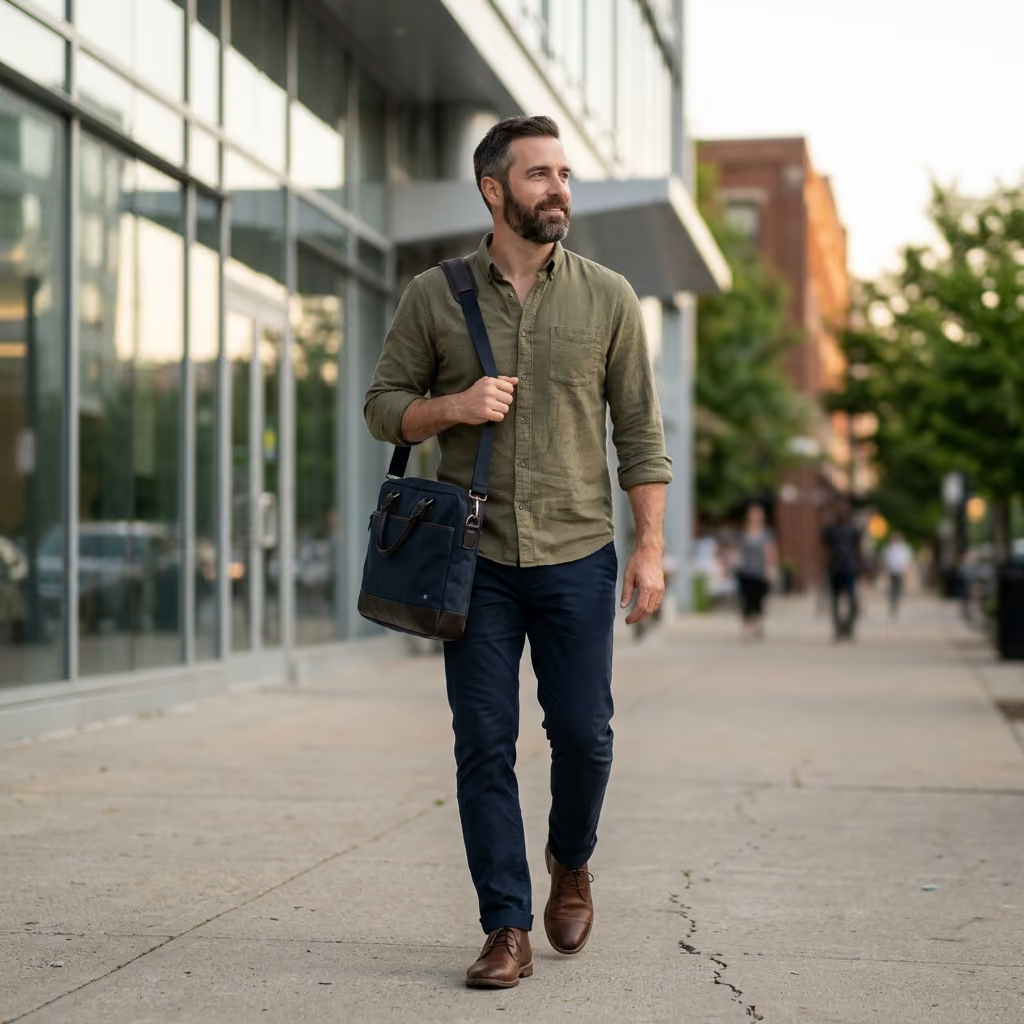

Life stress is often dismissed as a lack of willpower, but it actually alters your physical recovery capacity and requires flexible training models.





When life becomes overwhelmingly chaotic, conventional fitness culture offers a single prescription: push harder. The standard narrative treats gym attendance as a moral test where discipline conquers exhaustion, emotional turmoil, and sleepless nights.
This approach is physiologically counterproductive. Strength training does not occur in a vacuum separate from your work deadlines, personal conflicts, financial pressures, or sleep disruptions.
Your central nervous system, endocrine pathways, and musculoskeletal tissues do not maintain separate accounts for emotional stress and physical lifting. They draw from the same biological reserve.
When non-training demands rise, your capacity to absorb, adapt to, and recover from mechanical tension drops. Understanding this relationship allows you to program around real life without abandoning momentum, sacrificing hard-won muscle, or burning out.
Credible exercise physiology demonstrates that psychological stress directly impedes physical recovery from resistance exercise. In a landmark study published in the Journal of Strength and Conditioning Research, investigators examined how chronic mental stress affected recovery after strenuous lifting. Participants experiencing high life-event stress and elevated perceived stress showed significant impairments in muscular strength recovery across a full 96-hour post-workout window. Their subjective ratings of energy, fatigue, and muscle soreness remained depressed far longer than those reported by low-stress peers.
This evidence confirms that life stress is not merely an excuse. It is an active physiological variable that alters your recovery curve. A heavy session that produces manageable fatigue during a calm week can become an unrecoverable stimulus during an intense work crisis.
Sleep restriction further complicates this dynamic. Systematic reviews investigating inadequate sleep and muscular force output reveal nuanced findings. A single isolated night of poor sleep rarely impairs maximal isometric or single-repetition strength in trained individuals. The real damage emerges across consecutive nights of restricted sleep.
Under cumulative sleep debt, multi-joint movement performance degrades significantly. Velocity declines, perceived exertion spikes, and injury risk climbs as motor control falters. Sports recovery consensus statements categorize sleep as the foundation of both physical and neurological restoration.
Training capacity is fluid, shifting from week to week and day to day. When you acknowledge this reality, adjusting your workout becomes a calculated decision rather than a failure of willpower.
Aging brings subtle shifts in physiological resilience that make stress-aware programming indispensable. After 35, baseline muscle protein synthesis responses become slightly less efficient, requiring more intentional protein distribution and recovery management. Tendons, ligaments, and articular cartilage experience gradual reductions in water content and collagen turnover. Connective tissues require longer recovery windows between heavy, high-volume exposures than they did a decade earlier.
Hormonal dynamics also shift over time. Baseline testosterone levels show gradual year-over-year declines, while cortisol clearance and autonomic nervous system regulation can become less responsive under chronic psychological friction. These changes do not mean you cannot build impressive strength or dense muscularity in your late thirties, forties, or fifties. They simply mean the margin for programming error narrows.
Sleep architecture changes naturally across midlife. Deep slow-wave sleep, the specific phase where growth hormone release peaks and tissue repair accelerates, often declines in duration. A poor night of sleep at 42 exacts a higher physical toll than the same shortfall did at 22.
Midlife also brings compounding responsibilities. Careers peak in complexity, financial obligations expand, and caregiving demands for aging parents often emerge. When physical remodeling slows and non-training responsibilities multiply, rigid training plans lead directly to overuse injuries and systemic fatigue.
To build a sustainable training plan, you must audit what constitutes your total stress load. Your body manages demands through an overarching biological budget. Physical labor, resistance sets, cardiovascular work, emotional labor, sleep deprivation, nutritional deficits, and cognitive strain all compete for the same adaptive energy.
Systemic fatigue occurs when your total stress load consistently outpaces your current recovery capacity. It does not always announce itself as sore muscles. Instead, systemic fatigue manifests across multiple body systems, altering energy, mood, and daily drive.
When systemic fatigue accumulates, you may notice:
Neglecting these signals produces a downward spiral. When athletes attempt to solve stress-induced stagnation by adding more sets or pushing closer to failure, they deepen systemic fatigue. Protecting your strength and body composition training requires recognizing that fatigue is a biological signal demanding adjustment, not an obstacle to ignore.
Systemic fatigue directly suppresses male vitality and sexual wellbeing by dampening luteinizing hormone signals and raising systemic inflammation. Chronic fatigue also disrupts insulin sensitivity and appetite regulation, complicating your nutrition and metabolic balance. Balancing these demands preserves long-term physical drive and daily performance.
Stress-aware programming carries specific cultural relevance for gay men over 35. Urban gay communities frequently place an intense cultural premium on aesthetic presentation, leanness, and muscularity. This aesthetic environment can generate chronic hyper-vigilance regarding body image, body weight, and physical aging.
Many gay men balance demanding professional careers with vibrant social calendars, late-night events, weekend travel, and active dating lives. When social connections and dating apps constantly reinforce youthfulness and physical perfection, taking a restorative deload or reducing workout volume can trigger deep psychological anxiety. Missing a session feels like falling behind in a competitive social arena.
Minority stress represents an additional, documented layer of chronic baseline strain. Navigating societal stigma, workplace microaggressions, and historical trauma activates subtle sympathetic nervous system tone throughout the day. This invisible cognitive load depletes the same recovery reserves required to rebuild muscle tissue after heavy squats or deadlifts.
A mature approach reconciles aesthetic ambition with physiological reality. Muscle tissue does not disappear during a five-day period of reduced training volume. Preserving long-term physical presence requires pacing your body intelligently so you remain lean, athletic, and structurally sound across decades. Prioritizing longevity and healthy aging allows you to maintain physical confidence without letting gym anxiety dominate your mental space.
Cultivating resilience in confidence, relationships, and community provides emotional stability that protects against fitness burnout. When your self-worth is grounded across multiple areas of life, adjusting a workout during a hectic week becomes an act of intelligent self-care.
Autoregulation is the practice of adjusting training volume, load, and intensity based on real-time feedback rather than rigid percentages. Fixed percentage models assume that your 1-repetition maximum (1RM) remains constant every day. In reality, your true capacity fluctuates by 10% to 15% in either direction based on sleep, stress, and systemic fatigue.
The most practical autoregulation framework relies on Rating of Perceived Exertion (RPE) and Repetitions in Reserve (RIR). RPE measures the difficulty of a completed set, while RIR defines how many additional repetitions you could have performed with pristine form before reaching failure.
Systematic reviews demonstrate that autoregulated resistance training produces equal or superior strength gains compared to fixed loading models. By targeting an RPE of 7.5 to 8.5 on working sets, you automatically account for daily stress. On an energized day, the bar weight naturally rises. On an exhausted day, the load self-adjusts downward while still delivering the exact neurological stimulus intended for that workout.
Another effective autoregulation method is velocity loss monitoring. In athletic research, cutting sets when repetition speed drops by 20% limits neuromuscular fatigue while building maximal strength. Hypertrophy protocols allow greater velocity loss, around 25% to 40%, but require longer recovery windows. When life stress is high, limiting set fatigue preserves joint integrity and prevents systemic exhaustion.
When personal crises, intense travel, or overwhelming work deadlines strike, trainees often abandon the gym entirely. This all-or-nothing mindset causes detraining, loss of movement groove, and mental frustration. The solution is applying the minimum effective dose for strength and muscle retention.
Peer-reviewed reviews on minimal-dose training demonstrate that strength and muscularity are remarkably resilient. Younger trainees can maintain muscle size and maximal strength for up to 32 weeks with as little as one resistance session per week, provided they perform one hard set per movement pattern at high relative intensity.
For adults over 35, the maintenance requirements are slightly higher but still remarkably modest. Performing two brief sessions per week, containing two to three challenging work sets per movement pattern, reliably preserves muscle mass and neurological strength across months of disruption.
During a crisis, shifting your objective from aggressive progression to steady maintenance is a tactical victory. Minimal dose programming protects your metabolic baseline, keeps your joints healthy, and keeps the psychological identity of being an active lifter intact.
Designing an adaptable program requires building flexibility directly into your weekly schedule. Rather than following a rigid calendar that falls apart when a meeting runs late, use modular templates that scale up or down instantly.
Create three distinct versions of every scheduled training day in your notebook or tracking app:
This structure separates top-end strength exposure from total fatigue accumulation. You work up to a single, focused heavy set at a designated RPE, followed by lower-intensity back-off work.
Abandon the traditional Monday-Wednesday-Friday calendar if your work shifts or social life fluctuate unpredictably. Organize your program as an ongoing sequence of sessions:
If a major crisis occurs on Wednesday, push Session B to Thursday without feeling that the entire week has been ruined. The calendar serves your life, not the other way around.
Adjusting training around life stress requires strategic clarity. Lifters frequently make predictable errors that worsen systemic fatigue instead of relieving it.
Mistake 4 involves using high-volume lifting as your sole emotional coping mechanism. Exercise provides mood support, mental clarity, and stress relief. However, using two hours of exhausting physical training to numb work anxiety or relationship grief adds physical trauma onto psychological exhaustion. When life is emotionally heavy, use the gym for grounding movement, then seek restorative sleep, honest conversations, and professional support for life challenges.
While research confirms a clear link between life stress and impaired resistance-exercise recovery, scientific limitations remain. Much of the clinical literature on sleep loss investigates acute, total sleep deprivation over 24 to 48 hours in laboratory settings. These protocols do not perfectly match the real-world reality of working adults, who usually face chronic, partial sleep restriction of 5 to 6 hours per night.
Furthermore, individual response variations are substantial across all recovery literature. In many sleep and strength trials, certain participants experience significant drops in force production, while others maintain stable strength numbers despite sleep deprivation.
Subjective tracking tools like RPE and RIR carry inherent limitations. Trainees who struggle with high anxiety or acute stress may overestimate workout difficulty, rating moderate sets as near-maximal. Conversely, highly competitive lifters often underestimate RPE, claiming they have two reps in reserve when their technique is already degrading.
Autoregulation tools, wearable recovery scores, and minimum-dose protocols are flexible guides rather than rigid laws. Combine scientific guidelines with honest self-awareness, movement quality assessments, and practical experience to guide your training decisions.
Long-term physical development is built on consistency across years, not perfection across seven-day blocks. When you treat training capacity as dynamic, stressful periods cease to be roadblocks. They become phases where you protect your movement habits, preserve your joints, and maintain hard-won strength while real life takes center stage.
Make your training plan flexible enough that real life cannot break it, and you will maintain strength, health, and physical confidence for decades.
Stay connected for research-led guidance on fitness, body composition, skin, grooming, vitality, sexual wellbeing, relationships and healthy aging. Clear ideas for gay men 35+ who want to look good, feel strong and age with confidence.


Build habits and systems that support clear thinking, steady energy and long term capacity throughout a demanding career.
explore the Blog