
Mobility, balance, and coordination form the foundation of lifelong physical autonomy and can be assessed using practical movement tests for healthy aging.





You catch your toe on a raised sidewalk slab during an evening walk. For a split second, your weight pitches forward. Your nervous system must register the error, plant your trailing foot with sufficient speed, and brace your hips and spine to prevent a hard fall. Ten years ago, you might not have registered the misstep. Today, that small stumble reveals how many physical systems must coordinate simultaneously to keep you upright, agile, and moving without hesitation.
Movement capacity is not a static trait that vanishes overnight. It recedes in subtle increments through reduced joint clearance, slower stepping reactions, and unaddressed stiffness.
Maintaining your physical agency across midlife and later decades requires an active, structured approach. Building physical resilience before you face a crisis preserves your freedom to travel, train, socialize, and live independently.
Evidence from international health organizations demonstrates that maintaining physical independence requires much more than simple daily step counts. The World Health Organization recommends that older adults engage in varied multicomponent physical activity emphasizing functional balance and muscle strengthening on three or more days each week. This recommendation exists because strength, balance, and coordination decline along distinct physiological pathways when left untrained.
Research compiled in major geriatric reviews reveals that structured balance and functional exercise programs reduce fall rates by approximately 24 percent across older populations. Tai chi and specific neuromotor drills demonstrate a 23 percent reduction in fall incidents. These outcomes reflect changes in the central nervous system, muscle recruitment patterns, and joint mechanics rather than random good fortune.
Targeted balance training changes how the brain and spinal cord process position signals. As we age, mechanoreceptors in the soles of the feet experience reduced sensitivity. When foot-position awareness drops, the brain requires clearer signals from the inner ear and eyes to maintain equilibrium. Balance and mobility exercises force the nervous system to recalibrate these inputs, preserving rapid postural corrections.
General aerobic activity such as casual walking provides clear cardiovascular benefits. However, global falls prevention guidelines establish that walking alone does not provide sufficient stimulus to challenge dynamic balance or reactive stepping. Protecting physical autonomy requires deliberate training that combines joint mobility, dynamic stability, muscular power, and multisensory coordination.
Physical changes after age 35 occur quietly across several interconnected bodily systems. Muscle mass and fast-twitch motor units decline gradually if they are not stimulated through resistance training. These fast-twitch fibers generate the rapid bursts of force necessary to catch yourself when you trip or to step quickly around an obstacle.
Joint structures also undergo predictable changes. Connective tissues lose a portion of their water content and resting elasticity, leading to sensation of stiffness in the ankles, hips, and thoracic spine. Ankle dorsiflexion, which is the ability to pull the foot upward toward the shin, often diminishes. A loss of ankle range changes how your foot clears the ground during normal walking, increasing the likelihood of catching your toe on rugs, stairs, or uneven pavement.
Sensory systems shift alongside musculoskeletal changes. Proprioception, the internal map that tells your brain where your limbs are in space, becomes less sharp without regular physical challenges. The vestibular system in the inner ear undergoes gradual cellular attrition, reducing your tolerance for quick head turns or rapid changes in direction.
Postural control strategies also change over time. Younger bodies rely primarily on an ankle strategy, making micro-adjustments at the feet to maintain balance. As ankle mobility and strength decline, the body defaults to a hip strategy, bending at the waist to keep from falling. If hip strength is also compromised, the body must take a compensatory step. Training preserves these reflex tiers, keeping your movement smooth and reactive.
To build an actionable training program, movement capacity can be broken down into four distinct pillars. These four elements work together to preserve function in the gym, on the street, and at home.
Mobility represents the usable active range of motion available at a joint. It differs from passive flexibility, which merely measures how far a muscle can stretch with external assistance. Usable mobility requires active muscular control at the outer boundaries of a joint's range.
Functional mobility focuses on specific target zones:
Balance is the active management of your body's center of mass over its base of support. It functions across a wide spectrum of daily conditions:
Coordination governs the timing, sequencing, and accuracy of muscle recruitment. It dictates how smoothly you transition between different movement planes.
Coordination training develops reciprocal movement between opposite arms and legs. It refines foot placement accuracy on rough ground and regulates your ability to speed up or slow down with control. It also enables you to coordinate breathing patterns with core bracing during physical exertion.
Resilience is the physical reserve that allows your tissues to absorb unexpected stress without injury. It includes lower-body muscular strength, tendon stiffness, bone mineral density, and cardiovascular stamina.
A resilient body possesses a wide margin of safety. If you miss a step on a flight of stairs, resilient joints and muscles absorb the sudden impact force without tearing connective tissue or fracturing bone. Building this structural buffer is a primary purpose of regular progressive strength training.
Translating movement training into real life means looking at the physical demands of your daily schedule. Carrying groceries, climbing steep subway stairs, lifting luggage into overhead bins, and navigating crowded venues all draw upon the four movement capacities.
Getting down to and up from the floor with ease is one of the clearest indicators of functional longevity. Floor transfers require ankle dorsiflexion, hip flexion, knee stability, and upper-body pressing strength. When people stop practicing floor transitions, they lose the joint range and confidence required to perform them safely.
Recreational pursuits also depend heavily on movement quality. Hiking on loose gravel demands reactive ankle stability and visual-vestibular coordination. Weekend sports and outdoor cycling require rapid weight shifts and multidirectional control.
Maintaining these movement skills directly protects your personal autonomy. When moving through your environment feels easy and secure, you maintain your social engagements, travel plans, and active lifestyle without fear of physical setbacks. You can review our broader longevity and healthy aging resources for more context on building lifelong physical capacity.
For gay men over 35, physical capability connects directly to identity, community involvement, and long-term self-reliance. Many gay men navigate midlife and older age without traditional family caregiving networks. Maintaining personal autonomy, strength, and mobility is therefore central to long-term independence.
Remaining physically agile supports an active social life across decades. Whether you are navigating crowded nightlife venues, traveling internationally, enjoying outdoor recreation, or staying active in community sports leagues, balance and coordination allow you to participate fully. Physical self-possession creates visible confidence in how you carry yourself.
Intimacy and sexual wellbeing also rely heavily on movement quality. Hip mobility, core stability, lumbar control, and muscular endurance directly affect comfort and physical expression. Prioritizing movement health supports ongoing physical vitality and sexual wellbeing as you age.
Living well across midlife means refusing to accept physical decline as an unavoidable consequence of getting older. Cultivating physical reserve allows you to show up with vitality in your relationships, career, and personal pursuits. Our editorial perspective on social connection and self-confidence explores how physical capability reinforces mental and social resilience.
Before starting any new exercise progression, establish your current baseline through simple, standardized self-assessments. Perform these assessments in a clear space near a wall or sturdy countertop for safety. If you feel sharp pain, dizziness, or significant instability at any point, stop immediately.
The Timed Up and Go measures transitional balance, walking speed, and turning stability. It is widely used in clinical and athletic settings to evaluate functional mobility.
Completing the test in under 10 seconds indicates good baseline mobility. Taking 12 seconds or longer indicates that dynamic balance, turning speed, and lower-body power need targeted training.
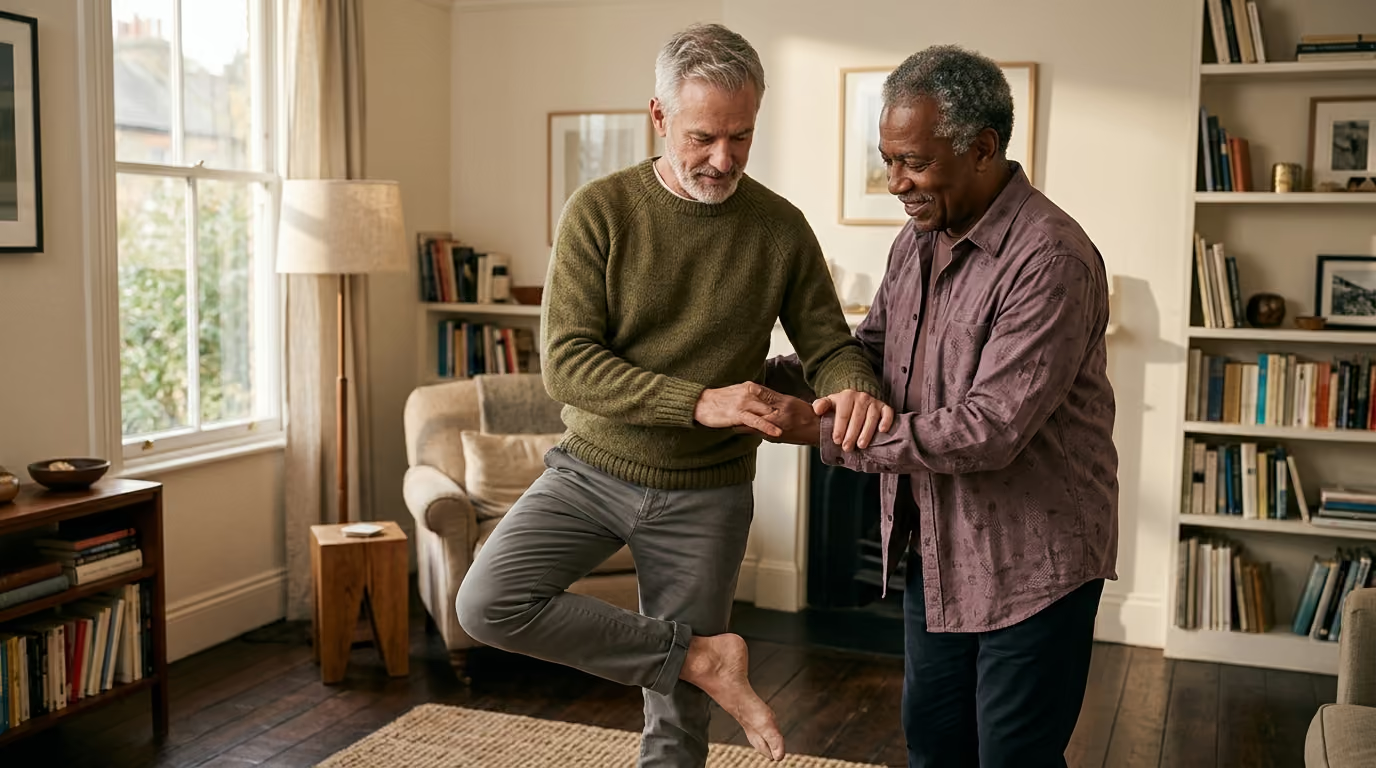
This sequence assesses static postural stability by progressively narrowing your base of support. Time each stage for up to 10 seconds. Move to the next stage only if you can hold the position without moving your feet or holding onto a support.
Difficulty holding the tandem or single-leg positions indicates a need for regular static balance and ankle proprioception work.
This test measures lower-body functional strength and muscular endurance.
For men between ages 35 and 60, completing fewer than 14 to 17 controlled repetitions suggests that lower-body strength and power should be prioritized.
Review these daily movement markers to identify specific physical restrictions:
If you answered no to several of these questions, the practical programming below will help restore those capacities. Explore our additional movement and body composition guides for more detailed physical protocols.
A complete movement regimen addresses five distinct training categories. Integrate exercises from each category across your weekly training split.
Strength provides the structural framework for dynamic balance. Focus on multi-joint patterns that build the hips, thighs, and calves.
Power is the ability to produce force quickly. It is your primary defense against sudden stumbles and missteps.
Target the joints that most commonly limit smooth gait and upright posture.
Challenge your nervous system by altering your base of support, head movement, and surface stability.
Combine motor sequencing with cognitive processing or physical manipulation.
Choose the routine that matches your current physical condition and training background. Practice each routine consistently for 8 to 12 weeks before progressing to a more demanding schedule.
This program is designed for beginners, individuals returning from a sedentary period, or those experiencing noticeable balance hesitation.
This program suits moderately active individuals who want to maintain movement efficiency, joint health, and dynamic stability.
This advanced program is designed for fit adults seeking high levels of coordination, power, and physical reserve.
This routine modifies joint stress for individuals navigating osteoarthritis, joint replacements, or spinal stiffness.
Avoiding common training errors will keep your routine productive and safe.
Walking is an outstanding base of aerobic conditioning. However, ordinary forward walking does not train lateral hip stability, single-leg rotational control, explosive power, or rapid multi-directional stepping. You must include targeted functional balance and resistance exercises to build true fall resistance.
Passive stretching temporarily increases tolerance to stretch, but it rarely produces lasting changes in functional mobility. Usable joint range requires strength and neuromuscular control at end-range positions. Pair your mobility stretches with active strengthening exercises to cement new movement patterns.
Standing on unstable inflatable discs while performing heavy lifts increases injury risk without providing meaningful real-world benefits. Most daily balance challenges occur on solid surfaces under shifting environmental demands. Train balance on stable ground by manipulating your base of support, head position, visual inputs, and movement velocity.
Power declines nearly twice as fast as maximum strength as we age. Safely training rapid force production using bodyweight or light loads trains the nervous system to recruit motor units quickly. This explosive capability is precisely what keeps a stumble from turning into a fall.
Exercise programming should be reinforced by sensible environmental awareness. Modifying your surroundings minimizes unnecessary hazards while you build your movement capacity.
While physical training provides documented benefits, it is important to recognize where research evidence remains limited or uncertain.
Much of the formal literature on fall prevention focuses on clinical populations and adults aged 65 and older. While the underlying physiological mechanisms apply directly to adults in midlife, high-quality long-term trials measuring fall rates specifically in active 40-year-olds and 50-year-olds are less common. We extrapolate training guidelines from broader exercise science and geriatric research.
Commercial claims surrounding proprietary balance equipment, specialized footwear, and passive stretching devices frequently outpace the underlying evidence. No single tool or specialized gadget replaces structured resistance training, progressive mobility work, and multi-directional balance practice.
Self-assessments like the Timed Up and Go and Four-Stage Balance Test are valuable screening tools, but they cannot predict every real-world incident. Complex environments involving sudden distractions, fatigue, alcohol intake, or medication interactions introduce variables that simple physical tests cannot fully capture. Maintain a holistic view of your health, recovery, and surroundings rather than relying on a single screening score.
Consistency produces physical adaptations far more effectively than occasional bouts of exhausting exercise. Use this 12-week roadmap to build your movement habit sustainably.
While self-directed movement training is safe for most healthy adults, certain signs warrant a comprehensive clinical evaluation. Consult a physician, physical therapist, or qualified specialist if you experience:
A clinical physical therapist can perform specialized gait analysis, assess inner-ear vestibular function, and tailor rehabilitative protocols for specific joint conditions or post-surgical recovery.
Return to this manual whenever you experience a change in physical condition, such as recovering from a minor illness, rehabilitating a sprain, changing your weekly workout split, or noticing stiffness during daily activities. Use the self-assessments every six months to verify that your strength, balance, and usable joint mobility remain sharp and capable.
Building movement reserve across midlife is an investment in your autonomy, confidence, and lifelong vitality. Train your balance and mobility while you are functioning well, and your physical capacity will support you across every decade to come.
Stay connected for research-led guidance on fitness, body composition, skin, grooming, vitality, sexual wellbeing, relationships and healthy aging. Clear ideas for gay men 35+ who want to look good, feel strong and age with confidence.


Build habits and systems that support clear thinking, steady energy and long term capacity throughout a demanding career.
explore the Blog