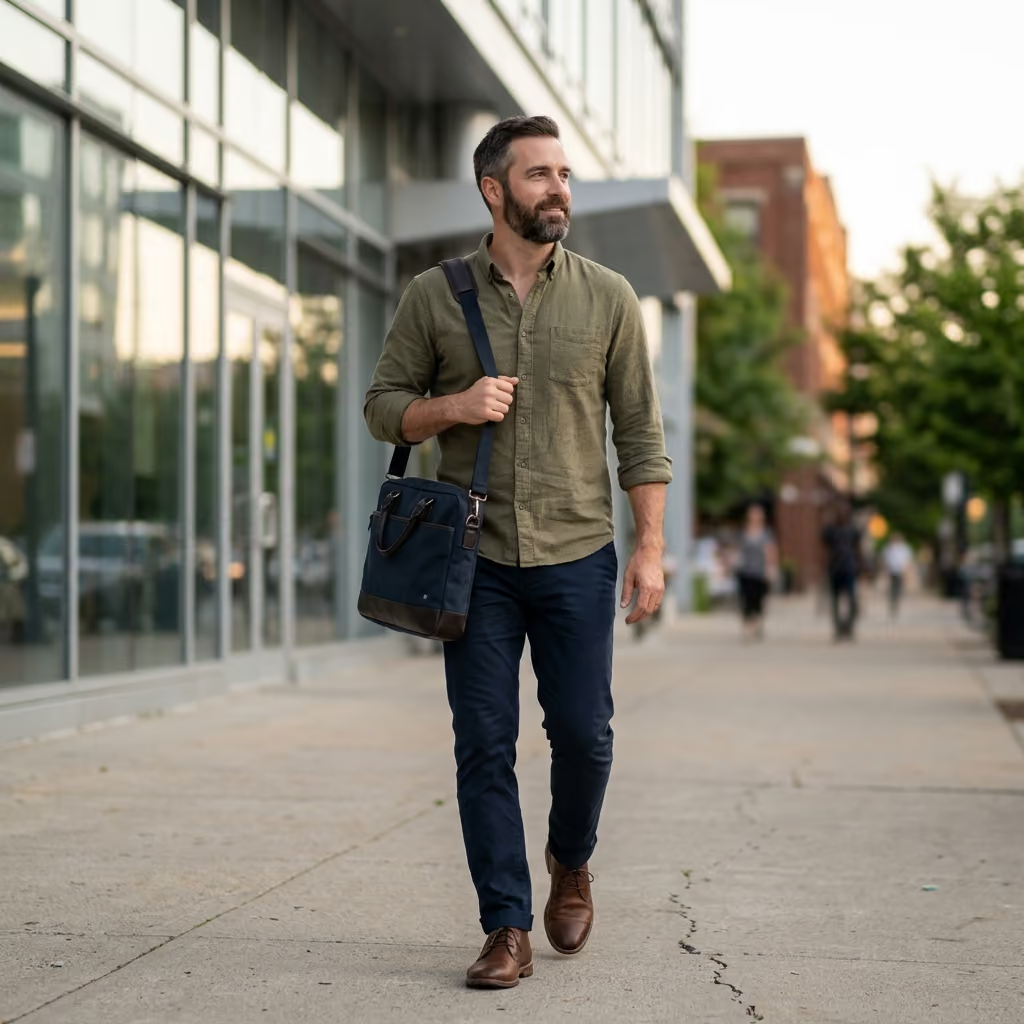

Active social calendars do not guarantee genuine connection for gay men over 35, who must assess deeper intimacy gaps to build lasting belonging.





If you or someone you know is experiencing thoughts of suicide or self-harm, support is immediately available. Call 911 for emergency danger. Dial or text 988 to reach the Suicide & Crisis Lifeline, press 1 for the Veterans Crisis Line, or text 838255. Safety planning and securing access to potential means should be arranged in collaboration with a healthcare provider, trusted friend, or clinician.
Loneliness is not a personal failure, a lack of social skill, or an inevitable outcome of aging as a gay man. It is the subjective, distressing gap between the social connection you desire and the connection you feel you have. Being physically alone is an objective physical state, while loneliness is an internal evaluation of belonging and closeness.
This guide examines the clinical, psychological, and social dimensions of connection. It maps the boundaries between loneliness, social isolation, chosen solitude, intimacy deficits, and social anxiety. It also outlines a step-by-step diagnostic framework and actionable strategies designed specifically for gay men navigating life after 35.
According to data from the Centers for Disease Control and Prevention (CDC), social isolation and loneliness represent distinct conditions with measurable health associations. Social isolation is an objective lack of contact, relationships, or community support. Loneliness is the subjective feeling of being disconnected or lacking meaningful relationships.
A person can live alone with very few contacts yet experience high satisfaction and zero loneliness. Another person can live with a long-term partner, manage a large professional circle, and feel profoundly isolated. The CDC notes that more than one in three adults aged 45 and older report feeling lonely.
Research documented by the CDC indicates that persistent loneliness and social isolation correlate with elevated risks for cardiovascular disease, stroke, type 2 diabetes, cognitive decline, depression, and anxiety. These associations do not prove that loneliness directly causes physical illness on its own. They demonstrate that social connection functions as a vital pillar of biological and mental health.
Psychological interventions can create meaningful reductions in loneliness. Systematic reviews of cognitive behavioral therapy (CBT) protocols show a moderate pooled effect in reducing loneliness scores. Research indicates that CBT-based approaches tend to outperform passive social support groups by targeting negative cognitive biases, hypervigilance, and avoidance patterns. Loneliness operates as an adaptive psychological signal, prompting an individual to seek safety and social repair.
Social networks naturally shift during midlife, but gay men navigate distinct developmental dynamics. Research on older lesbian, gay, and bisexual adults indicates higher rates of reported loneliness compared to heterosexual peers. Studies demonstrate that this difference is driven primarily by higher rates of living alone, lower likelihood of having a partner, less support from families of origin, and greater strain within friend networks.
Biological families may remain emotionally distant or entirely estranged because of past rejection. Many gay men rely heavily on chosen families for practical support and emotional security. When friends relocate, enter intense career phases, or experience health changes, those chosen support networks can thin out quickly.
Generational trauma also shapes the social landscape for men over 35. The ongoing historical legacy of the HIV epidemic removed an entire generation of mentors and peers. This created gaps in intergenerational continuity, leaving many men without visible models for aging with connection and purpose.
Urban gay social ecosystems frequently center around youth culture, physical aesthetics, and nightlife venues. When a man moves past 35, his relationship to these spaces often changes. Stepping back from late-night bar scenes without having alternative community structures in place can produce sudden social dislocation. A thoughtful approach to longevity and healthy aging requires cultivating non-transactional relationships that support long-term vitality.
Distinguishing between different states of social disconnection prevents applying the wrong solution to the problem. Treating social anxiety with more bar invitations or treating emotional loneliness with a crowded party often worsens distress.
Loneliness is not a single uniform state. Researchers using the De Jong Gierveld scale divide the experience into two separate forms:
Social isolation is an objective condition characterized by few social contacts, infrequent interactions, and minimal practical support. You can quantify social isolation by counting regular conversations, emergency contacts, or recurring weekly commitments. An isolated man might go weeks without speaking to anyone outside of transactional service interactions.
Solitude is intentional, restorative time spent alone. The American Psychological Association emphasizes that chosen solitude differs fundamentally from unwanted isolation. Healthy solitude allows for nervous system recovery, creative pursuits, physical training, and reflection. The defining markers of healthy solitude are choice, comfort, and the knowledge that connection remains accessible whenever you want it.
Social anxiety involves a persistent fear of scrutiny, rejection, or negative evaluation in social settings. Men with social anxiety often want connection intensely but avoid social situations to protect themselves from anticipated humiliation. The National Institute for Health and Care Excellence (NICE) notes that social anxiety is maintained through safety behaviors, self-focused attention, negative self-imagery, and post-event rumination.
Intimacy requires mutual emotional disclosure, responsiveness, trust, and physical or emotional affection over time. An intimacy gap occurs when interactions remain entirely superficial or purely sexual. A man may be sexually active on dating apps but remain completely devoid of emotional intimacy. Separating physical gratification from emotional attunement is central to understanding male vitality and sexual wellbeing in midlife.
To rebuild your social life effectively, you must identify the precise breakdown in your connection landscape. Use this structured self-reflection framework to clarify your current baseline.
Select the single statement that most accurately reflects your current internal state:
Rate each of the following dimensions on a scale from 1 (completely inadequate) to 5 (fully satisfied):
Identifying where your lowest numbers sit prevents you from pursuing broad, unfocused social efforts that fail to address your specific gap.
Ask yourself two diagnostic questions:
When time alone is driven by fear, shame, physical exhaustion, or a lack of options, it ceases to be restorative solitude and becomes protective isolation.
Examine your top three to five existing connections using clear quality criteria:
Networks filled with one-sided or highly critical acquaintances often generate more loneliness than physical solitude. Improving your confidence and relationships requires setting boundaries with draining contacts while investing in reciprocal peers.
Many common approaches to finding connection fail because they substitute high-stimulation environments for genuine belonging.
Dating platforms create an illusion of abundant social access through continuous digital notifications. However, these platforms operate primarily on visual assessment, rapid evaluation, and intermittent reinforcement. Using romantic or sexual apps to cure general loneliness frequently leads to rejection fatigue, objectification, and heightened alienation. Sexual validation does not satisfy a need for emotional safety or community belonging.
Bars and clubs remain accessible public venues for gay men, but they rely heavily on alcohol, loud environments, and rapid sensory processing. These settings make sustained, vulnerable conversation nearly impossible. If a man attempts to build an entire social network exclusively in nightlife settings, relationships often remain tied to substance use and late-night availability rather than mutual care.
Men often say, "The gay community rejected me," after a negative experience in a specific gym, party circle, or neighborhood. No single gay community exists. The queer population is divided across micro-communities defined by age, profession, ethnicity, artistic interests, athletic pursuits, and personal values. Expecting every queer space to feel like home sets up unrealistic expectations.
Adult friendship formation requires repeated, low-stakes exposure over time. Men experiencing acute loneliness often approach new acquaintances with intense expectations, hoping for immediate intimacy. When an acquaintance fails to reciprocate with equal intensity, the lonely individual often retreats into total isolation, viewing the interaction as proof of unworthiness.
Effective social rebuilding requires targeting the specific type of deficit you identified in your self-assessment.
If your primary issue is network depletion, focus on creating predictable, recurring contact rather than chasing deep emotional bonds right away.
If you have acquaintances but lack depth, focus on selective deepening with a small number of candidate friends.
If social anxiety prevents you from engaging, implement structured cognitive and behavioral steps aligned with clinical recommendations.
Explore broader community and relationship resources that align with your genuine values rather than scene expectations.
Rebuilding a sustainable social life does not require an immediate lifestyle overhaul. It requires a systematic, progressive series of behavioral steps executed across thirty days.
To see how these principles function in real life, consider three representative models of common midlife social challenges.
An illustrative scenario involves a 44-year-old corporate executive who attends multiple professional dinners each week, stays active in an urban fitness community, and maintains hundreds of contacts. Despite a full social calendar, he experiences profound emotional loneliness. He realizes that all of his interactions are performative, centered around status, career positioning, and appearance.
His intervention does not involve attending more events. Instead, he intentionally scales back large networking gatherings. He selects two longstanding acquaintances and invites them to casual, one-on-one dinners at home. He deliberately speaks about personal matters outside of work. By slowing down and allowing vulnerability, he transforms surface acquaintances into genuine confidants.
Consider an illustrative model of a 49-year-old man who recently exited an eleven-year relationship. His former partner retained their shared friend group, housing arrangement, and social routines, leaving him in sudden, objective isolation.
Rather than jumping directly onto dating apps to fill the emotional void, he focuses first on structural stabilization. He joins a local master's swimming team that practices three mornings a week, guaranteeing regular, low-stakes human contact. He reaches out to an old college friend living two hours away for weekly phone check-ins. He enters individual therapy to process the grief of the breakup before attempting to date again.
Another illustrative model involves a 38-year-old man who relocated to a new city for work. Overwhelmed by unfamiliarity and worried about not fitting into the local gay community, he spends his weekends entirely alone in his apartment, scrolling social media and feeling increasingly alienated.
He implements a graded exposure hierarchy. Week one involves working from a neighborhood coffee shop for two hours on Saturday. Week two involves joining a local queer trail-hiking group and committing to staying for the entire two-hour hike. By shifting his focus away from his internal anxiety and engaging in the shared physical task of hiking, he gradually forms connections without the pressure of nightlife culture.
While research on social connection has advanced significantly, critical gaps remain in the scientific literature regarding gay men over 35.
Much of the broader loneliness literature relies on cross-sectional survey data. Cross-sectional studies identify correlations between loneliness and negative health outcomes, but they cannot prove direct causation. It remains challenging to disentangle whether loneliness accelerates physical decline, or whether underlying chronic health issues cause people to withdraw socially.
Epidemiological studies on sexual minorities frequently combine lesbian, gay, bisexual, and transgender adults into a single broad demographic category. This aggregation masks the distinct social trajectories of gay men, who experience unique subcultural norms around aging, body image, and sexual networks.
Prevalence estimates for loneliness among gay men vary widely across published studies, ranging from 13% to nearly 35%. This wide variance stems from differences in measurement tools, sample recruitment methods, geographic locations, and whether researchers measured general perceived loneliness, social isolation, or emotional loneliness.
Most randomized controlled trials evaluating loneliness interventions focus on general older populations, nursing home residents, or university students. High-quality intervention trials designed specifically for midlife gay men navigating minority stress, chosen family dissolution, or community rebuilding remain scarce. Recommendations must therefore combine established psychological principles with cultural fluency.
No. Research demonstrates that living arrangements do not dictate subjective loneliness. While living alone is an objective structural state, many men living alone report high life satisfaction, rich chosen families, and deep social fulfillment. Conversely, men living with domestic partners often experience significant loneliness if emotional reciprocity and mutual understanding are absent in the home.
Post-breakup network collapse is common when social lives are shared entirely with a partner. Focus on stabilizing basic routines first before attempting to rebuild a wide network. Reconnect with independent acquaintances from your past, join structured interest groups where you can form new bonds separate from your ex-partner, and allow yourself to grieve the loss of your social ecosystem without rushing into immediate dating.
Seek out activity-centered groups where alcohol is absent or secondary. Look for queer sports leagues, hiking and outdoor groups, volunteer initiatives, creative writing or arts workshops, book clubs, and professional or civic organizations. Building bonds around shared values or physical activities creates deeper, more sustainable connections than late-night socializing.
Solitude is healthy when it is consciously chosen, deeply restorative, and flexible. It becomes problematic isolation when you want social contact but avoid it due to anxiety, shame, or despair. If you feel trapped in your home, experience pervasive feelings of unworthiness, or find yourself unable to reach out to someone during an emergency, your solitude has shifted into protective withdrawal.
The presence of loneliness does not mean your capacity for connection is broken. It is an internal call to adjust your environment, invest in reciprocal relationships, and align your daily social life with your authentic values.
Stay connected for research-led guidance on fitness, body composition, skin, grooming, vitality, sexual wellbeing, relationships and healthy aging. Clear ideas for gay men 35+ who want to look good, feel strong and age with confidence.


Build habits and systems that support clear thinking, steady energy and long term capacity throughout a demanding career.
explore the Blog