
Intergenerational friendships among gay men reduce social isolation and build lasting community through shared interests, equal agency, and mutual support across age groups.





Most advice on gay social life assumes that men naturally divide themselves by age. Younger men are directed toward nightlife, hookup apps, and peer groups in their twenties. Men past 35 are told to settle into established couples, gym routines, or age-segregated dinner clubs. When cross-generational contact is discussed, culture tends to reduce it to romantic pursuit, career mentorship, or patronizing charity.
That framework misses what genuine friendship across cohorts actually offers. The most resilient gay male social networks are not built on age silos, nor are they built on one-sided mentorship. They function as reciprocal partnerships where dignity, curiosity, humor, and emotional support flow in both directions.
Creating durable community across age lines requires unlearning old habits. It means setting aside the impulse to treat an older gay man as an archive of historical tragedy. It also means refusing to treat a younger gay man as an unpaid digital tutor or an audience for unsolicited advice. When two men connect as equals with distinct life histories, they build a shared social fabric that enriches both lives.
Building these connections is a vital component of long-term health and emotional vitality. Exploring intentional confidence and relationships allows men to move past superficial boundaries. By grounding our connections in evidence, we can create durable social networks across every stage of adulthood.
Research in social gerontology and public health separates social isolation from subjective loneliness. Social isolation is an objective measurement of network size and contact frequency. Loneliness is the subjective pain of feeling disconnected or misunderstood. A person can have dozens of weekly interactions and still experience deep loneliness.
Data from the National Academies demonstrates that poor social connection carries severe physical health risks. Prolonged isolation and chronic loneliness correlate with elevated risks of cardiovascular disease, cognitive decline, depression, and premature mortality. For gay men, these risks are shaped by distinct demographic patterns.
Studies comparing sexual-minority adults to heterosexual peers show significant structural differences in support networks. Research published in peer-reviewed aging journals indicates that sexual-minority older adults are less likely to have an intimate partner or biological children in their household. Their social networks rely heavily on friendships rather than biological family.
While gay men often maintain friend networks comparable in size to heterosexual peers, their support systems face distinct vulnerabilities. When an individual relies exclusively on friends within their exact age cohort, the entire network ages simultaneously. Health crises, mobility limitations, and cognitive changes can strain the group all at once.
Survey findings from organizations like SAGE and AARP show that over half of older LGBTQ+ adults report feeling socially isolated at least sometimes. Furthermore, nearly 80 percent express concern about whether they will have adequate support networks as they grow older. These concerns are not limited to older cohorts. Younger sexual-minority men report elevated rates of isolation, driven by social fragmentation, geographic relocation, and shallow digital interactions.
Cross-sectional research shows that intergenerational connection creates tangible benefits for both age groups. When younger and older adults engage in reciprocal community programs, participants report reduced loneliness, improved self-worth, and broader social safety nets. The critical factor is reciprocity. Relationships built on charity or one-way aid do not generate the same psychological benefits as mutual peer connection.
Life after 35 brings subtle shifts in how gay men navigate friendship, energy, and community. In early adulthood, social circles are often organized around proximity, nightlife, professional ambition, or romantic pursuit. High-density social environments can create an illusion of deep connection that proves fragile over time.
By midlife, priorities change. Many men notice their social circles shrinking as peers partner up, relocate, change careers, or manage health adjustments. The desire for casual validation frequently gives way to an appetite for reliability, intellectual depth, and mutual dependability.
Psychologist Erik Erikson described midlife as a stage defined by generativity versus stagnation. Generativity involves the drive to contribute to something that outlasts the self. For gay men, who frequently step outside traditional parenthood, generativity often expresses itself through community participation, cultural stewardship, and creative collaboration.
This developmental shift can enrich cross-cohort friendships when managed with self-awareness. An older man may feel a genuine desire to offer encouragement, hospitality, or perspective to someone navigating earlier career and relationship transitions. However, healthy generativity is invited rather than imposed. It becomes counterproductive when an older man assumes a younger friend needs his constant guidance.
At the same time, men over 35 frequently benefit from the fresh perspectives of younger peers. Connecting across age lines prevents social calcification. It introduces new cultural frameworks, creative energies, and viewpoints that keep midlife adults engaged with the changing world.
Understanding these life stages is central to sustaining long-term wellbeing. Learning how social networks integrate with longevity and healthy aging helps men protect their emotional and cognitive resilience over time.
Intergenerational friendship among gay men occurs within a specific historical and cultural setting. Unlike heterosexual families, where generational transfer happens automatically across dinner tables, gay men often experience cultural segregation by age.
Historical conditions explain much of this divide. The HIV/AIDS epidemic devastated an entire generation of gay men in the 1980s and 1990s. This loss created a demographic gap that severed natural mentorship pathways and disrupted informal cultural transmission. Younger generations grew up without seeing sufficient models of healthy gay aging. Older survivors were left to rebuild their lives within thinned peer networks.
Differences in political and social environments also shape each cohort. A man who came of age during the Stonewall era or the height of the AIDS crisis developed his survival strategies under criminalization, systemic discrimination, and intense social stigma. A man who came of age after marriage equality and the advent of biomedical HIV prevention navigates an entirely different landscape of social visibility and civil rights.
These differing baselines can lead to misunderstandings if unaddressed. Older men may sometimes perceive younger men as politically naive or unappreciative of past struggles. Younger men may view older men as overly cautious, cynical, or resistant to contemporary language around gender and sexuality.
Chosen family serves as a powerful bridge across these cultural gaps. In LGBTQ+ history, chosen families emerged because biological relatives often rejected sexual-minority members. Research on the convoy model of social relations confirms that chosen families provide essential psychological protection against external minority stress.
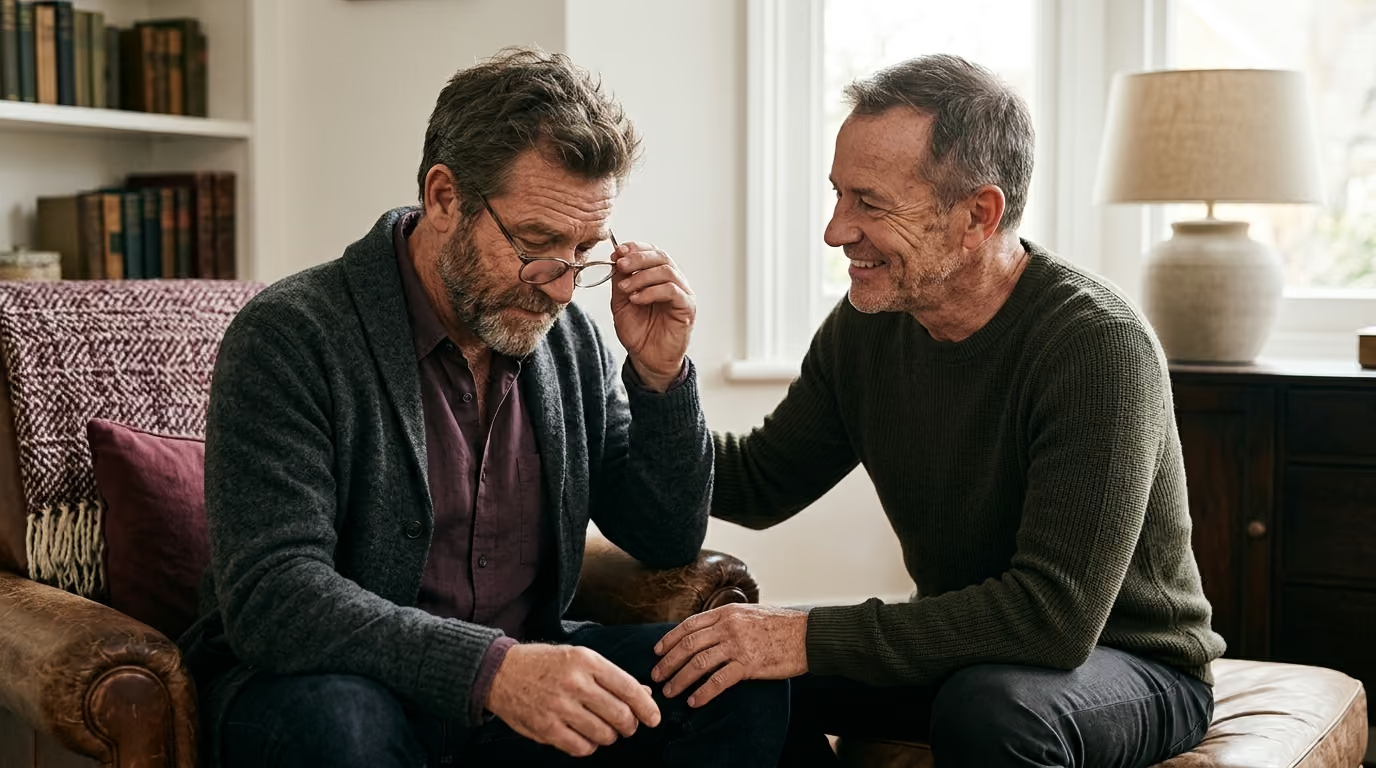
Intergenerational friendships enrich these chosen family structures. They create multidirectional links that allow historical memory, modern insight, and emotional care to circulate freely across generations.
A major obstacle to genuine intergenerational friendship is the tendency to turn connection into a formal hierarchy. When an older man is cast as the wise mentor and a younger man as the eager pupil, equality disappears. The interaction becomes a performance of expertise rather than a spontaneous friendship.
Mentorship has its place in professional contexts, but it makes a poor foundation for personal intimacy. When one person always gives advice and the other always receives it, vulnerability becomes one-sided. The older man feels pressured to appear flawless, while the younger man feels inhibited from expressing his own mature convictions.
Recent scholarship on LGBTQ+ community organizing highlights the power of multidirectional mentorship. In this framework, learning moves in all directions. An older man might share insight on long-term career resilience, personal endurance, or navigating historical health crises. A younger man might offer knowledge regarding modern digital advocacy, shifting cultural paradigms, or community organizing strategies.
Rescue fantasies present an equally destructive trap. A younger man might approach an older adult with the paternalistic assumption that the older man is lonely, helpless, and in need of saving. Conversely, an older man might assume a younger man is reckless, confused, and desperate for adult rescue.
Both assumptions undermine personal dignity. Genuine friendship requires that both individuals enter the relationship as self-directed adults. They do not meet to complete a social service project. They meet because they appreciate each other's humor, perspective, and company.
Consider an illustrative scenario involving two men who meet through a local arts organization. An older participant and a younger participant initially interact around video editing and local theater archives. If the older man insists on lecturing about historical productions while dismissing modern techniques, the relationship stalls.
When the two pivot toward genuine collaboration, the dynamic changes. The younger man shares contemporary production methods, while the older man provides access to historical production notes and community figures. They begin meeting for dinner simply to discuss cinema and cooking. The relationship shifts from a transactional exchange into an authentic peer connection.
To build balanced relationships across age differences, men can use a straightforward operational model: the PEER framework. This approach focuses on dignity, mutual agency, and practical boundaries.
Begin by seeing the individual sitting across from you rather than an abstract demographic category. Avoid leading with generational cliches or asking someone to explain their entire age cohort.
Avoid opening interactions with questions like:
Replace those leading inquiries with questions focused on personal character and present interests:
A friendship becomes extractive when one person uses the other for a single utility. An older man is not an oral history library, a financial patron, or a real estate contact. A younger man is not an unpaid technician, a social media consultant, or an ornament to signal youthfulness.
Healthy connection rests on mutual curiosity. Both people must bring something to the conversation, whether it is humor, culinary skills, shared athletic hobbies, or emotional presence during difficult weeks.
Both individuals must have equal power to guide the direction of the relationship. Either person should feel entirely comfortable suggesting a venue, declining an invitation, setting a boundary, or introducing a new topic of conversation.
Equality of agency does not mean both men possess identical financial or physical resources. It means that both men respect each other's autonomy. If an activity involves financial costs, choose venues that do not place pressure on either person's budget. Transparent communication about practical logistics prevents hidden resentments from forming.
Generational differences in vocabulary, cultural references, and social etiquette will inevitably surface. When a disagreement occurs, focus on understanding the emotional impact rather than defending personal intentions.
A sustainable friendship has room for repair. If an older man uses outdated language, a younger friend can name his boundary without resorting to moral condemnation. If a younger man makes a careless assumption about aging, an older friend can offer a clear correction without withdrawing into defensiveness.
Using the comprehensive guides available through GayFitLab resources can offer additional scaffolding for building intentional, mature connections.
Intergenerational friendships rarely materialize out of thin air. They develop most naturally in structured settings where men share a common goal or activity that takes attention off the age difference.
The most durable way to connect across cohorts is through an activity that both people genuinely enjoy. When two men meet around an authentic interest, age becomes a secondary trait rather than the main focus.
Consider joining or organizing groups around:
Shared activities create regular, low-pressure contact. Men learn how their peers react under different conditions, which builds mutual trust naturally over time.
Working together on a tangible project creates shared ownership and breaks down conversational awkwardness. A collaborative project distributes authority based on task requirements rather than social age.
Examples of balanced collaboration include:
When both men share authorship of a physical outcome, the power dynamic remains balanced. Neither person is a guest in the other person's world.
A skill swap provides an intentional structure for practical contribution. The goal is to highlight competence on both sides without reinforcing age-based stereotypes.
A skill swap should never assume that older adults lack technical skills or that younger adults lack practical capabilities. The exchange is simply an agreed mechanism to ensure that both men contribute value to the partnership.
Large formal events can feel intimidating, while one-on-one meetings can feel intense for newcomers. A recurring community table offers a balanced middle ground.
A successful community table features:
Repeated low-stakes interactions allow men to build familiarity before deciding to pursue one-on-one friendships.
As cross-generational relationships mature, they can encounter complicated boundary questions. Handling these situations directly ensures that friendships remain safe, respectful, and resilient.
Differences in financial stability and career stage are common across different age cohorts. An established midlife professional or retiree may have significant assets, while a younger man may be navigating entry-level employment or high living costs.
Unacknowledged financial differences can distort a friendship. If an older friend routinely pays for expensive meals or event tickets, the younger friend may feel beholden or patronized. Conversely, an older friend might feel taken advantage of if he is always treated as an open wallet.
Handle money transparently:
Because we age at different rates, a close friend may eventually face significant health issues, chronic illness, or mobility decline. Chosen families often step forward to provide essential care when biological families are absent.
Data on LGBTQ+ aging indicates that non-biological chosen family members provide a large majority of informal care for older community members. However, a personal friendship should not quietly slide into unpaid, full-time caregiving without open discussion.
If a friend develops acute care needs, sit down and establish explicit boundaries:
Maintaining the distinction between friendship and professional caregiving preserves the dignity of both individuals.
Gay male social spaces frequently blur the lines between platonic friendship, sexual interest, and romantic connection. While attraction can exist across age differences, ambiguity can disrupt a friendship if expectations are not aligned.
If romantic or sexual feelings arise, communicate honestly rather than letting unspoken tension grow. If both men agree to maintain a purely platonic connection, honor that agreement through consistent behavior. Treating a friend with platonic respect allows trust to deepen over decades.
For men interested in broader relationship patterns, exploring vitality and sexual wellbeing can bring clarity to how emotional and physical health interact in adulthood.
Age is never the only difference at play in a relationship. Race, socioeconomic background, immigration status, gender expression, and disability shape how men experience the world.
An older white gay man and a younger gay man of color navigate different social realities regarding policing, housing security, and institutional inclusion. True peers do not ignore these structural realities. They listen to each other's lived experiences without defensiveness, recognizing that community solidarity requires acknowledging inequality where it exists.
While the benefits of social connection are well-documented, specific research into LGBTQ+ intergenerational friendships has clear limitations that should be acknowledged.
Much of the existing research on sexual-minority aging relies on cross-sectional survey data from urban centers. Men living in rural areas, men of color, working-class men, and transgender individuals remain underrepresented in major social network studies. Consequently, findings from metropolitan community centers may not apply universally to small-town environments.
Furthermore, few longitudinal studies have tracked structured intergenerational interventions over several years. We have solid evidence that short-term community programs improve mood and reduce immediate feelings of isolation. We have less empirical data on how many of these connections endure as permanent friendships once formal programs conclude.
We must also avoid assuming that cross-generational friendship is a universal remedy for structural social challenges. An intentional friendship provides companionship, mutual learning, and emotional steadiness. It cannot replace professional mental health treatment, affordable senior housing, or accessible healthcare systems.
Recognizing these research gaps prevents us from making inflated claims. Intergenerational connection is not a magic cure for every social problem. It is simply an effective, accessible way for men to build durable community, bridge cultural divides, and navigate adulthood with greater resilience.
You can learn more about our editorial standards and research methodology on the GayFitLab about page.
Building genuine connection across cohorts frees gay men from the confines of generational silos, creating a resilient chosen family that sustains us at every stage of life.
Stay connected for research-led guidance on fitness, body composition, skin, grooming, vitality, sexual wellbeing, relationships and healthy aging. Clear ideas for gay men 35+ who want to look good, feel strong and age with confidence.


Build habits and systems that support clear thinking, steady energy and long term capacity throughout a demanding career.
explore the Blog