
Inclusive strength training provides evidence-based frameworks and movement adaptations to help people of all ages build muscle safely and sustainably.





Many men search online for how to start lifting weights when standard gym equipment causes joint pain or feels poorly constructed for their body frame. They often encounter rigid instructions written for young athletes with symmetrical mobility and ideal leverage. The reality is that resistance exercise works best when adapted to the individual human rather than forcing the human into a standardized exercise label. Inclusive strength training treats physical movement as an adaptable skill that can build muscle, protect joints, and improve daily energy for every body type.
Credible public health research shows that regular resistance exercise provides broad systemic benefits regardless of starting body size or athletic history. World Health Organization guidelines recommend that adults perform muscle-strengthening activities involving all major muscle groups on two or more days every week. These recommendations extend explicitly to older adults and people living with physical limitations or chronic conditions. The objective is to support functional capacity, preserve independence, and maintain physical resilience over time.
Clinical studies demonstrate that muscle tissue adapts positively to mechanical tension across all ages and body shapes. A systematic review evaluating resistance training in adults with higher body weight found large improvements in muscle strength and moderate improvements in physical function. These performance gains occurred even when overall body weight remained unchanged. Muscle mass increases and neural adaptations happen reliably when target muscles work against a sufficient challenge, regardless of whether that challenge comes from a barbell, a resistance band, or a seated cable machine.
Research also illustrates the psychological barriers created by rigid fitness environments. Systematic reviews on weight stigma show that everyday judgment and internalized body shame lead directly to reduced physical activity. When fitness culture demands a specific appearance or punishes non-standard mobility, people avoid exercise facilities altogether. Creating adaptable training protocols removes these artificial social barriers and allows participants to experience consistent strength gains without public embarrassment or joint distress.
Physical adjustments naturally alter how the body responds to exercise as the years advance. Age-related changes in connective tissue structure reduce tendon elasticity and alter joint lubrication. Cartilage wears unevenly over time, which can make deep joint angles uncomfortable under heavy loading. Recovery capacity between intense training sessions also slows down as cellular repair mechanisms become less rapid.
Metabolic and hormonal profiles shift steadily after age 35. Muscle tissue naturally declines at a rate of three to eight percent per decade after thirty if resistance stimulus is absent. This process, known as sarcopenia, affects overall physical stability, insulin sensitivity, and resting energy expenditure. Fat distribution may also change, leading to increased abdominal accumulation even when daily calorie intake remains constant.
These biological developments reflect normal human aging rather than personal failure or physical decline. Modifying exercise positions to match changing joint angles protects structural integrity while preserving physical capacity. Adapting stance width, limiting joint range to pain-free zones, and scheduling adequate rest days allow mature adults to build lean muscle safely. You can review specialized strength training and body composition strategies designed to support sustainable performance across every decade of adult life.
Effective strength programs use structured frameworks to modify exercises without losing the underlying training stimulus. Instead of discarding an exercise completely when it causes discomfort, coaches and lifters can adjust specific variables to restore comfort and safety.
Every movement modification begins by separating the underlying training goal from current physical limitations.
If a conventional barbell back squat causes lower back strain or knee pain, the goal remains building lower body force. The constraint is limited joint tolerance under spinal loading. The choice becomes a high box sit-to-stand or a supported leg press, which challenges the quadriceps without distressing the lumbar spine.
Selecting the body's physical position is the primary programming decision before adding external weight. Altering position alters balance demands, joint stress, and structural stability.
A person managing acute fatigue or balance hesitation can perform upper body presses from a supported seated bench. As stability improves, the movement can transition through supported standing to unsupported variations without changing the muscle groups being worked.
Public health guidelines highlight two weekly strength sessions as a foundational benchmark. However, optimal starting volume varies based on individual recovery capacity and current activity history.
Short workouts repeated consistently create far better long-term strength adaptations than exhausted, multi-hour gym sessions that require days of bed rest to recover from.
Monitoring physical sensations during a workout helps distinguish normal muscular exertion from harmful joint stress.
This monitoring framework allows individuals to direct their own workouts safely without relying on push-through-the-pain gym mentalities.
Designing an inclusive resistance routine involves selecting one exercise from each primary movement category. This ensures total body development without overstressing any single joint complex.
Knee-dominant movements build the quadriceps, gluteal muscles, and supporting connective tissues around the knee joint.
Hip-dominant movements strengthen the posterior chain, including the hamstrings, glutes, and lower back muscles responsible for hip extension.
Pushing movements develop the chest, anterior shoulders, and triceps while supporting shoulder girdle health.
Pulling exercises build the mid-back, lats, posterior shoulders, and biceps, which are essential for maintaining posture and shoulder stability.
Carrying tasks build core stability, shoulder blade control, grip strength, and real-world work capacity.
Trunk control exercises build abdominal resistance to unwanted twisting or bending, protecting the spine during daily lifting tasks.
Physical environments frequently contain hidden barriers that restrict access for larger individuals, older adults, and people with mobility aids. Understanding spatial clearance and equipment design helps lifters choose safe, accommodating spaces.
Accessibility involves far more than installing an entry ramp at the front door. Commercial gyms and home setups require adequate spatial clearances around every piece of equipment.
U.S. Access Board specifications mandate a clear floor space of at least 30 inches by 48 inches adjacent to exercise equipment. This clearance permits a person using a wheelchair or mobility device to position themselves safely for transfer or direct use. Enclosed areas surrounded on three sides require increased dimensions to allow safe turning radii.
Positioning equipment too close to walls or neighboring machines creates collision hazards and restricts movement. Clear pathways measuring at least 36 inches in width should connect major training zones, enabling unhindered movement throughout the facility.
Standard commercial machines are typically constructed for individuals within average height and weight distributions. These structural choices create specific access issues for diverse bodies.
When machine architecture restricts full movement, switching to adjustable cable towers, free-standing dumbbells, or heavy-duty resistance bands provides immediate freedom of movement.
Every exercise tool offers unique mechanical advantages and operational trade-offs.
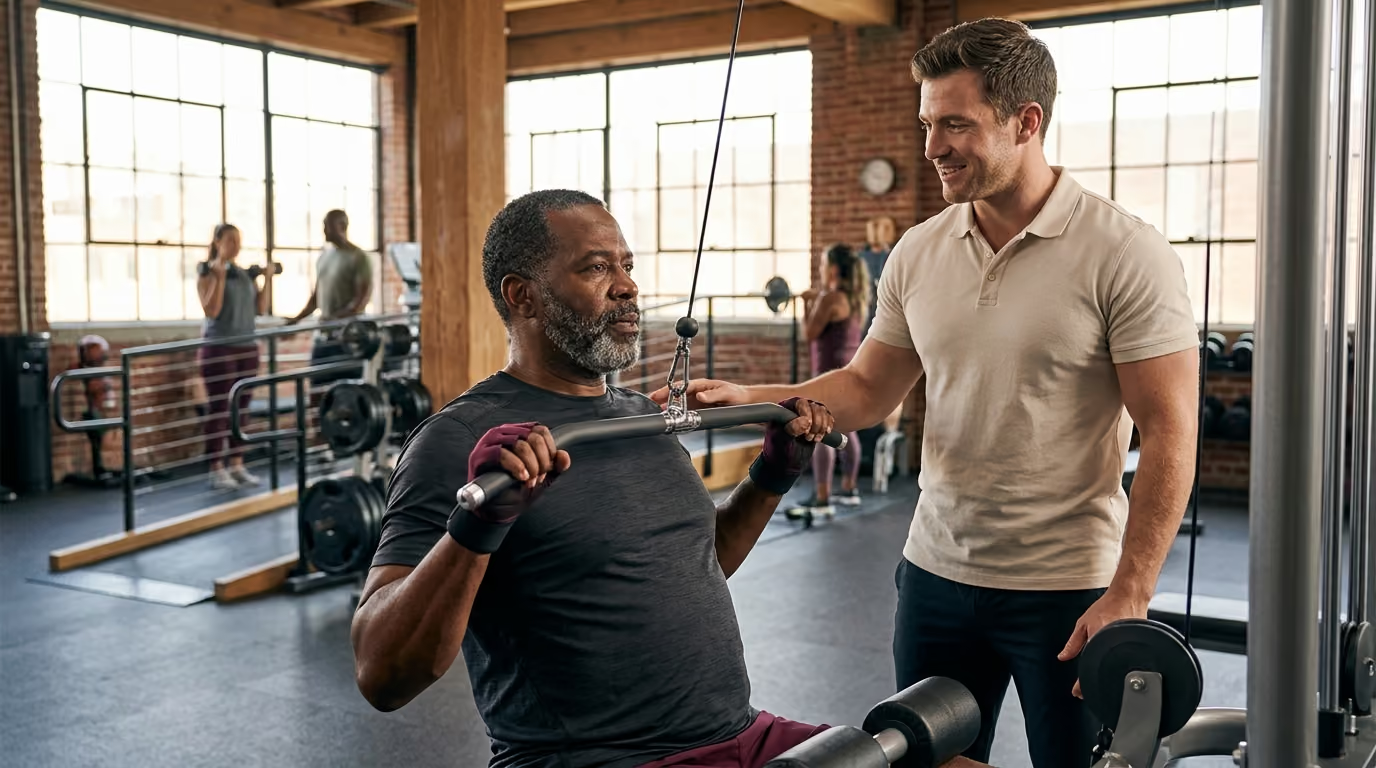
Cable systems provide constant continuous tension throughout the movement path while allowing customized angles of push and pull. They do not force the user into a rigid fixed joint track. They permit seated, standing, or floor-based training without requiring tight equipment transfers.
Resistance bands are highly portable, inexpensive, and exert minimal stress on joints at the start of a movement pattern. Research comparing exercise modalities shows that band-based training produces muscular strength improvements comparable to traditional machines while offering superior ease of access.
Free weights permit natural wrist and elbow rotation, accommodating unique anatomical structures. However, holding heavy weights demands significant grip strength and balance control.
Machines eliminate balance requirements and isolate specific muscle groups efficiently. They are valuable for beginner loading but require careful inspection to ensure the physical frame and seat dimensions fit comfortable user parameters.
Translating resistance exercise into practical daily function is the ultimate purpose of inclusive strength training. Building physical capacity improves daily vitality, energy management, and physical confidence.
Consistent strength practice yields clear functional improvements that simplify daily activities:
For detailed strategies on preserving physical performance as the years progress, consult our resource on healthy aging and longevity principles.
The following scenarios illustrate how the Goal-Constraint-Choice framework solves specific movement barriers in real-world settings.
Social dynamics and gym culture heavily influence whether individuals maintain long-term exercise habits. Commercial fitness environments often reinforce rigid aesthetics that discourage participation among diverse populations.
Fitness spaces within gay culture frequently emphasize narrow body ideals, youthfulness, and hyper-masculine aesthetics. These unwritten standards can make gyms feel intimidating for men over 35, larger individuals, or those recovering from illness or injury. Body judgment and age-related exclusion create significant psychological distress, causing many men to abandon resistance exercise entirely.
Inclusive training challenges this dynamic by prioritizing physical function, joint health, and personal vitality over superficial appearance standards. Reframing fitness as a tool for lifelong health creates spaces where men of all ages, sizes, and presentation styles can build physical strength without fear of social judgment. Strengthening muscle tissue directly supports physical energy, confidence, and overall wellness. You can explore further research on male vitality and sexual wellbeing to see how functional strength supports comprehensive health after age 35.
The terms used by trainers and exercise partners shape the psychological training environment. Replacing shame-driven, penalty-based coaching language with objective, movement-focused instructions fosters sustainable engagement.
Implementing clear informed consent protocols regarding physical guidance or touch cueing creates a safe, professional training atmosphere.
Tracking physical development requires broad, reliable metrics that extend beyond body weight or scale readings.
Relying exclusively on bathroom scales overlooks major strength gains and positive tissue adaptations. Resistance exercise frequently increases lean muscle tissue while reducing fat mass, resulting in stable scale weight despite major improvements in body composition. To learn more about how physical activity interacts with energy balance, read our detailed analysis of metabolic health and nutrition.
Reliable alternative measures of strength progress include:
Evaluating real-life physical functional capacity provides meaningful feedback that directly connects to daily vitality.
These functional markers reflect true improvements in muscle tissue quality and neural coordination, offering meaningful motivation that scale numbers cannot provide.
While the evidence supporting inclusive resistance training is robust, specific gaps remain within current exercise science literature.
Much of the published literature on high-intensity strength training focuses on younger, non-disabled athletic populations. Studies investigating adaptations in larger bodies, older adults, or individuals with complex mobility needs often feature smaller sample sizes or shorter intervention periods. Consequently, exact optimal parameters for power development and high-velocity training in these demographics remain less defined.
Additionally, long-term adherence comparisons between commercial gym training and home-based resistance band programs require further multi-year research. While short-term strength gains are comparable between bands and free weights, long-term habit retention depends heavily on individual access, social support, and personal preference.
Individuals managing complex medical conditions, acute joint injuries, recent surgeries, or uncontrolled systemic symptoms should consult qualified healthcare professionals before initiating new exercise protocols. Self-monitoring tools provide safety guidance but cannot replace individualized medical advice.
Inclusive strength training adapts resistance exercise to fit your unique frame and movement capabilities, building real-world strength and vitality without joint pain or shame. True physical progress is measured by expanded capacity, movement confidence, and functional independence rather than scale weight or rigid exercise formats.
Stay connected for research-led guidance on fitness, body composition, skin, grooming, vitality, sexual wellbeing, relationships and healthy aging. Clear ideas for gay men 35+ who want to look good, feel strong and age with confidence.


Build habits and systems that support clear thinking, steady energy and long term capacity throughout a demanding career.
explore the Blog