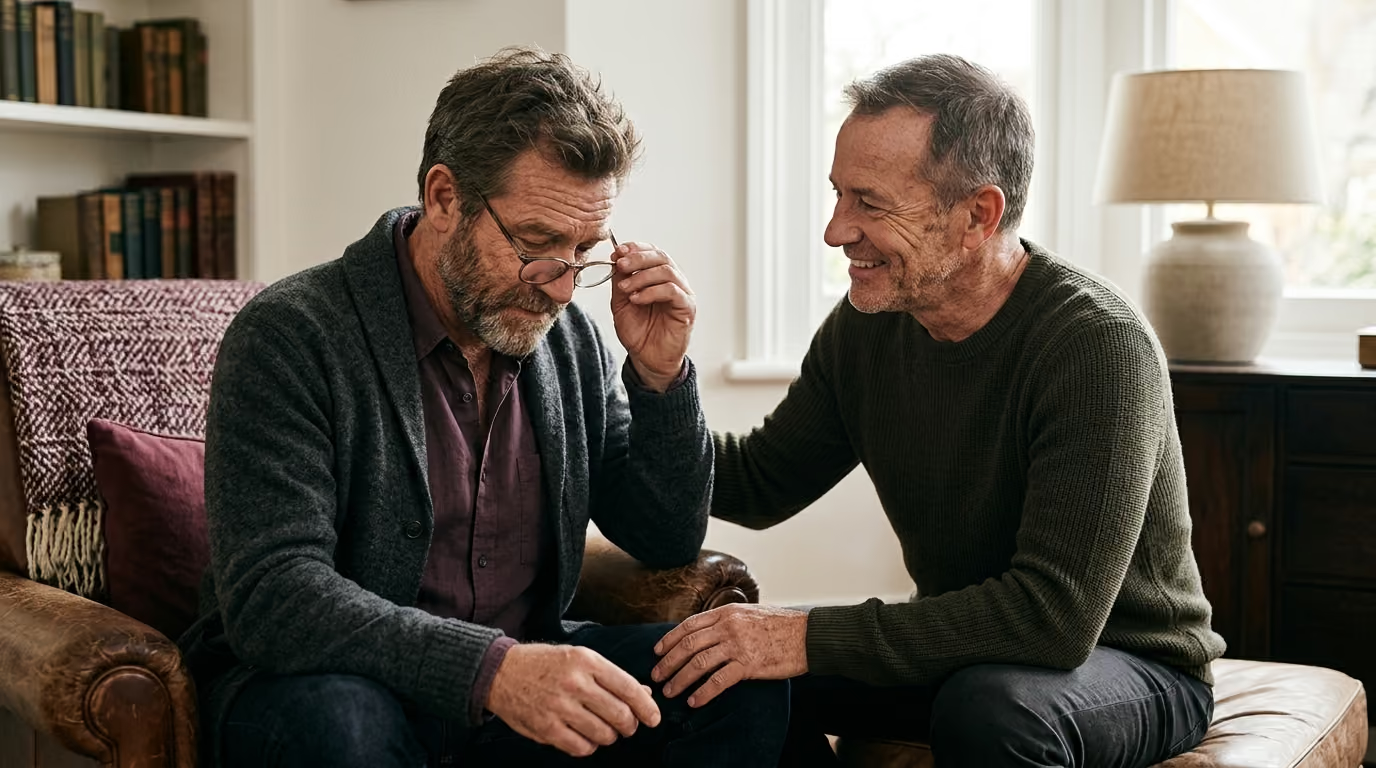

Disagreements over sex, time, and boundaries can derail your connection unless you use proven de-escalation tools to protect your emotional intimacy.





If you are in immediate danger, call 911. For 24/7 support, call or text 988 and press 1 for the Veterans Crisis Line, or text 838255.
Popular relationship advice suggests that frequent disagreements signal incompatibility. Many men believe that keeping passion alive requires avoiding uncomfortable conversations. In reality, avoiding friction often erodes intimacy faster than arguing. When partners swallow grievances to keep the peace, emotional distance grows, sexual desire cools, and silent resentment replaces genuine connection.
Disagreements about time, sex, money, friends, household labor, privacy, and family are normal parts of long-term partnership. The goal of conflict resolution is not to eliminate differences or crown a winner. The true objective is lowering perceived threat, understanding underlying emotional needs, creating workable agreements, and protecting your mutual bond.
Understanding how to navigate conflict with skill transforms inevitable disagreements into opportunities for deeper trust. By examining behavioral research, relationship psychology, and gay social dynamics, you can build a resilient partnership that thrives under pressure.
Research on same-sex couples challenges old stereotypes about male emotional avoidance and instability. Observational studies by researchers at the Gottman Institute demonstrate that gay male couples use distinct strengths when handling conflict. Gay partners frequently employ humor, affection, and positive communication when raising difficult topics. They also show a notable capacity to remain calm during emotionally charged discussions.
These findings show that gay couples often handle emotional tension with greater initial positivity than different-sex couples. Gay partners are less likely to use defensive posturing during the opening minutes of a disagreement. Research indicates that the ability to repair minor ruptures predicts long-term relationship stability. When negativity occurs, the speed and quality of repair determine whether intimacy survives.
Sexual communication research also highlights clear patterns among men. A longitudinal daily-diary study evaluated 103 diverse cisgender male couples over fifteen days. The researchers found that open sexual communication was positively associated with daily relationship satisfaction and emotional closeness. When one partner initiated clear, respectful conversations about sexual needs, both men reported higher emotional intimacy.
The evidence demonstrates that domestic labor patterns among same-sex partners differ from traditional arrangements. Sociological studies show that same-sex couples tend to share household labor more equally. They exhibit less task segregation based on rigid roles. Equality in daily execution does not mean identical division of labor, but it does reflect active negotiation.
Long-term success depends on deliberate relational maintenance. When you understand the science of relational stability, conflict stops feeling like an existential threat to your future.
Before applying communication tools, partners must distinguish between ordinary relational friction and destructive abuse. Ordinary conflict involves two partners negotiating competing preferences, resources, or boundaries. Both individuals retain their voice, their autonomy, and their right to say no without fearing physical violence or retaliation.
Relationship danger involves an imbalance of power maintained through intimidation, coercion, isolation, or violence. Data from the Centers for Disease Control and Prevention show that intimate partner violence occurs in sexual minority communities at rates equal to or higher than heterosexual populations. Lifetime physical violence, stalking, or sexual coercion affects significant numbers of gay and bisexual men.
If your relationship involves threats, physical harm, stalking, forced sexual acts, or complete financial control, communication frameworks are insufficient. These patterns require safety planning and specialized support. If you or someone you know is in immediate danger, call 911 immediately. You can also contact the National Domestic Violence Hotline by calling 1-800-799-SAFE or texting "START" to 88788. If you are experiencing thoughts of self-harm, dial 988 to reach the Suicide & Crisis Lifeline.
Couples therapy and negotiation exercises are designed for relationships where basic emotional and physical safety exists. When fear replaces respect, individual protection must take precedence over relationship preservation.
Age introduces distinct psychological and practical dynamics into gay relationships. After 35, men often face shifting professional demands, changing energy levels, and evolving health realities. Career peaks can reduce personal time, leaving less bandwidth for unstructured romance. Physical recovery from stress becomes slower, which can lower emotional resilience during arguments.
Libido, erectile function, and body image often change in your late thirties, forties, and fifties. These physical changes can trigger silent anxieties about desirability and youth. A partner who feels self-conscious about his changing body might interpret casual comments as harsh criticism. When physical vitality shifts, men sometimes withdraw emotionally rather than admitting their vulnerability.
Midlife also brings accumulated relationship experiences and past relational wounds. Men who spent decades managing minority stress, discrimination, or family rejection may have sensitive threat detection systems. When an argument starts, an older partner might react to echoes of past betrayals rather than the present moment. Recognizing these age-related dynamics helps couples treat midlife friction with patience.
Prioritizing your shared long-term emotional and physical health provides the foundation for mutual growth. Mature love requires accepting that bodies, schedules, and priorities shift over time.
Most destructive arguments follow a predictable physiological sequence. A conflict begins with a specific trigger, such as an unwashed dish, a late arrival, or a distant tone of voice. The brain processes this trigger and attaches a meaning to it. A missed phone call becomes an internal narrative: "He does not respect my time."
This internal narrative activates threat circuitry in the nervous system. The heart rate climbs, adrenaline enters the bloodstream, and muscles tighten. When a person's heart rate exceeds roughly one hundred beats per minute during an argument, psychological flooding occurs. In this state, the brain loses access to nuance, empathy, and complex problem-solving.
Flooding pushes men into defensive survival strategies. One partner becomes the pursuer, raising his voice, repeating accusations, and demanding immediate answers. The other partner becomes the withdrawer, shutting down, avoiding eye contact, and walking away. The pursuer interprets withdrawal as abandonment, so he attacks harder. The withdrawer interprets attacks as danger, so he retreats further.
Trying to resolve a disagreement during physiological flooding is impossible. The conversation inevitably degrades into sarcasm, contempt, or cold silence. Interrupting this physiological loop is the foundational skill of conflict de-escalation.
Stopping an escalating fight requires deliberate, structured intervention. You must regulate your nervous system before attempting to solve practical problems. The following six-step protocol allows couples to lower tension and communicate clearly.
When you notice racing thoughts, raised voices, or clenched fists, pause the interaction immediately. A constructive time-out is not an act of rejection or stonewalling. State clearly that you are overwhelmed, and commit to a specific return time.
Use clear phrasing: "I notice my heart is racing, and I want to hear you clearly. Let us take a thirty-minute break and talk at eight o'clock." Spend this time walking, breathing deeply, or listening to calming audio. Do not spend the break rehearsing counter-arguments in your head.
The way a conversation begins predicts how it will end. Harsh openings packed with global accusations immediately trigger defensive walls. Replace statements like "You never help around here" with a structured four-part request:
An effective example sounds like this: "When plans change without advance notice, I feel anxious and disconnected. I start telling myself that our shared time is not a priority for you. Would you be willing to send me a text update as soon as your schedule changes?"
Human beings judge themselves by their intentions and others by their impact. Your partner may have made a careless choice without harboring malicious motives. Acknowledge that the emotional hurt is real while releasing assumptions about his underlying character.
Say: "I know you did not plan to hurt my feelings, but the impact left me feeling sidelined. Can we talk about what happened?" This simple distinction lowers defensiveness and keeps the conversation focused on collaborative problem-solving.
The listener must demonstrate comprehension before presenting his own perspective. Summarize your partner's core points in your own words. Confirm whether your understanding matches his internal experience.
Validation does not require total agreement with his assessment. You can validate an emotional reality by saying: "It makes sense that you felt isolated when I stayed late at the gym without checking in. I can see why that felt dismissive."
Surface arguments about dirty laundry or late arrivals are almost always proxies for deeper emotional currencies. Surface complaints generally represent requests for security, autonomy, recognition, respect, or erotic desire.
Ask your partner: "What would help you feel secure right now?" When you identify the underlying vulnerability, the practical solution becomes obvious.
Micro-repairs are brief verbal course corrections that prevent emotional drift during tense dialogues. When you feel a conversation sliding toward irritation, use simple grounding statements.
These small gestures interrupt defensive reflexes and remind both men of their mutual commitment.
Couples fight over predictable categories of daily life. Mastering navigating gay relationships and emotional confidence requires practical frameworks tailored to these specific operational domains.
Conflicts over time emerge when one partner values spontaneous independence while the other requires scheduled connection. Tension increases when time spent with friends or hobbies is interpreted as emotional withdrawal.
Solve this by building a weekly shared calendar that establishes three distinct categories of time:
Treating independent time as a natural human need rather than a relationship failure preserves personal autonomy.
Differences in sexual desire are universal in long-term relationships. Conflicts accelerate when the higher-desire partner feels rejected and the lower-desire partner feels pressured. Rejection begins to feel like a judgment on attractiveness, while initiation feels like an obligation.
Build agreements around male sexual vitality and intimacy that separate physical touch from sexual performance:
Sexual communication must always center on enthusiastic consent, mutual safety, and erotic exploration.
Money arguments combine practical math with deep-seated emotional beliefs about survival, status, and freedom. Differences in earning power can introduce unspoken resentment or power imbalances if left unaddressed.
A sustainable financial agreement uses a three-account model:
Transparent financial guidelines eliminate suspicion while preserving individual economic dignity.
Friction over chores often stems from invisible labor rather than physical execution. One partner frequently assumes the role of household manager, noticing shortages, planning schedules, and carrying the mental load.
Conduct a household audit to categorize daily and weekly tasks. Assign complete ownership of specific areas rather than asking one partner to perform ad-hoc tasks upon request. When one man owns the kitchen, he handles the menu planning, shopping, cooking, and cleanup independently. Complete ownership removes the need for nagging and eliminates scorekeeping.
The line between healthy privacy and secretive behavior requires explicit definition. Anxious partners may seek reassurance through digital monitoring, while avoidant partners may demand complete secrecy.
Clarify digital boundaries through direct agreements:
Gay social circles frequently include former romantic or sexual partners. Tension develops when one partner feels excluded from his partner's history or suspects lingering emotional attachments.
Establish clear social guidelines:
Understanding gay relationship dynamics and community connection helps you balance historical community ties with the sanctity of your current romance.
Partners often exist at different stages of outness with their biological families, employers, or religious communities. Discrepancies in outness create intense conflict if one partner feels forced back into the closet during family gatherings.
Protect your partnership by establishing shared rules of engagement:
Gay men navigate distinct cultural realities that shape how conflicts arise and resolve. Decades of research on minority stress demonstrate that societal prejudice and historical marginalization affect internal relationship dynamics. When gay men experience discrimination or microaggressions in daily life, their baseline stress levels increase. This background stress can spill over into domestic arguments.
Chosen families play a central role in gay life, offering vital support networks. These close-knit social groups can complicate romantic disputes if boundaries blur. When a partner shares private relationship problems with mutual friends, he risks triangulating the conflict and creating social camps. Strong relationships maintain clear boundaries around what remains private within the couple.
Relationship structures in gay communities also encompass diverse paradigms, from strict monogamy to consensual nonmonogamy and monogamish arrangements. Conflict often arises not from the structure itself, but from ambiguity around implicit rules. Open dynamics require rigorous communication, clear safer-sex agreements, and honest check-ins regarding emotional attachments.
Intersectional factors such as race, socioeconomic background, and physical ability introduce additional layers of complexity. When partners come from different racial or cultural backgrounds, their communication norms and experiences with authority differ. Approaching these differences with cultural humility strengthens your emotional bond.
Lasting conflict resolution requires translating emotional breakthroughs into durable, observable behaviors. Abstract promises such as "I will try harder to be attentive" fail because they lack measurable criteria. Sustainable agreements outline specific actions, timelines, and review intervals.
Use the structured framework below whenever you need to resolve a recurring issue.
Treating agreements as experimental trials removes the pressure of permanent perfection. If an arrangement feels unbalanced after three weeks, adjust the parameters together without blaming each other.
While clinical literature provides valuable guidance, several limitations exist within the research on same-sex relationships. Much of the early observational research conducted on gay couples involved relatively small, racially homogeneous cohorts. These studies primarily focused on middle-class, urban gay men, which can limit the generalizability of their conclusions across diverse socioeconomic populations.
Additionally, some studies evaluating specific therapeutic interventions for same-sex couples, such as Gottman Method Couples Therapy, used uncontrolled observational designs. Without randomized control groups, researchers cannot definitively prove that therapeutic frameworks alone caused all measured relationship improvements. Individual motivation and natural maturation may account for part of the progress.
National survey datasets on intimate partner violence have historically grouped diverse sexual minority identities together. Early surveillance systems frequently combined gay, bisexual, and transgender data into broad categories, masking differences between distinct subgroups. Transgender and gender-nonconforming men remain underrepresented in long-term longitudinal relationship studies.
Recognizing these research gaps prevents couples from adopting clinical findings as absolute rules. Use scientific studies as helpful guideposts while tailoring communication tools to fit the unique realities of your own partnership.
Managing relationship conflict with emotional maturity protects your connection and builds enduring trust. When both partners commit to lowering threat, honoring vulnerability, and crafting clear agreements, your bond becomes stronger after every storm.
Stay connected for research-led guidance on fitness, body composition, skin, grooming, vitality, sexual wellbeing, relationships and healthy aging. Clear ideas for gay men 35+ who want to look good, feel strong and age with confidence.


Build habits and systems that support clear thinking, steady energy and long term capacity throughout a demanding career.
explore the Blog