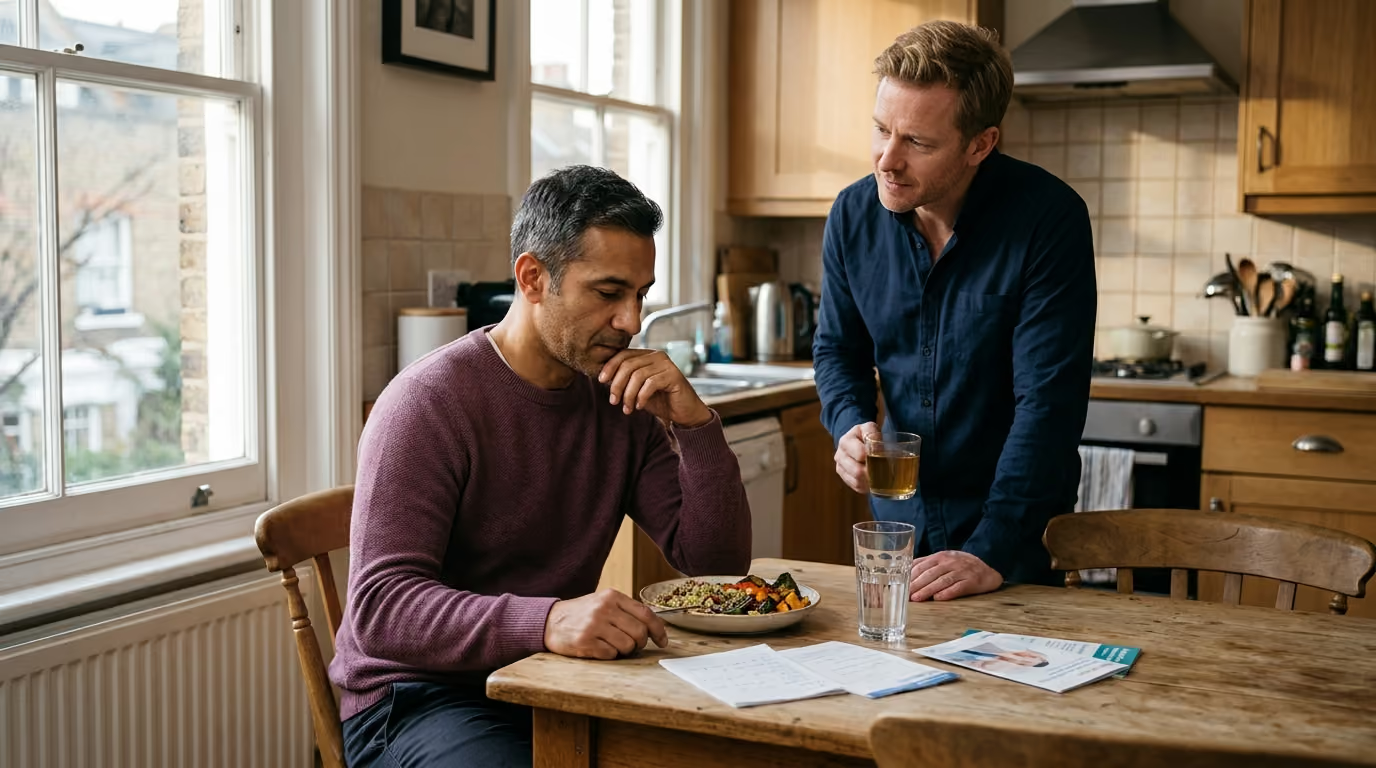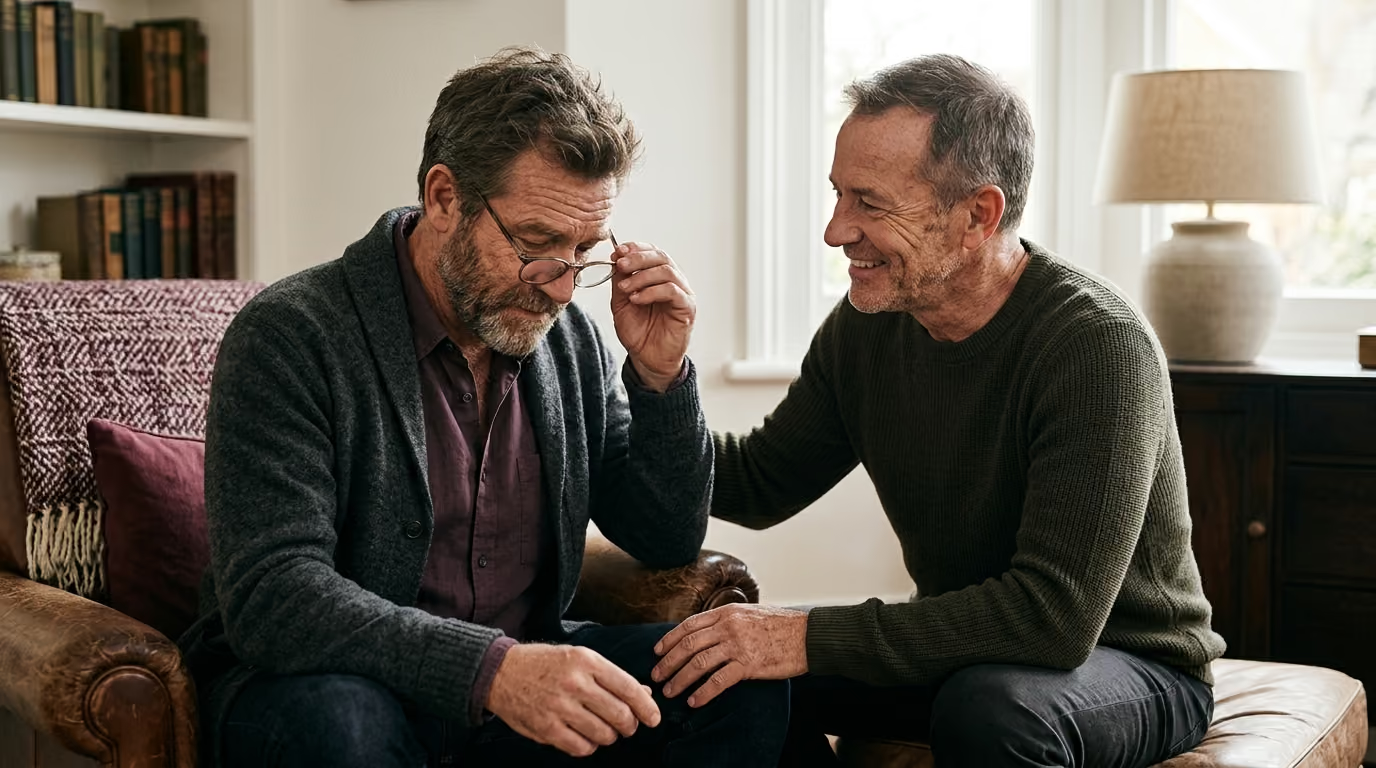

Couples facing gaps in age or culture build stronger relationships by actively evaluating everyday power dynamics and fostering mutual respect.





If you are in immediate danger, call 911. For 24/7 support, call or text 988 and press 1 for the Veterans Crisis Line, or text 838255.
Dating across difference is not an obstacle course designed to test personal endurance. It is also not a performance of open-mindedness or a collection of social credentials. Real connection across social lines is an ongoing practice of understanding how history, access, culture, and desire shape each partner.
When two people date across variations in race, age, class, disability, relationship background, or gender presentation, they encounter both generative opportunities and distinct friction points. Difference can expand emotional perspective and spark deep attraction. At the same time, unexamined differences can conceal unequal power, create communication barriers, or produce emotional exhaustion.
Moving through these dynamics requires moving past shallow clichés about love conquering all. Genuine confidence in dating comes from developing practical tools: learning cultural humility, executing relational power audits, respecting bodily and social boundaries, and knowing the difference between healthy adaptation and quiet subjugation. This guide breaks down the behavioral science, social realities, and communication frameworks required to build resilient, egalitarian partnerships.
Empirical research across sociology, communication studies, and relationship science shows that human variation itself does not doom romantic partnerships. Instead, relationship quality depends on how partners perceive, communicate about, and adapt to those variations.
Data from the Pew Research Center illustrates a massive demographic and cultural shift in how people form relationships across social boundaries. In 1970, fewer than 1% of married couples in the United States were made up of spouses of different races. By 2000, that share had climbed past 5%. Public attitudes shifted in tandem. In 1987, only 48% of American adults approved of Black and white people dating. By 2003, that number reached 77%, and among adults born after 1976, approval surpassed 90%. Later Pew polling found that roughly nine in ten Millennials reported feeling comfortable with a family member marrying someone from a different racial background.
Acceptance in public surveys, however, does not eliminate interpersonal friction. A 2024 study on diversity ideologies in intercultural relationships analyzed 838 participants across cross-sectional and longitudinal cohorts. The researchers found that individuals who adopted a colorblind approach, meaning they attempted to ignore cultural differences, struggled with partner acceptance. These individuals expressed their own cultural habits freely but showed lower acceptance of their partner's distinct cultural practices, leading to mixed relationship outcomes. By contrast, difference-aware approaches supported healthier long-term engagement.
Communication studies provide additional nuance. A 2025 study evaluating relational dynamics discovered that basic communication patterns vary only slightly based on racial, ethnic, or national differences. Broad cultural background differences introduced minor communication obstacles that showed a modest statistical correlation with lower satisfaction and commitment. The research indicates that cultural difference is not an absolute barrier. Misunderstanding arises when partners rely on rigid stereotypes rather than learning their partner's personal communication preferences.
Longitudinal research on age differences reveals distinct patterns over time. Large-scale household panel data indicate that couples with substantial age gaps often report high initial satisfaction. That satisfaction advantage frequently diminishes after six to ten years together compared to similarly aged couples. The data also show that relationships with large age gaps can experience lower resilience during unexpected economic shocks. The central issue is rarely chronological age alone. The true variables are life stage alignment, financial autonomy, health changes, and shared long-term planning.
Disability and health status represent another critical area of research. Systematic reviews on interpersonal relationships show that severe physical or sensory disabilities are common among adults in cohabiting partnerships. International human rights frameworks, including the United Nations Convention on the Rights of Persons with Disabilities, emphasize that disabled individuals hold equal rights to romantic, sexual, and family life. Research identifies that the primary strains on these relationships rarely stem from impairment itself. The strains originate from structural barriers: inaccessible venues, inadequate transportation, financial restrictions, clinical stigma, and patronizing social attitudes.
To explore the foundations of relational communication in more depth, review our research on confidence and relationship dynamics.
A confident relationship requires an honest appraisal of power. Power in a partnership is not a static trait possessed by one person. It is relational, context-dependent, and subject to change over time. When partners come from different social, economic, or physical backgrounds, power asymmetries inevitably enter the living room.
Understanding power requires distinguishing between five distinct relationship concepts:
Variation in background, age, race, neurotype, physical capability, or personal history. Difference is neutral. It describes what is present without assigning hierarchy.
Unequal access to wealth, legal protections, social legitimacy, physical mobility, or institutional safety. Inequality is external and structural, yet it directly impacts how much risk each partner carries.
A fundamental misalignment in core values, life goals, financial habits, or boundary structures. Incompatibility is not a moral failure. It simply means two people cannot meet each other's needs sustainably.
External prejudice or structural bias that devalues one partner's dignity, legal rights, or bodily autonomy. Discrimination can target race, sexual orientation, gender presentation, or physical ability.
A repetitive pattern of coercive control, intimidation, isolation, or exploitation designed to dominate another person. Abuse is never a communication misunderstanding or an acceptable consequence of difference.
The Centers for Disease Control and Prevention (CDC) reports that more than one in three women and one in six men in the United States experience contact sexual violence, physical violence, or stalking by an intimate partner during their lifetimes. CDC data on psychological aggression document that tens of millions of adults experience coercive control. Coercive tactics include tracking movements, making unilateral life decisions, destroying property, and restricting contact with friends and family.
To maintain an egalitarian partnership, couples can use a structured power audit. This framework examines five operational pillars:
Who controls the money, the lease, the mortgage, the vehicle, and the health insurance? If one partner holds all material resources, the other partner's ability to negotiate boundaries or leave the relationship becomes severely compromised.
Whose identity receives public respect? Whose family of origin is welcoming, and whose family is hostile? If one partner is accepted by society while the other faces continuous marginalization, the burden of social navigation is unequal.
Whose preferences decide where to live, how to spend leisure time, and how conflicts are resolved? An imbalance occurs when one partner's comfort is treated as the default setting.
Who faces legal, physical, or social danger if the relationship is disclosed? In queer relationships, dating someone who is legally vulnerable or not out involves different baseline risks for each person.
If the relationship ends tomorrow, what happens to each partner? Can both individuals secure safe housing, maintain their income, and retain their support network? A healthy partnership ensures that staying together is an active choice rather than a survival necessity.
Couples should revisit this power audit during major life transitions such as moving into a shared home, changing careers, experiencing health shifts, or relocating to a new city.
Dating across age gaps takes on new meaning after age 35. For gay men, age-discrepant relationships are common, yet they carry unique psychological and social dimensions. Exploring these dynamics without moralizing requires examining how life stages interact with physical vitality, financial security, and emotional maturity.
As men age past 35, physical recovery, metabolism, and long-term vitality shift naturally. These physiological changes are normal aspects of adult life rather than personal failures. When a 45-year-old dates a 26-year-old, or when a 38-year-old dates a 58-year-old, the primary challenge is rarely biological. The core challenge is aligning asynchronous life stages.
Consider how generational positioning influences daily priorities:
A younger partner may be in an intensive career-building phase, working long hours, building professional networks, and managing entry-level compensation. An older partner may occupy an established leadership role, value predictable evenings, or contemplate retirement. Misalignment happens when the older partner demands domestic availability that the younger partner cannot afford to give.
Income disparity frequently accompanies age gaps. If the older partner covers all travel, dining, and housing expenses, a subtle dynamic of patronage can develop. The younger partner may feel pressure to defer on small and large choices. True respect means creating financial agreements where both voices carry equal weight, regardless of who pays the restaurant bill.
Differing eras of socialization produce distinct cultural vocabularies. Gay men in their fifties and sixties navigated different historical conditions regarding the HIV epidemic and legal protections than men in their twenties. Dismissing an older partner as out of touch or patronizing a younger partner as shallow damages mutual respect.
Over a multi-decade horizon, age gaps eventually intersect with caregiving realities. An older partner may face mobility changes or chronic health management earlier. A confident couple discusses these realities candidly rather than treating future care needs as an unspoken taboo.
To examine how physical health and vitality evolve through midlife, consult our resources on healthy aging and long-term vitality.
When disagreements occur in age-gap relationships, both partners must ensure that experience is not weaponized. An older partner claiming superior wisdom to silence an argument is exercising condescension, not maturity. A younger partner dismissing an older partner's boundaries as rigid is avoiding accountability. An egalitarian relationship requires that both adults treat each other's perspectives as legitimate.
Interracial and intercultural dating requires moving beyond superficial harmony. A strong connection does not ignore cultural differences, nor does it turn a partner into an ethnographic study. Respectful dating requires cultural humility: the ongoing practice of self-reflection, acknowledging personal knowledge limits, and rejecting the belief that one's own cultural norms are universal.
The difference between cultural sharing and cultural consumption is fundamental:
A mutual, voluntary exchange of traditions, values, foods, and perspectives. Cultural sharing is rooted in intimacy and respect. It occurs naturally over time with explicit consent and shared joy.
Treating a partner's ethnic identity as an aesthetic accessory, a sexual kink, or a bucket-list experience. Cultural consumption reduces an individual to an exotic stereotype. It expects the minoritized partner to provide constant education, emotional labor, and culinary or cultural entertainment.
Navigating cultural difference requires specific conversational frameworks. Avoid sweeping questions such as, "How does your culture handle dating?" Such inquiries treat complex, diverse populations as monoliths. Instead, employ the principle of specificity over symbolism.
Use targeted questions that focus on the individual:
Extended family systems frequently introduce significant friction in intercultural relationships. In individualistic cultural traditions, romantic couples often expect to make choices in total isolation from parents or siblings. In collectivist cultural traditions, family consultation regarding major milestones is a standard expression of respect and care.
Neither approach is inherently superior. Relationship conflict erupts when one partner labels the other's family structure as either backward or cold. Healthy navigation involves negotiating clear boundaries together. Couples must decide which decisions belong entirely to the two of them, which areas welcome family input, and how they will present a united front when family members overstep.
For practical guidance on building resilient community networks, review our editorial on confidence, relationships, and community resources.
Disability, neurodivergence, and chronic health conditions are standard aspects of the human experience. In romantic relationships, accessibility is not a personal favor performed by a nondisabled partner. Accessibility is a fundamental relational practice that ensures both people can participate equally in dating, intimacy, and shared life.
Research on interpersonal disability experiences underscores that physical, sensory, and cognitive barriers frequently limit relationship formation. Inaccessible restaurant entrances, sensory-overwhelming venues, lack of public transit options, and exclusionary social formats create structural isolation. In gay male culture, where social life often centers on high-stimulation nightlife, gym spaces, and fast-paced events, accessibility requires deliberate, intentional planning.
To build an equitable partnership across differences in physical or cognitive ability, apply these structural standards:
Do not plan an outing and ask at the last minute if the disabled partner can manage it. Integrate access criteria from the start. Verify step-free access, accessible restrooms, appropriate seating, lighting conditions, and sound levels before making reservations.
Unsolicited assistance strips an adult of agency. If your partner has a physical disability or chronic pain, do not grab mobility aids, take over tasks, or make assumptions about what they need. Ask clearly: "Would assistance be helpful right now, or do you have this covered?" Accept their answer without taking offense.
In relationships where one partner assists another with medical tasks, transportation, or physical care, the boundary between intimacy and control can blur. The partner offering care must never use that support to direct decisions, monitor social contacts, or demand emotional compliance. The partner receiving care must retain complete authority over their own medical decisions and schedule.
Chronic illnesses and neurodivergence often involve unpredictable shifts in energy, pain, or sensory processing. A resilient couple establishes a low-guilt cancellation and modification policy. When plans must change due to symptom flare-ups, the adaptation is treated as a neutral scheduling adjustment rather than a personal slight.
Intimacy must be decoupled from narrow, rigid performance standards. Physical disability, chronic illness, and neurodivergence may require adjustments to sexual mechanics, pacing, positioning, and sensory environments. Open dialogue about what feels pleasurable, what causes discomfort, and how to communicate consent creates a fulfilling sexual connection.
To read more on maintaining physical health, bodily confidence, and fulfilling intimacy, see our research on sexual wellbeing and intimacy.
Socioeconomic class shapes how people view security, risk, leisure, and obligation. When partners come from different class backgrounds or earn drastically different incomes, unaddressed assumptions about money can generate quiet resentment.
Class is not merely a number on a tax return. Class background influences deeply ingrained habits:
A partner from an affluent background may view risk as exciting and assume that financial emergencies can always be resolved. A partner from a working-class background may carry chronic stress regarding financial precarity, debt, or the need to provide financial support to extended family members.
Differences in what constitutes a reasonable dinner cost, vacation budget, or gift can create tension. If the wealthier partner consistently chooses expensive venues, the less wealthy partner may feel forced into financial overextension or uncomfortable dependence.
Earning less money does not mean an individual has more free time to manage domestic chores. Assuming that the partner with the lower income should handle cooking, cleaning, and administrative errands reproduces economic exploitation within the home.
Couples can manage class and income differences through practical operational models:
Shared living expenses, such as rent, utilities, and groceries, can be split proportionally based on income rather than down the middle. This ensures that both partners retain comparable percentages of their earnings for personal savings, retirement, and discretionary spending.
When selecting shared activities, plan dates around what the lower-earning partner can comfortably afford without stress. If the higher-earning partner wishes to upgrade an experience, such as choosing international travel or luxury lodging, that partner covers the difference as a gift, with zero strings attached.
Both partners should maintain separate, individual bank accounts alongside any shared accounts. Financial autonomy requires that each person retains money that they control entirely without needing to justify purchases to the other.
Clear communication prevents assumptions from undermining intimacy across difference. When navigating distinct backgrounds, unspoken expectations produce misunderstandings. Confident dating relies on structured boundary models, deliberate consent frameworks, and dependable repair practices.
To navigate differences without losing personal integrity, categorize relationship topics into three tiers:
In gay male relationships, partners frequently have different levels of public outness. According to Pew Research Center data on LGBTQ adults, disclosure is highly uneven. While 96% of LGBTQ adults have shared their identity with at least one person, 23% of those with living parents are not out to them, 32% are not out to extended family, and 25% of employed LGBTQ adults are not out to coworkers. Furthermore, majorities of gay men report experiencing slurs or jokes regarding their sexual orientation.
Dating someone who is selectively out requires nuanced negotiation:
When cross-cultural or interpersonal misunderstandings occur, intent does not erase outcome. Defending oneself by saying, "That is not what I meant," dismisses the partner's experience. Use this four-part structure to address missteps:
Example Script: "When I made that joke about your family's holiday traditions, I intended to be playful. I see that the impact was making you feel that I disrespect your background. I apologize. In the future, I will speak about your family's customs with the respect they deserve."
To understand our underlying commitment to clear, evidence-based relationship guidance, review the research standards at GayFitLab.
While sociological and psychological research provides valuable patterns, scientific literature on dating across difference contains distinct methodological limitations. Readers must evaluate research findings within their proper context rather than treating statistical correlations as universal rules.
First, large-scale relationship datasets remain heavily skewed toward heterosexual, cisgender married couples. Longitudinal studies examining age gaps, marital stability, and division of household labor often rely on demographic samples where traditional gender roles skew the results. Applying these findings directly to gay male relationships requires caution, as queer partnerships often organize domestic labor, monogamy agreements, and relationship milestones differently.
Second, intercultural communication research frequently relies on cross-sectional survey methods. Cross-sectional data capture a single snapshot in time. They cannot definitively prove cause and effect between cultural differences and relationship outcomes. Many studies assess self-reported relationship satisfaction, which is subject to social desirability bias and changing personal moods.
Third, academic research on disability in romantic contexts has historically suffered from medical-model bias. Older studies frequently treated disability as an individual deficit rather than analyzing how inaccessible environments and social discrimination impact relationship quality. Modern research utilizing social models of disability is expanding, yet comprehensive longitudinal data on queer disabled partnerships remain sparse.
Finally, broad demographic data cannot account for individual emotional maturity, trauma history, communication skills, or personal compatibility. Two people may match across every demographic category and fail completely due to poor emotional regulation. Conversely, two people with extensive differences in age, race, culture, and physical capability can build an extraordinary partnership through mutual humility, transparent communication, and shared values.
Attraction becomes fetishization when an individual's race, age, physical disability, or gender expression is treated as a sexual gimmick, an aesthetic trophy, or a collection item. If you view the person as a representative of a category rather than a complex human being with unique flaws and quirks, your interest is reductive. Ask yourself: If their demographic identity were removed from the equation, would you still admire their character, humor, values, and mind?
You and your partner must establish a clear, united strategy for managing hostile relatives. The partner whose family is causing harm must take primary responsibility for setting boundaries. It is unfair to expect one partner to endure disrespect or bigotry from in-laws. Decide in advance which events you will attend together, what behaviors will trigger an immediate departure, and how you will protect your shared domestic sanctuary.
Address spending habits through concrete systems rather than moral judgments. Determine shared living costs and agree on a transparent contribution model. Keep individual discretionary spending accounts entirely separate so that differing philosophies on dining, clothing, or hobbies do not cause daily friction. As long as shared financial obligations and savings goals are met, each partner should retain freedom over their personal funds.
Adaptation becomes self-erasure when changes consistently flow in one direction. If you are the only partner learning a new language, adjusting your schedule, modifying your social circle, hiding your identity, or suppressing your boundaries, the relationship is extractive. Healthy adaptation is reciprocal: both individuals stretch, learn, and adjust to make room for each other's full humanity.
Dating across difference is a practice of mutual curiosity, structural awareness, and unwavering respect for personal boundaries. Sustainable love does not erase identity; it honors each partner's distinct reality while building an egalitarian life together.
Stay connected for research-led guidance on fitness, body composition, skin, grooming, vitality, sexual wellbeing, relationships and healthy aging. Clear ideas for gay men 35+ who want to look good, feel strong and age with confidence.


Build habits and systems that support clear thinking, steady energy and long term capacity throughout a demanding career.
explore the Blog