
Building strength with minimal gear helps gay men over 35 optimize muscle growth, protect joint health, and master progressive overload without heavy weights.





Can you build a strong, lean, and aesthetic physique without lifting heavy barbells in a crowded commercial gym? Many men search for this exact question when work demands, travel schedules, or gym fatigue make traditional weight room routines difficult to maintain. The short answer is yes. You do not need massive machines or heavy iron plates to stimulate muscle growth and develop real physical power.
Mechanical tension is the primary language your muscles understand. Your body cannot distinguish between a heavy iron barbell, a thick elastic band, a suspension strap, or your own body mass angled against gravity. When you apply mechanical tension correctly, your nervous system and muscle fibers adapt by growing stronger and denser.
This guide provides a practical blueprint for effective minimal-equipment strength training. You will learn the science of muscle tension, how to manipulate leverage and tempo, how to master seven movement patterns, and how to construct weekly routines that deliver real results in limited space.
Credible clinical research confirms that heavy weight room machinery is not required to build muscle size or functional strength. For decades, traditional fitness culture taught that muscle growth required heavy weights moved for eight to twelve repetitions. Modern exercise science paints a far more flexible picture.
Systematic reviews comparing elastic resistance bands to conventional free weights and machines show similar strength improvements across upper and lower body exercises. A major review published by researchers analyzing elastic training trials found no significant difference in strength outcomes between elastic bands and conventional weight machines. When resistance bands are stretched to create sufficient tension, they stimulate motor units effectively.
Studies examining exercise intensity demonstrate that muscle hypertrophy occurs across a wide loading spectrum. Muscle growth can be achieved with light loads around 30 percent of your one-rep maximum, as well as with heavy loads around 80 percent. The critical requirement is not the total weight on a bar. The key requirement is taking sets close to muscular fatigue.
Position statements from the American College of Sports Medicine recommend that adults perform muscle-strengthening activities covering all major muscle groups at least two days per week. The World Health Organization echoes this standard in its physical activity guidelines. Evidence shows that whether you use adjustable dumbbells, suspension trainers, resistance bands, or advanced bodyweight variations, you can fulfill these health and fitness guidelines completely at home.
Maximum strength gains still lean slightly toward heavier external loads due to specific neurological adaptations. Lifting very heavy objects trains your brain to recruit high-threshold motor units rapidly. However, for general physical strength, muscle mass retention, and athletic body composition, minimal equipment provides more than enough stimulus.
Aging brings natural physical shifts that alter how your body responds to exercise. Starting in your mid-30s, natural tendon elasticity gradually decreases, joint recovery takes longer, and baseline muscle mass declines if it is not actively challenged. Metabolic flexibility can slow down, making body composition management require more deliberate care.
These natural changes do not signal physical decline. They simply mean your training strategy must become smarter and more precise. Heavy axial loading, such as heavy back squats or max-effort deadlifts, can put significant stress on aging spinal discs and connective tissue. Minimal-equipment training offers a safer, high-reward alternative that protects your joints while challenging your muscles.
Unilateral bodyweight exercises, adjustable dumbbells, and band training reduce joint shear forces. By working one leg or arm at a time, you double the relative load on the target muscle without placing massive external weight across your spine. A single-leg split squat with moderate dumbbells offers the same quadriceps tension as a heavy barbell squat, with a fraction of the axial compression.
Training at home or while traveling eliminates the friction of commuting to a gym, saving hours each week. Lowering logistical barriers helps you maintain training consistency, which is the single most important factor for preserving lean muscle mass, joint health, and metabolic strength past age 35. To learn more about maintaining physical conditioning as you age, read our resource on longevity and healthy aging.
Translating exercise science into everyday life means looking athletic, moving with posture confidence, and maintaining high daily energy. Minimal-equipment strength training produces visible muscle density, sharpens the shoulder-to-waist taper, and improves pelvic and core stability.
Physical strength directly enhances daily functional capacity. Carrying heavy luggage, lifting furniture, or engaging in recreational sports becomes effortless when your core and limbs are conditioned through full ranges of motion. Stronger muscles act as metabolic sinks, absorbing circulating glucose and improving insulin sensitivity, which keeps body fat low.
Sexual wellbeing and physical confidence are closely linked to strength and cardiovascular health. Compound movement patterns, such as deep hip hinges and glute bridges, strengthen the pelvic floor and improve lower-body circulation. Strong glutes and core muscles support lower back posture during intimacy and daily activity. Discover more strategies in our guide on male vitality and sexual wellbeing.
Training at home also gives you complete control over your environment. You can complete an intense, effective workout in 35 minutes before your morning shower or after work without waiting for equipment. This convenience reduces daily stress and frees up energy for your career, social life, and personal relationships.
In gay culture, physical appearance and body composition often carry high social visibility. Commercial gym environments can sometimes foster competitive body comparisons, youth obsession, or performative workout cultures that generate anxiety rather than health.
For many gay men over 35, commercial gyms feel crowded, loud, and inefficient. Minimal-equipment training provides an empowering alternative that places the focus back on personal health, autonomy, and sustainable physical strength. You build a strong, lean body on your own terms, without comparing yourself to twenty-year-olds or navigating gym politics.
Maintaining physical fitness at home or during travel supports a fluid, active lifestyle. Gay men over 35 often balance demanding careers, social schedules, weekend trips, and community involvement. Being able to unroll a mat, attach a suspension trainer to a door, or pick up a pair of dumbbells means your routine never breaks down when you leave town.
Building strength with simple equipment reinforces internal confidence. Your physical condition becomes the result of consistent discipline and smart biomechanics rather than access to expensive luxury gym memberships. You can read more about building physical confidence in our section on confidence and social connection.
The biggest challenge in minimal-equipment training is continuing to challenge your muscles when you do not have endless weight plates to add to a bar. To overcome this limitation, you must learn to manipulate ten distinct training variables.
When using adjustable dumbbells, add resistance in small, controlled increments. Increasing a dumbbell load by two to five pounds creates a distinct neurological adaptation requirement. If you hit your target repetitions, increase the load slightly during your next session.
When external load is fixed, increase the total repetitions per set. A double-progression model works best here. For example, choose a range of 8 to 15 repetitions. Start with a weight you can lift for 8 repetitions, and keep that same weight until you can perform 15 clean repetitions before increasing the load or changing the leverage.
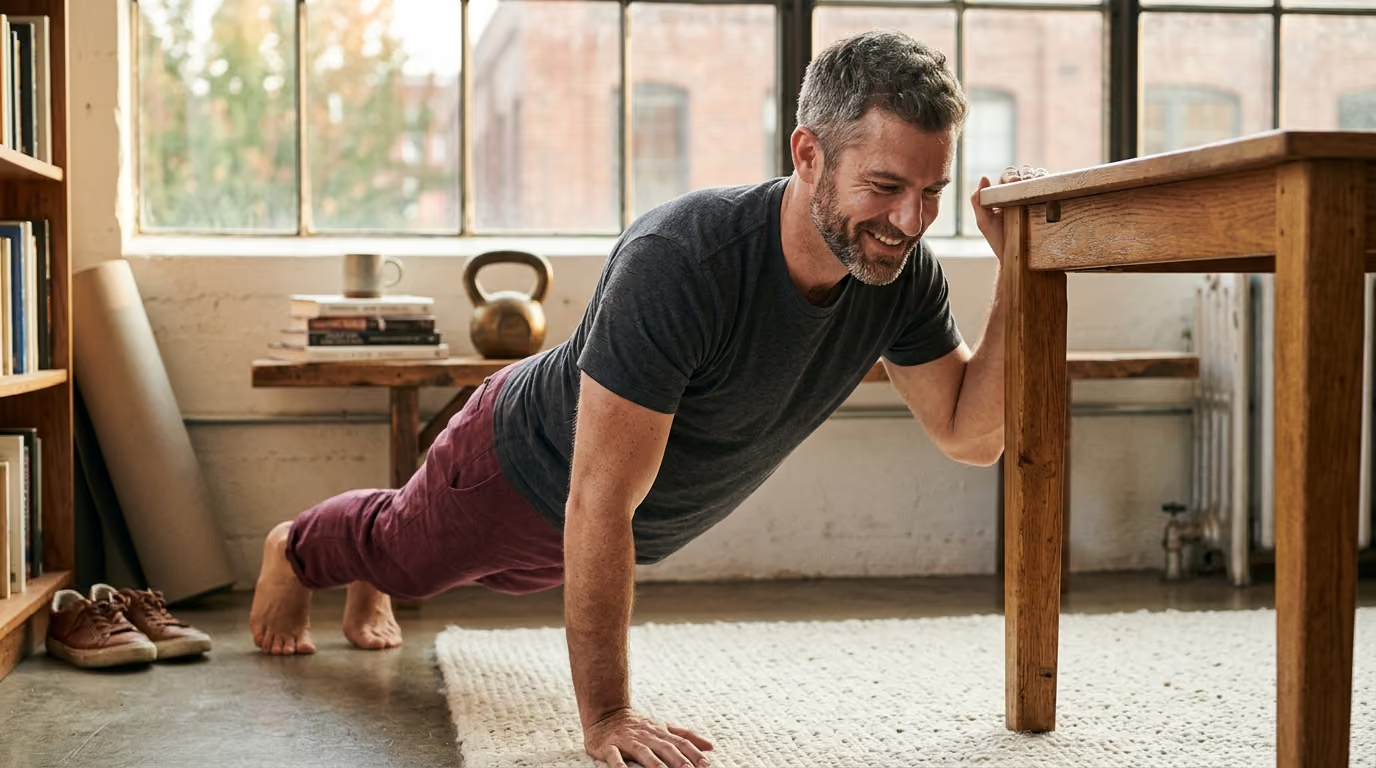
You can alter exercise difficulty dramatically by changing body position relative to gravity. Incline push-ups are easier because your hands are elevated. Floor push-ups increase resistance, while feet-elevated push-ups place even more of your body mass onto your chest and shoulders.
Increasing the distance a muscle travels under tension increases muscular work. Performing push-ups with your hands elevated on handles or blocks allows your chest to stretch deeper at the bottom. Performing lunges with your front foot elevated increases hip flexion and places greater stretch on your glutes.
Slowing down the lowering phase of a lift forces your muscle fibers to work harder. Lower your body over three to four seconds during a squat or push-up, pause for two seconds at the bottom stretch position, then explode upward. This technique increases time under tension without requiring extra weight.
Transitioning from two-legged movements to single-leg movements doubles the work required by the working leg. Unilateral exercises, such as Bulgarian split squats and single-leg Romanian deadlifts, demand deep stabilization from your hips and trunk while taxing target muscles heavily.
Proximity to failure measures how close you come to being unable to complete another repetition with good technique. Exercise scientists use Repetitions in Reserve (RIR) to measure this effort.
Research shows that muscle hypertrophy improves as sets are performed closer to failure (1 to 2 RIR). For minimal-equipment training, ending most working sets with one to two repetitions remaining ensures a high training stimulus without risking joint injury.
Reducing stability increases the demand on core and stabilizing muscles. Performing rows or chest presses on a suspension trainer requires your core, shoulders, and hips to stabilize your entire body against rotation, turning a standard press or row into an intense full-body movement.
If you cannot make an exercise heavier, you can increase your total weekly sets. Performing four sets of an exercise instead of three increases total training volume, providing a stronger signal for muscle retention and growth.
Training density refers to the amount of work completed within a specific timeframe. By reducing rest intervals from 90 seconds to 60 seconds between non-competing exercises, you force your metabolic systems to adapt, improving local muscular endurance and conditioning.
A complete strength program should be built around movement patterns rather than isolated muscles. Organizing your routine around these seven patterns ensures balanced development, joint stability, and complete muscle engagement. Explore detailed workout structures in our guide to strength, fitness, and body composition.
The squat pattern targets the quadriceps, glutes, and core. It builds lower-body power and supports knee and hip stability.
Step-by-Step Progression:
The hinge pattern targets the glutes, hamstrings, and lower back. It strengthens the entire back of your body, protecting your spinal posture.
Step-by-Step Progression:
The horizontal push pattern builds the chest, front shoulders, and triceps. It develops pressing strength and upper-body posture.
Step-by-Step Progression:
The horizontal pull pattern targets the upper back, rear shoulders, and latissimus dorsi. It balances pressing movements and restores proper shoulder alignment.
Step-by-Step Progression:
The vertical push pattern trains the shoulders, upper chest, and triceps. It improves overhead strength and shoulder health.
Step-by-Step Progression:
The vertical pull pattern targets the lats, biceps, and grip strength. It expands the back, building a wide upper body taper.
Step-by-Step Progression:
The core should be trained primarily to resist unwanted movement, protecting the lumbar spine while transmitting force between upper and lower limbs.
Step-by-Step Progression:
Selecting the right tools simplifies your training space and maximizes exercise options. You do not need a garage full of gear. A few well-made items are all you need.
Adjustable dumbbells offer clear, precise resistance tracking. They allow you to increase weight in small increments, which is ideal for pressing, rowing, lunging, and curling movements.
Loop resistance bands provide variable resistance, meaning tension increases as the band stretches. A systematic review published in medical literature demonstrated that elastic bands build muscle strength as effectively as conventional gym weight stack machines when sets are taken near failure.
Suspension trainers use bodyweight leverage. Changing your foot placement alters the percentage of body weight you pull or push, providing infinite resistance choices.
Bodyweight training requires no financial investment. You can increase bodyweight difficulty by altering your lever length, tempo, or range of motion. Backpacks stuffed with books or water bottles can add external weight to push-ups and squats.
To achieve results, your training must follow a structured schedule. The following routines organize movement patterns into balanced weekly templates.
This routine meets physical activity guidelines set by health organizations, fitting easily into busy travel or work schedules.
Day 1 and Day 2 (Non-consecutive days, e.g. Tuesday and Saturday)
This template is ideal for intermediate trainees wanting to build lean muscle mass while keeping training sessions under 45 minutes.
Schedule: Monday, Wednesday, Friday
Workout A
Workout B
Workout C
This split allows higher volume per muscle group while providing full recovery days.
Schedule: Monday (Upper A), Tuesday (Lower A), Thursday (Upper B), Friday (Lower B)
Upper Body A
Lower Body A
Upper Body B
Lower Body B
Proper nutrition supports performance and muscle recovery across all training templates. Read our complete editorial guide on nutrition and metabolism to optimize your daily protein and energy intake.
While minimal equipment can build an impressive, athletic physique, it has clear physiological boundaries. Honest exercise science requires acknowledging where minimal equipment reaches its limits.
First, developing elite maximal strength (such as a 500-pound deadlift or a 350-pound bench press) requires heavy external loads. Heavy barbell training trains neurological recruitment efficiency in ways that lighter bands or single-leg bodyweight movements cannot fully replicate. If your goal is powerlifting performance, minimal equipment serves only as a temporary or supplemental tool.
Second, absolute lower-body loading can eventually plateau for advanced trainees using minimal equipment. While single-leg split squats provide intense quadriceps stimulus, holding heavy dumbbells can eventually stress your grip or upper back balance before maxing out your leg muscles.
Third, commercial claims surrounding resistance bands can be misleading. Many band manufacturers label elastic bands with static weight equivalencies (e.g. "50 lbs of resistance"). In reality, a band only produces its maximum rated tension at full stretch. At the start of a rep, resistance is much lighter, altering the resistance curve compared to free weights.
Understanding these boundaries allows you to use minimal equipment effectively without falling for marketing hype. Minimal equipment excels at building functional strength, supporting lean muscle hypertrophy, improving joint resilience, and keeping you consistently fit for life.
Building physical strength does not require an iron-filled weight room or expensive gym machinery. By applying progressive overload, manipulating exercise leverage, controlling repetition tempo, and mastering foundational movement patterns, you can build an aesthetic, powerful, and resilient body anywhere.
Apply these action steps this week to kickstart your minimal-equipment strength routine:
To learn more about our editorial philosophy and research-led standards, visit about GayFitLab.
Stay connected for research-led guidance on fitness, body composition, skin, grooming, vitality, sexual wellbeing, relationships and healthy aging. Clear ideas for gay men 35+ who want to look good, feel strong and age with confidence.


Build habits and systems that support clear thinking, steady energy and long term capacity throughout a demanding career.
explore the Blog