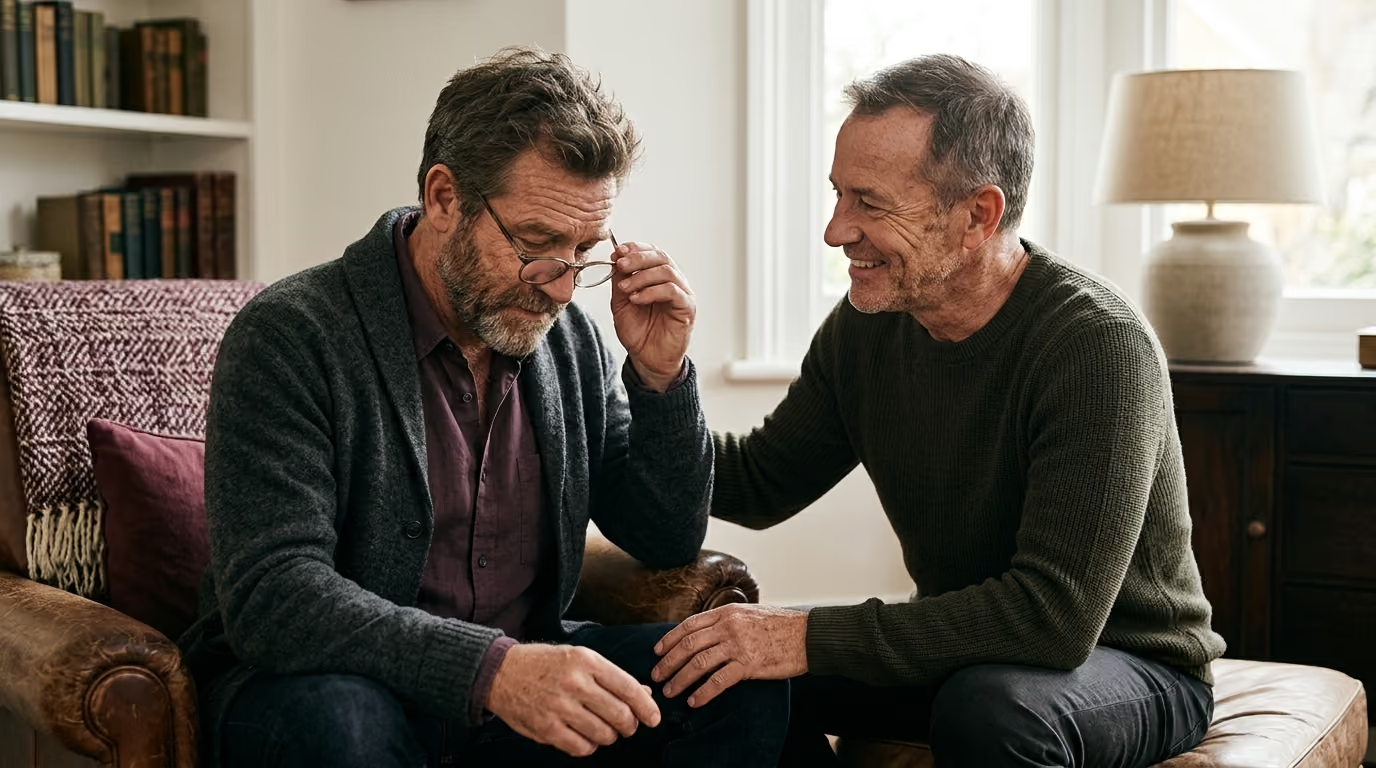

Stronger chosen family networks develop when gay men use research-backed frameworks to cultivate emotional support, practical infrastructure, and lifelong community bonds.





A friendship network is not a single intimate bond expected to satisfy every emotional, practical, and social requirement. It is a distributed ecosystem of distinct connections where different people provide companionship, practical assistance, validation, identity recognition, and crisis support.
Many gay men place unreasonable pressure on one primary partner or a single best friend. When that person cannot meet every demand, the entire support architecture can feel unstable.
Building chosen family requires moving away from the fantasy of an all-in-one relationship. True relational resilience comes from understanding different categories of friendship, mapping personal networks deliberately, and aligning daily expectations with actual human capacity.
Social relationship research demonstrates that interpersonal networks differ across structure, closeness, functional roles, and overall quality. A single person in your life may offer deep emotional intimacy while lacking the schedule or resources for practical assistance. Another person may be completely dependable during an emergency move or hospital discharge without ever becoming an emotional confidant.
Data examining sexual minority adults highlights distinct patterns in how gay men construct support systems. Research published in peer-reviewed journals shows that gay and bisexual men frequently rely on chosen families within LGBTQ+ communities to a greater degree than their heterosexual peers. In community studies comparing heterosexual and sexual minority adults, heterosexual individuals and lesbian women often relied on families of origin for major assistance, such as substantial financial loans. Gay and bisexual men relied far more heavily on friends for those critical safety nets.
Support within these networks is multi-dimensional rather than a uniform resource. Sociological and psychological literature breaks social support down into specific categories:
This includes active listening, empathy, validation, comfort, and emotional regulation during distress. A study of 166 gay men recruited through community organizations indicated that the most frequent and supportive network member was usually a close friend. Emotional support was the most common form of assistance exchanged within these networks.
This involves guidance on navigating healthcare systems, recommendations for affirming medical providers, career advice, and shared strategies for handling minority stress. It provides practical knowledge that helps individuals navigate specific life challenges without having to educate their peers first.
This consists of tangible, logistical, or physical aid. Examples include rides home from surgical procedures, help moving apartments, pet care during travel, meal preparation during illness, or emergency financial backing. Instrumental support requires explicit coordination and clear boundaries regarding time and capacity.
This encompasses shared activities, fitness routines, creative projects, dining, and nightlife. Companionship provides vital structure, play, and joy without demanding deep psychological disclosure or heavy crisis management.
For sexual minorities, identity affirmation involves being recognized accurately without needing to hide personal history, mannerisms, or relationship structures. Research indicates that being able to live completely openly within one's personal network is a primary indicator of network quality and psychological well-being. Supportive friendships also function as a measurable buffer against minority stress, softening the negative emotional impact of external stigma and prejudice on difficult days.
Entering midlife introduces significant shifts in how gay men navigate their social worlds. In earlier decades, social life often revolves around shared spaces, nightlife density, geographic concentration in urban gay neighborhoods, and rapid network expansion. As men move past 35, professional responsibilities, relationship commitments, relocations, and changing health priorities naturally alter the tempo of social interaction.
Social networks often undergo a natural pruning process during this stage of life. Research on friendship trajectories across the lifespan indicates that adults gradually prioritize emotional depth and relationship quality over pure network size. For gay men, this phase frequently coincides with a conscious re-evaluation of scene-based connections that were held together purely by proximity or shared recreation.
Physical vitality, recovery speeds, and long-term wellness also begin to influence social routines. Developing sustainable habits around sleep, movement, and nutrition often makes late-night socializing less appealing. You can read more about maintaining baseline physical resilience in our guides on longevity and healthy aging strategies.
At the same time, midlife can reveal structural vulnerabilities in a man's support network. Gay men are statistically more likely to live alone and less likely to have children than their heterosexual counterparts. When parents age or pass away, the absence of a traditional family safety net becomes acute.
This reality makes the intentional cultivation of a robust chosen family after 35 a practical necessity rather than an optional social luxury. Building mutual aid systems, establishing durable emergency contacts, and creating lasting holiday traditions require deliberate planning.
The phrase chosen family is widely used in LGBTQ+ culture, yet it is often conflated with casual friendship or broad community popularity. A bustling social calendar filled with circuit parties, dinner parties, and professional contacts does not constitute a family. Conflating social visibility with durable support is one of the most common causes of isolation among adult gay men.
Chosen family can be understood across three operational dimensions:
This is the psychological acknowledgment that specific people hold the status of family in your internal world. It reflects deep affection, shared history, and mutual recognition. You view them as your primary kin, particularly if your family of origin is absent, unsupportive, or emotionally unsafe.
This dimension is defined by consistent, observable behavior over extended periods. Chosen family in practice involves showing up for routine milestones, participating in shared holiday traditions, and offering practical care during ordinary life events. It is defined by what people do rather than what they say.
This is the most demanding and critical dimension of chosen family. Infrastructure means that these individuals are integrated into your crisis, legal, and long-term care plans. They hold keys to your home, know your medical directives, serve as designated emergency contacts, and coordinate logistics when health challenges arise.
A friend can occupy one of these dimensions without occupying the others. Someone may feel like a brother in conversation yet lack the logistical stability or geographic proximity to provide post-operative care. Recognizing these distinctions prevents unfair expectations and protects both parties from avoidable resentment.
To build a resilient network, you must understand what individual relationships can realistically hold. Expecting a gym buddy to manage your existential grief creates friction. Expecting an emotionally attuned confidant to also handle physical labor can strain a deep connection.
This taxonomy outlines eight distinct relationship types, their primary functions, and their reasonable boundaries.
The intimate confidant is the person you turn to for emotional disclosure, vulnerability, identity processing, and deep reflection. They understand your personal history, your insecurities, and your core values.
Anchors provide long-term continuity, mutual obligation, shared holiday traditions, and foundational life security. They are committed to remaining in your life across decades and evolving life stages.
This friend shares specific cultural, sexual, racial, or gender-affirming reference points. They offer an intuitive understanding of the gay experience, minority stress, or intersectional dynamics without requiring baseline explanations.
Activity partners are organized around shared hobbies, physical training, creative interests, or specific routines. They bring energy, accountability, and fun to your weekly schedule.
These friends populate your wider social circle. You see them at community events, professional mixers, dinner parties, fundraisers, and seasonal gatherings.
Practical allies are friends and neighbors with whom you maintain clear, transactional, or logistical reciprocity. They are dependable for specific, well-defined tasks.
Mentors and elders offer historical perspective, professional wisdom, relational guidance, and intergenerational connection. They provide living models of healthy aging and resilience.
Many gay men maintain meaningful friendships with former partners. These relationships often retain deep affection, shared history, and integrated social circles.
To learn more about navigating adult connection, read our detailed work on cultivating confidence and mature relationships.
Developed by social scientists, the Convoy Model of Social Relations offers a structured method for assessing personal networks. Rather than viewing relationships as a simple binary of close friends versus acquaintances, the convoy model conceptualizes your social world as concentric circles of varying intimacy, function, and responsibility.
This innermost circle contains the few individuals who know you intimately and are directly involved in your fundamental life security. They are your primary emergency contacts, your healthcare proxies, and the people you call during acute grief or profound life changes. Membership in this ring requires proven continuity, high trust, and explicit mutual consent.
The second ring consists of trusted friends with whom you share meaningful emotional vulnerability and recurring support. You turn to them to process relationship challenges, work stress, and personal aspirations. While they are vital to your mental health, they do not necessarily hold operational keys to your life infrastructure.
The third ring includes your activity partners, gym buddies, colleagues, and recurring social groups. These relationships provide essential social stimulation, routine, and joy. They protect you from isolation and connect you to the wider world without requiring deep emotional exposure.
The outermost ring contains neighbors, acquaintances, service providers, former colleagues, and online connections. While interactions here may be brief or infrequent, outer ties provide novel information, diverse viewpoints, and unexpected assistance during specific situations.
A healthy network does not cram every friend into Ring 1. Moving relationships into their appropriate rings based on demonstrated behavior creates clarity, reduces interpersonal strain, and reveals genuine gaps in your support system.
Building chosen family is rarely a linear process. Gay men often navigate specific systemic and relational hurdles that can undermine network stability if left unaddressed.
Relying entirely on one partner or one best friend to fulfill all emotional, social, practical, and physical needs is inherently precarious. If that individual experiences burnout, relocates, enters a consuming relationship, or faces an illness, your entire emotional foundation collapses. Diversification is a necessary safeguard for emotional health.
Assuming that shared sexual identity guarantees automatic safety, trust, and shared values is a frequent mistake. LGBTQ+ spaces can still harbor racism, classism, body shaming, and ageism. Trust must be earned through consistent individual behavior over time, not assumed based on identity labels alone.
Using family language to bypass healthy personal boundaries creates dysfunction. Chosen family does not mean unlimited financial bailouts, constant emotional availability, or tolerating chronic disrespect. Healthy chosen families maintain clear boundaries and respect personal limits.
Many networks excel at emotional processing and lively social gatherings but completely fall apart during practical crises. A network that cannot provide a ride home from an outpatient procedure or coordinate basic meals during an injury is functionally incomplete. Practical dependability is just as valuable as emotional warmth.
For a deeper exploration of our philosophy on evidence-based health and community development, visit our overview of the GayFitLab mission.
To transform these concepts into actionable habits, you must evaluate your current social network with clear eyes. A capacity audit identifies where your support architecture is strong and where hidden vulnerabilities exist.
Review your current contacts and answer these specific diagnostic questions:
High-stakes life needs require structural redundancy. Relying on a single person for vital functions creates unnecessary risk. For critical support needs, identify:
Clarifying expectations does not require intense, confrontational conversations. Clear, polite communication sets healthy boundaries and establishes mutual understanding naturally.
> "I want to support you through this, but I have had a draining week and cannot offer good advice right now. Can we talk about this on Saturday when I have full focus?"
> "I cannot assist with your physical move this weekend due to prior commitments. I am happy to help you order lunch for the crew that day instead."
> "I am updating my emergency contact information at my clinic this week. Would you be comfortable being listed as a secondary contact for logistics?"
> "What you are carrying right now is really heavy, and it deserves specialized support. Let us look up some affirming therapists or resources together who can help navigate this."
If you want to explore more resources on personal growth, check out our comprehensive collection of relationship and community guides.
While existing literature on social support and sexual minority health is robust, important gaps remain. Understanding the limitations of current research prevents sweeping generalizations and allows for a more nuanced perspective.
Much of the foundational research on gay social networks relies on cross-sectional surveys and convenience sampling. Studies are frequently conducted within major urban centers with visible LGBTQ+ institutions. Gay men living in rural, suburban, or culturally conservative environments often face entirely different structural conditions that require unique social adaptations.
Additionally, demographic data frequently groups all sexual and gender minorities together under broad umbrellas. This aggregation can mask significant disparities.
Research from the Centers for Disease Control and Prevention indicates that rates of loneliness and lack of emotional support vary significantly across sexual orientation, gender identity, and socioeconomic status. Bisexual and transgender individuals frequently report higher levels of social isolation than cisgender gay men.
Economic security also plays a massive, often under-studied role in network stability. Building chosen family requires time, leisure, emotional energy, and residential stability.
Men navigating financial strain or housing insecurity face distinct barriers to establishing durable mutual aid networks. Current research is only beginning to account for these intersectional economic realities.
Yes, many gay men successfully integrate former partners into their long-term chosen families. Success requires an intentional transition period with clear emotional and physical boundaries. The relationship must transition away from romantic entitlement, jealousy, and sexual expectations into stable, platonic mutual support.
If your closest friends are long-distance, manage chronic health conditions themselves, or work demanding schedules, acknowledge these limitations without assigning blame. Build local practical alliances with neighbors, join community mutual-aid groups, and integrate professional resources into your care plans. Do not expect emotional closeness to automatically translate into physical availability.
Focus on recurring, low-pressure shared activities rather than seeking immediate best friends. Join masters swimming programs, running clubs, volunteer organizations, or creative workshops where repeated exposure happens naturally. Allow connections to move gradually through the convoy rings based on observed consistency over time.
Yes. Biological family and chosen family are not mutually exclusive. Many gay men maintain warm relationships with affirming biological relatives while relying on chosen family for identity-specific understanding and daily companionship. The goal is to cultivate authentic, safe support wherever it genuinely exists.
The most resilient gay friendship networks are built with intention, realistic expectations, and clear functional boundaries. When you stop asking one person to be your entire world, you create the space to construct a lasting, dependable chosen family.
Stay connected for research-led guidance on fitness, body composition, skin, grooming, vitality, sexual wellbeing, relationships and healthy aging. Clear ideas for gay men 35+ who want to look good, feel strong and age with confidence.


Build habits and systems that support clear thinking, steady energy and long term capacity throughout a demanding career.
explore the Blog