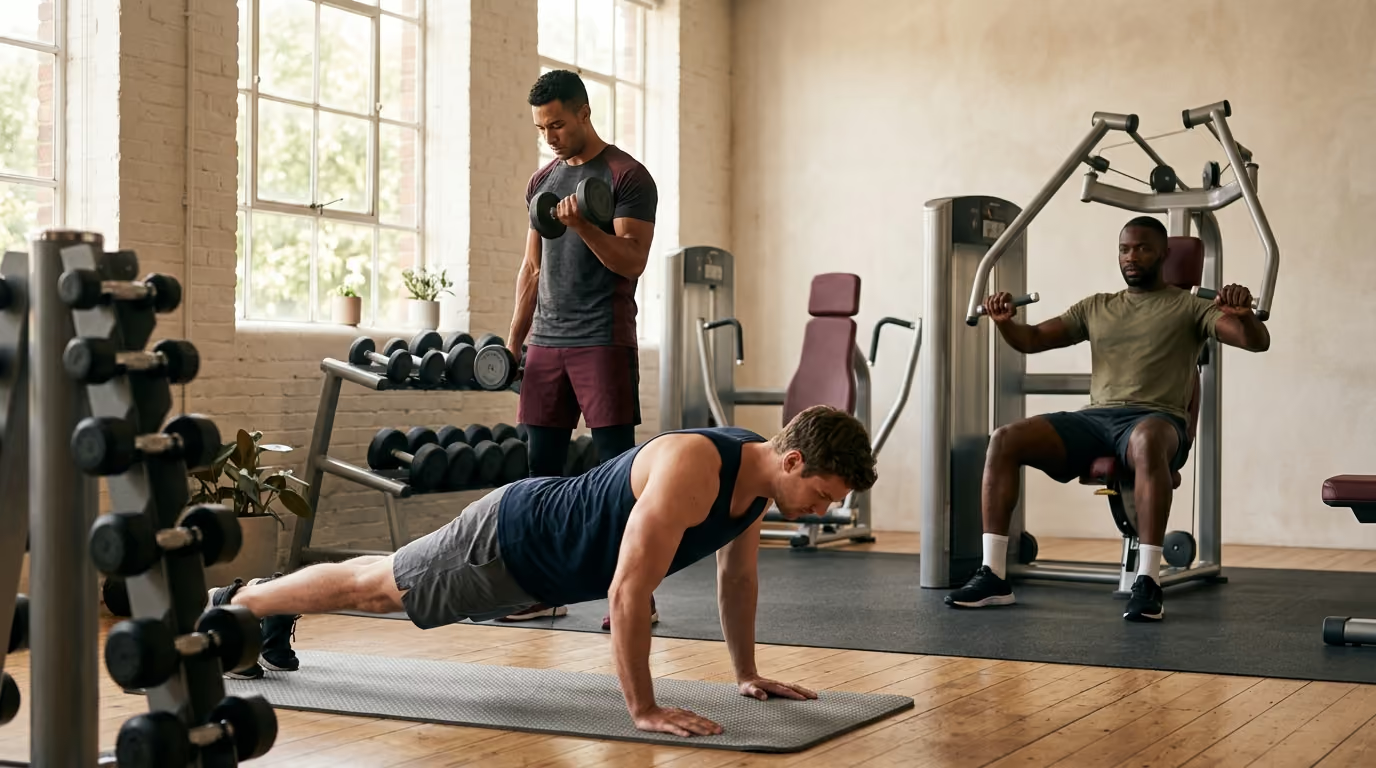

Maximum muscle growth and strength adaptations require choosing the ideal balance of free weights, resistance machines, and bodyweight movements for your specific training goals.





Many men enter a search bar looking for a direct answer to a simple question: should you train with free weights, machines, or your own bodyweight? Fitness culture often turns this question into a tribal debate. Some lifters claim that barbells and dumbbells are the only tools for real muscle. Others insist that modern selectorized machines are superior for joint health and hypertrophy, while calisthenics enthusiasts argue that bodyweight control is the purest test of functional capability.
The scientific literature offers a clear and liberating resolution. Controlled research demonstrates that your muscular system does not possess eyes to see what equipment you are holding. Muscles respond to mechanical tension, total volume, proximity to muscular fatigue, and range of motion. Barbells, dumbbells, cables, selectorized machines, kettlebells, and bodyweight movements are simply distinct delivery systems for mechanical tension.
Each modality brings distinct mechanical properties, neuromuscular demands, and practical advantages. Choosing the right tool requires matching equipment to your specific training goals, joint structure, schedule, and personal environment. This comprehensive resource compares every major resistance training tool across hypertrophy, maximal strength, joint health, and long-term consistency.
To understand why different training tools produce comparable muscular development, you must separate the internal stimulus from the external tool. Resistance exercise forces skeletal muscle fibers to produce force against an opposing load. When a muscle fiber contracts with high effort through an adequate range of motion, mechanosensors inside the cell trigger intracellular signaling pathways that drive muscle protein synthesis.
Systematic reviews and meta-analyses examining free weights versus machine-based training reveal no statistically significant difference in muscle hypertrophy when volume and effort are equated. A comprehensive 2023 meta-analysis showed that both modalities stimulate equivalent muscle growth across upper and lower body muscle groups. Whether you perform a barbell back squat, a 45-degree leg press, or a challenging single-leg split squat, the quadriceps experience high levels of tension provided the set is performed close to muscular fatigue.
Hypertrophy is remarkably load-independent across a broad spectrum of intensities. Meta-analytic data indicate that training with light loads between 30 percent of one-repetition maximum and heavy loads up to 85 percent of one-repetition maximum produces comparable muscle size gains when sets are carried near volitional failure. The primary variable governing muscle size is accumulating enough challenging, high-quality sets per week rather than the specific type of metal or lever in your hands.
Where equipment choice matters most is in the specificity of maximal strength adaptations. The principle of specificity dictates that neuromuscular coordination, balance, and motor skill develop most effectively within the exact movement pattern trained. Trainees who practice heavy barbell bench pressing display greater strength gains when tested on a barbell bench press. Trainees who train on a chest press machine achieve superior strength gains when tested on that machine. Strength is a coordinated neural skill as much as an expression of muscular size.
Weekly training volume also follows a graded dose-response relationship. Higher weekly set numbers per muscle group correlate with greater hypertrophy up to the limits of individual recovery capacity. World Health Organization guidelines and the American College of Sports Medicine recommend that adults engage in multi-joint muscle-strengthening activities at least two days weekly. Trainees exploring our strength and body composition resources will find that structuring these weekly sets around accessible, repeatable equipment produces the most reliable long-term adaptations.
Free weights represent any implement whose path of motion is completely unconstrained by an external track, cable, or lever arm. The lifter must balance, stabilize, and guide the resistance through three-dimensional space while producing force against gravity. This freedom of movement creates distinct mechanical benefits alongside specific physical demands.
Barbells are the gold standard for applying high external loads across bilateral compound movements. Because both hands or feet interact with a single rigid bar, balance demands are distributed symmetrically, allowing lifters to handle heavier absolute loads than with independent implements. Small incremental weight plates allow precise, measurable micro-loading over months and years.
This efficiency makes the barbell exceptionally valuable for developing absolute whole-body strength in foundational patterns such as the deadlift, back squat, overhead press, and barbell row. Barbells recruit substantial stabilizing musculature throughout the trunk, hips, and upper back to maintain structural posture under heavy axial loading.
The rigid structure of a barbell also represents its primary mechanical drawback. A straight bar locks both wrists, elbows, and shoulders into a fixed geometric relationship. For lifters with asymmetrical shoulder mobility, carrying angles, or previous wrist injuries, forcing the body into a rigid barbell path can create unnecessary joint stress. Barbells also demand dedicated setup infrastructure, including power racks, platforms, and safety spotter arms to train safely near muscular failure.
Dumbbells provide two independent loads, requiring each limb to stabilize and lift its own weight without assistance from the dominant side. This unilateral independence exposes and corrects side-to-side strength imbalances before they become pronounced movement compensations. Dumbbells also allow continuous rotational freedom at the wrist, elbow, and shoulder joints throughout the repetition.
This rotational freedom makes dumbbells exceptionally accommodating for trainees managing chronic joint sensitivity. During a dumbbell chest press or overhead press, you can use a neutral or semi-pronated grip and alter the convergent pressing path to fit your individual shoulder anatomy. Dumbbells also permit a deeper stretch at the bottom of pressing and rowing movements compared to straight bars that collide with the torso.
The practical limitation of dumbbells lies in handling mechanics and progression increments. Getting heavy dumbbells into position for incline presses or hip thrusts can consume substantial energy and challenge shoulder stability before the set begins. In many gym environments, dumbbell increments increase by five-pound jumps per hand, which represents a large percentage leap on smaller upper-body isolation exercises. Grip strength can also fail on heavy dumbbell lunges or rows before the targeted lower-body or back muscles reach full fatigue.
Kettlebells feature a displaced center of mass that hangs several inches below the handle. This offset geometry makes kettlebells uniquely suited for dynamic, ballistic hip-hinge patterns, fluid transitions, and offset loaded carries. Movements like kettlebell swings, cleans, and snatches develop explosive hip extension and high rates of force development.
Systematic reviews evaluating kettlebell training show moderate evidence for improvements in explosive power, functional grip strength, and dynamic postural stability. Kettlebell swings offer a low-impact method for training the posterior chain with rapid acceleration and deceleration cycles. The offset weight also challenges core anti-rotation and lateral stabilization during unilateral carries and Turkish get-ups.
Kettlebells should not be viewed as a standalone replacement for traditional heavy loading or aerobic conditioning. Research demonstrates that kettlebell circuits do not reliably elicit the central cardiovascular adaptations produced by dedicated endurance training. Ballistic kettlebell movements require dedicated technical practice, spatial awareness, and mobile hips to prevent lumbar compensation. Kettlebells excel as tools for power, conditioning, and dynamic stability, but they remain less precise than barbells or machines for isolated muscle hypertrophy.
Resistance machines and cable systems provide external stabilization and guided force vectors. By removing or modifying the need to balance an unconstrained object against gravity, these tools alter how mechanical tension is applied to target muscles.
Fixed-path machines use rigid lever arms, cams, and tracks to constrain movement to a predetermined arc or linear path. This design dramatically lowers the balance, stabilization, and motor coordination requirements of an exercise. The primary benefit of this stability is the ability to direct mechanical tension onto the targeted muscle group with minimal technical interference.
Machines allow trainees to train close to muscular failure with high psychological security. If your quadriceps reach failure during a leg press or hack squat, you can simply engage the safety catches without risk of being pinned under a bar. This makes machines valuable for accumulating local muscular volume and metabolic fatigue without taxing systemic recovery or risking technical breakdown under load.
A common misconception is that machines are inherently safer for every lifter. Because fixed-path machines enforce a single geometric trajectory, they may not align with an individual lifter's limb lengths, hip socket orientation, or joint kinematics. If a seated chest press or shoulder press machine forces your joints into an unnatural movement arc, repetitive loading can cause joint discomfort. Modern plate-loaded machines with converging or diverging axes offer improved biomechanical alignment, but seat positioning and joint axis alignment remain critical.
Cable systems occupy a versatile middle ground between fixed machines and free weights. A cable delivers resistance through a pulley connected to a weight stack, allowing the direction of resistance to come from any chosen height, angle, or plane. Unlike free weights, where the resistance vector is dictated purely by downward gravity, cables allow horizontal, diagonal, and rotational force applications.
This capability alters the internal resistance profile of an exercise. During a dumbbell lateral raise or chest flye, mechanical tension is minimal at the bottom of the movement and peaks sharply at the top. A cable allows you to maintain continuous tension throughout the entire range of motion, loading the target muscle heavily in its lengthened, mid-range, or shortened position depending on pulley height.
Cables are exceptionally valuable for unilateral exercises, rotator cuff conditioning, standing rotational work, and upper-body isolation movements. They allow lifters to fine-tune joint angles and hand positions to navigate around minor aches and pains. The main constraints of cable systems are gym availability during peak hours and maximum stack weight limits on certain multi-joint compound rows or presses.
Bodyweight training utilizes your own mass acting against gravity through varying leverage, angles, and limb placements. Calisthenics ranges from basic foundational movements like floor push-ups and bodyweight squats to advanced gymnastic variations like ring dips, strict pull-ups, and handstand push-ups.
A persistent fitness myth suggests that bodyweight training is useful only for muscular endurance and cannot stimulate meaningful hypertrophy. Peer-reviewed studies comparing progressive push-up variations to barbell bench pressing demonstrate equivalent gains in muscle thickness and strength when relative loading and effort are matched. By altering body angles, elevating the feet, using gymnastic rings, or transitioning to unilateral variations, you can place high mechanical tension on target muscle fibers.
Bodyweight training offers unmatched convenience, portability, and functional utility. It requires minimal financial investment and can be performed in hotel rooms, public parks, or home environments. Calisthenics movements naturally integrate trunk stabilization, scapular control, and kinesthetic body awareness. Exercises like pull-ups and dips load upper-body musculature through natural, joint-friendly paths of motion that accommodate your unique skeletal frame.
The primary mechanical limitation of bodyweight exercise is the difficulty of applying precise, incremental progressive overload. With free weights or machines, adding two pounds to a movement requires sliding a small plate onto a sleeve or moving a selector pin. In calisthenics, increasing resistance requires changing movement geometry, altering limb leverage, shifting to single-limb variations, or wearing a weighted vest.
Progressing from a standard push-up to an archer push-up or single-arm push-up represents a massive jump in loading intensity rather than a gradual step. This steep progression curve can make it challenging for intermediate lifters to find the exact resistance that corresponds to their target repetition range.
Lower-body development presents another clear challenge for calisthenics. While single-leg pistol squats, step-ups, and sissy squats can challenge the quadriceps, the human legs are powerful structures that quickly adapt to moving body mass alone. Achieving high levels of absolute posterior chain strength and glute hypertrophy without external loading is difficult over years of continuous training. A well-rounded calisthenics program often requires adding external loads to lower-body movements or incorporating pull-up bars and suspension straps for adequate upper-body pulling volume.
As men pass age 35, physiological changes alter how the body responds to mechanical loading and recovers from training sessions. Normal aging involves gradual shifts in collagen cross-linking within tendons, reduced cellular hydration in articular cartilage, and subtle decreases in the rate of muscle protein synthesis. These shifts do not mean you should avoid hard training. They simply require a more deliberate selection of training tools.
Tendon remodeling occurs more slowly than muscular adaptation. When a 40-year-old trainee experiences rapid strength gains, muscular force output can outpace the tensile capacity of tendons if loading is progressed too aggressively. Free-weight compound movements that place heavy passive stretch on tendons at extreme joint angles can trigger stubborn tendinopathy if volume and intensity are not carefully managed.
Machines and cables become increasingly valuable after 35 because they provide stable loading profiles that reduce shear stress across sensitive joints. A seated chest press or cable row allows a lifter to drive a muscle close to failure without demanding extreme stabilization from fatigued rotator cuff tendons or the lumbar spine. Incorporating both free weights and supported machines allows mature lifters to stimulate maximum muscular growth while managing joint wear.
Research on training range of motion demonstrates that full-range repetitions generally produce superior hypertrophy and strength adaptations compared to partial repetitions, particularly for the lower body. However, forced range of motion that causes sharp or persistent joint discomfort is counterproductive. Controlled, pain-free full range of motion that respects individual hip anatomy, ankle mobility, and shoulder mechanics preserves joint longevity while optimizing muscle retention.
Balancing training stress across different modalities protects against repetitive strain injuries. If barbell pressing irritates an anterior shoulder capsule, switching to neutral-grip dumbbells or an adjustable cable crossover preserves the hypertrophic stimulus while allowing irritated connective tissue to heal. Prioritizing joint comfort ensures that resistance training remains a lifelong contributor to longevity and healthy aging.
Resistance training is rarely practiced in a sterile laboratory environment. The choice of equipment interacts directly with daily schedules, body confidence, gym culture, and personal aesthetic goals.
For many gay men over 35, the commercial gym floor can be a complex social environment. Peak-hour gym spaces are often dominated by crowded free-weight zones, bench hoarding, and unspoken social posturing. Navigating these spaces can create unnecessary friction or self-consciousness for novices, men returning from a long training hiatus, or those who prefer an efficient, low-distraction workout.
Understanding equipment equivalence allows you to design workouts that fit your comfort level and schedule. If the free-weight area is overcrowded, or if you feel uncomfortable setting up a barbell squat rack, selectorized machines, cable stations, or a dedicated dumbbell corner offer an identical hypertrophic stimulus. You never need to feel that using machines represents a compromise in training seriousness.
Aesthetic priorities often focus on balanced upper-body proportions, broad shoulders, upper-chest fullness, and defined glutes and back musculature. Achieving these visual proportions requires strategic exercise selection across multiple equipment types:
Cultivating physical strength and physical vitality directly supports personal confidence and body image. Furthermore, maintaining lean muscle mass, systemic insulin sensitivity, and healthy cardiovascular circulation through resistance training forms the physiological foundation for sustained physical vitality and sexual wellbeing. The best equipment setup is the one that allows you to train with focus, consistency, and psychological ease.
Rather than adhering to rigid fitness dogmas, use this structured six-question framework to select the optimal equipment for any exercise in your training program.
A balanced weekly resistance training routine should be organized around fundamental human movement patterns rather than specific equipment labels. A time-efficient weekly plan incorporates at least one exercise from each of the following categories:
Understanding how each tool functions across different training scenarios helps you assemble an effective program.
Free weights deliver unconstrained movement paths and bilateral loading efficiency. They excel at building maximal absolute strength, establishing heavy multi-joint baseline capacity, and developing independent limb control.
Their primary limitations include high balance and stabilization demands that can limit target muscle fatigue, steep learning curves for complex lifts, and the need for spotters or safety racks during heavy sets taken near failure.
Best practical applications:
Machines provide rigid or guided lever arms that minimize balance demands. They excel at isolating specific muscle groups, accumulating local muscular volume, and allowing safe training all the way to volitional muscular failure without spotters.
Their primary limitations include fixed geometric movement paths that may not fit every lifter's skeletal frame, higher gym membership or equipment costs, and minimal transfer to unconstrained three-dimensional balance tasks.
Best practical applications:
Cables offer externally guided resistance combined with continuous tension angles and rotational freedom. They excel at matching muscle resistance profiles throughout the entire range of motion, accommodating sensitive joints, and enabling single-arm or single-leg variations.
Their primary limitations include equipment availability during busy gym hours, potential weight stack maximums on heavy compound exercises, and minor setup time required to adjust pulley heights and attachments.
Best practical applications:
Bodyweight training relies on moving body mass against gravity using leverage adjustments. It excels at developing upper-body pulling and pressing relative strength, improving core stability, and enabling workouts anywhere without equipment.
Its primary limitations include difficult progressive micro-loading, complex leverage adjustments for intermediate trainees, and significant challenges in providing heavy loading for lower-body posterior chain development.
Best practical applications:
While current exercise science provides robust principles for program design, several methodological limitations in the literature warrant transparent consideration.
Most published studies comparing free weights, machines, and bodyweight training feature relatively short intervention periods lasting between 6 and 12 weeks. While this duration is sufficient to measure initial muscular hypertrophy and neural strength adaptations, it cannot capture multi-year outcomes. Long-term training trajectories involve progressive tendon adaptations, connective tissue tolerance, and cumulative fatigue that short-term studies cannot fully evaluate.
A substantial portion of resistance training literature is conducted on young, untrained college-aged men. Although the fundamental physiology of muscle protein synthesis and mechanical tension remains constant across the lifespan, older adults and highly trained individuals exhibit different recovery rates, tendon elasticity, and joint wear patterns. Research specifically examining resistance training modalities in athletic populations over age 40 remains more limited.
Many studies equate volume between modalities using arbitrary formulas based on total load multiplied by repetitions. This calculation can misrepresent true internal muscular strain. A 200-pound machine leg press does not impose the same systemic, spinal, or muscular demands as a 200-pound barbell back squat due to mechanical leverage, pulley friction, and torso incline. Meta-analytic findings indicate broad equivalence for muscle growth, but direct 1-to-1 mechanical translations between specific tools should be interpreted with practical nuance.
Finally, commercial fitness marketing frequently exaggerates the unique benefits of proprietary equipment, functional training trends, or minimalist calisthenics programs. Trainees should remain skeptical of claims asserting that any single tool is mandatory for building an attractive, strong, and healthy physique.
Muscles respond to mechanical tension and progressive effort, making free weights, machines, cables, and bodyweight movements equally capable of building muscle and physical vitality over time.
Stay connected for research-led guidance on fitness, body composition, skin, grooming, vitality, sexual wellbeing, relationships and healthy aging. Clear ideas for gay men 35+ who want to look good, feel strong and age with confidence.


Build habits and systems that support clear thinking, steady energy and long term capacity throughout a demanding career.
explore the Blog