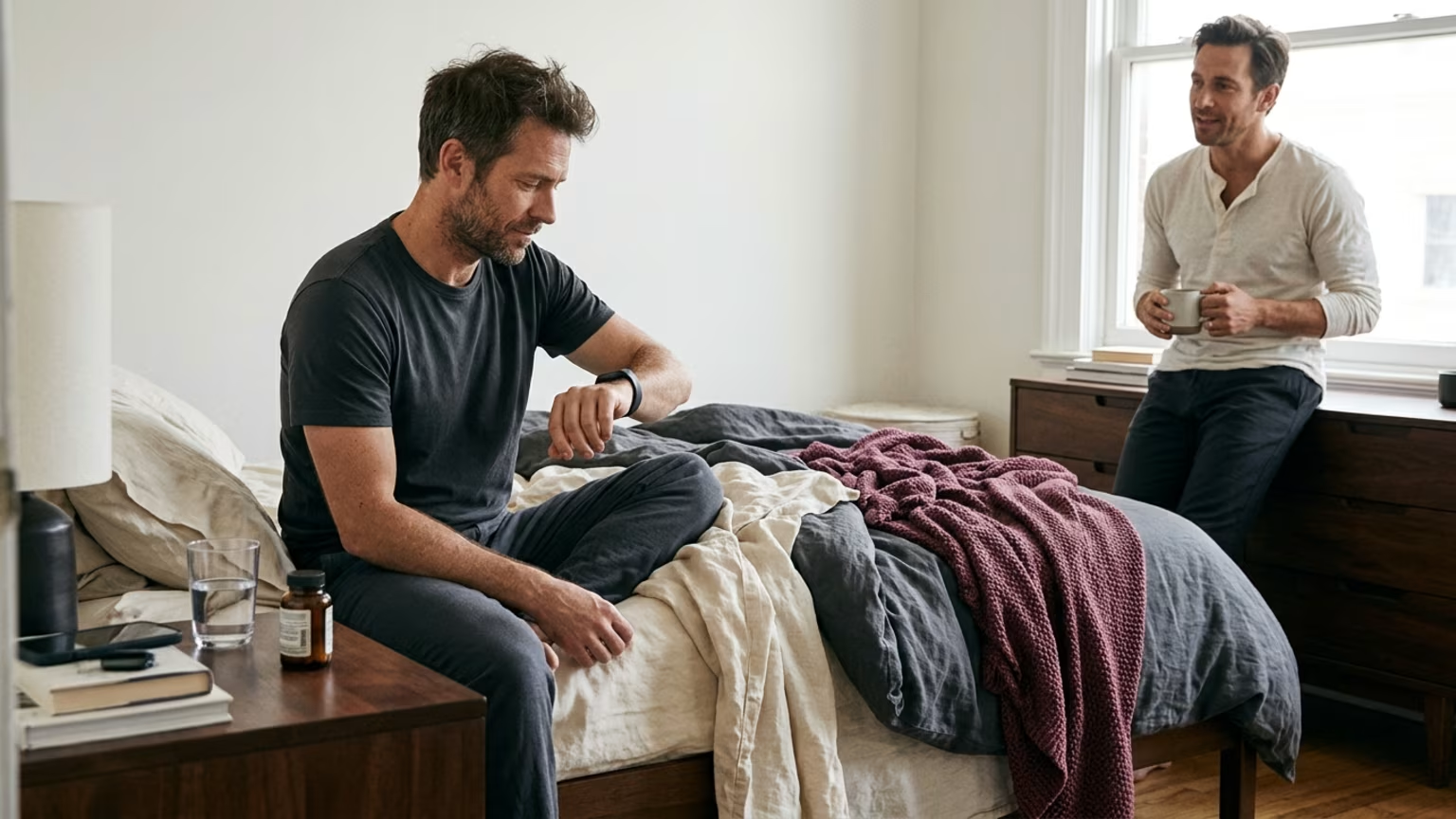

Yale’s sleep discussion puts tracker scores and supplements in context, with practical guidance on screening, symptoms and recovery after 35.





On October 29, 2026, Yale School of Management’s Health & Veritas published “The Science of Better Sleep with Christine Won” featuring the Yale School of Medicine sleep specialist. Yale’s episode description says the discussion covered sleep quality and why trackers and supplements may do more harm than good.
The useful message is not that every wearable belongs in a drawer or that every supplement is harmful. The evidence supports a more selective approach:
Yale’s public episode page does not provide a transcript supporting detailed recommendations from Won about particular products or sleep targets. Its resource list points toward related subjects rather than establishing that she endorsed every linked conclusion.
The watch finding concerns a specific device and condition, not every wearable score or sleep disorder. The sleep-duration recommendation is a population guide rather than a guarantee of restorative sleep. The melatonin information here comes through secondary reporting rather than an independently checked NCCIH page.
For a man over 35 refining his recovery routine, the practical shift is to assign each piece of information a clear role. A score can start a question. It should not settle a medical question by itself.
The smartwatch study shows why dismissing all consumer technology would miss something useful. A device studied for a defined screening purpose may flag a reason to seek assessment. That is a meaningful function without making the watch the final authority on someone's health.
The next step is to identify what the device is actually reporting. An alert about a possible breathing problem and a general nightly score should not be treated as interchangeable. The AASM evidence supports a specific screening application, not an assumption that every number on the same screen has the same clinical meaning.
This also changes how to think about a disappointing result. The editorial approach supported by these sources is to place the score beside your experience of sleep and daytime functioning. There is no need to turn a single dashboard result into a verdict on your recovery routine.
Useful data should help clarify a question: Is there a recurring concern worth discussing? That is a better purpose than making the number itself the goal.
A practical routine can stay modest: notice how sleep feels over time and how you function during the day. Keep tracker information as context for that account. This is editorial guidance drawn from the evidence, not a protocol attributed to Won.
The distinction matters when your experience and the device disagree. A reassuring score should not be used to dismiss persistent concerns. A disappointing score should not automatically become a reason to add a product or assume that something is medically wrong.
Instead of asking only whether the number improved, ask what you are trying to understand. Perhaps sleep continues to feel inconsistent. Perhaps the concern is daytime functioning. Those are clearer starting points for a conversation than a broad claim that your recovery is failing.
For men who train, appearance and physical performance can remain valid goals without becoming the only measures of a worthwhile routine. Feeling capable at work and having room for relationships also belong in the picture. Our guide to making recovery part of adult life offers a broader editorial frame.
The point is not to abandon measurement. It is to keep measurement connected to the concern that made you start tracking.
The AASM’s recommendation gives adults a useful reference point: regularly sleep seven or more hours. It does not turn a reported duration into a complete assessment of sleep quality.
For daily decision-making, duration and symptoms belong in the same conversation. Reaching the population recommendation does not answer every question about how sleep feels or whether a recurring symptom needs attention. Nor does a wearable supply a personalized medical target simply by displaying a precise-looking total.
That makes the recommendation a starting point for reflection rather than another pass-or-fail test. Keep the broader question in view: does your account of sleep and daytime functioning raise an issue that deserves qualified assessment?
For more context on how to read broad targets, see our discussion of sleep duration beyond a single universal number. The useful distinction is between having a reference point and treating it as a complete explanation of your experience.
Yale’s episode description raises the possibility that supplements can complicate sleep rather than automatically improve it. The melatonin summary gives that broad concern a more specific foundation: evidence for a timing-related problem should not be treated as evidence for every sleep complaint.
The same secondary report says melatonin’s long-term safety is not established. It also reports that the FDA does not approve dietary supplements for safety and effectiveness before they are sold. Availability is therefore not the same thing as a completed assessment of whether a product fits someone's circumstances.
For an adult reviewing a recovery routine, the supported next step is a discussion with a health professional or pharmacist about supplements. The source particularly advises that conversation when prescription medicines are involved. Personal decisions belong there rather than in an attempt to correct a wearable score.
A useful question for that discussion is what problem the product is meant to address. Jet lag and chronic insomnia are not interchangeable categories in the guidance summarized here. Naming the actual concern helps keep the conversation attached to the evidence.
This is a reason to pause before adding another sleep product, not an instruction to change an existing treatment. The goal is a clearer decision about the problem at hand rather than a larger collection of products presented as recovery tools.
The AASM recommends talking to a doctor or contacting an accredited sleep center for concerning symptoms such as habitual snoring or waking up gasping or choking. That recommendation gives symptoms a clear route to evaluation without requiring a wearable to confirm them first.
When a tracker flags a possible issue, bring the pattern and your experience into that conversation. The consumer-technology position summarized above supports using the information to help discussion. Its useful contribution is context for assessment.
Keep the account grounded in what you have noticed: the device alert and how sleep feels over time. Let the clinician determine what evaluation is appropriate. There is related reading on sleep apnea and everyday brain fog for readers considering that wider topic.
For gay men over 35, this approach leaves room for a full adult life. Better sleep does not have to be framed only as a way to train harder or look younger. Being present in a relationship and feeling energetic enough for friendships are legitimate priorities too.
Those priorities need not be identical for every reader. Your body goals and relationship circumstances can differ from someone else’s without making your concerns less valid. The common editorial principle is to use evidence to clarify decisions rather than impose a single model of healthy aging.
Use tracker data to inform questions, review supplement decisions with a qualified professional and give persistent symptoms more weight than a reassuring score.
Sleep concerns belong with the reader and their care team; GayFitLab’s contribution is research-led reporting shaped for gay men 35+. Where generic advice overlooks gay social and sexual-health context, its coverage places recovery alongside relationships and confidence without treating one body type or way of living as the standard for healthy aging.
Stay connected for research-led guidance on fitness, body composition, skin, grooming, vitality, sexual wellbeing, relationships and healthy aging. Clear ideas for gay men 35+ who want to look good, feel strong and age with confidence.


Build habits and systems that support clear thinking, steady energy and long term capacity throughout a demanding career.
explore the Blog