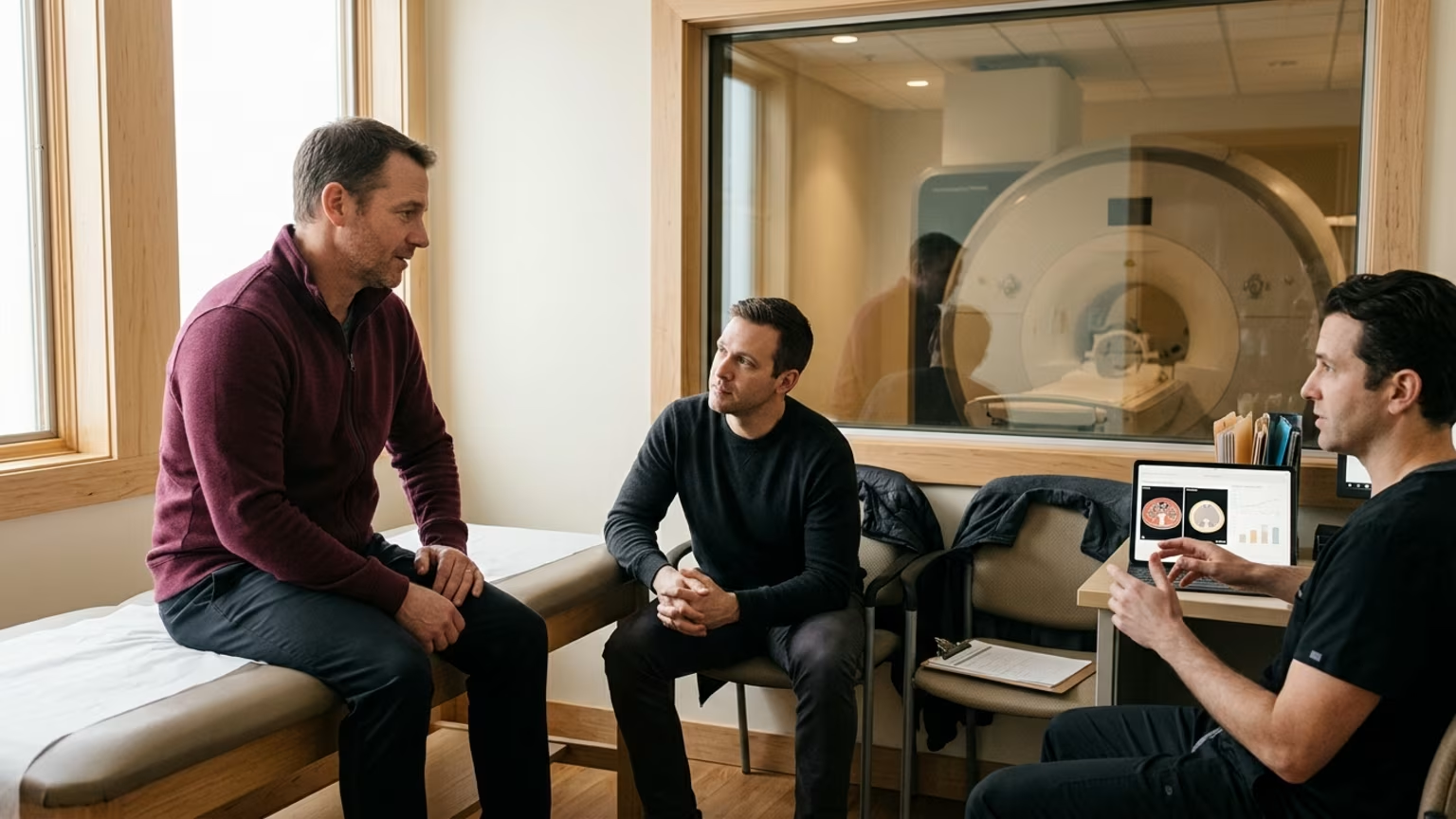

An MRI-focused announcement separates muscle size from composition during weight loss. Here is what men over 35 can discuss with their clinicians.





On October 1, 2026, AMRA Medical published an announcement about an MRI-focused presentation scheduled for that day at the European Association for the Study of Diabetes (EASD) meeting in Milan. Its chief scientific officer Dr. Jennifer Linge was scheduled to present “COURAGE Body Composition: Muscle Composition Assessed by MRI” in a symposium about preserving muscle during GLP-1 receptor agonist treatment.
A change in muscle volume answers a question about quantity. A change in fat infiltration addresses a different feature of the tissue. AMRA’s argument is that examining both can give a more detailed account of muscle changes during obesity treatment than weight or lean mass alone.
That distinction matters when interpreting a body-composition report. A lower lean-mass reading should not automatically become a verdict that muscle quality has deteriorated. Equally, a reassuring weight change does not establish what happened inside muscle.
In the announcement, Linge said body weight and lean mass do not reveal everything happening to muscle during weight loss. Her case for quantitative MRI was its ability to separate muscle volume from composition rather than asking one measurement to represent both.
The useful editorial shift is from a single score to a set of questions. How much did body weight change? What happened to the measured amount of muscle? What information is available about composition and physical function?
“Muscle quality” should remain a question to examine rather than a flattering label attached to any favorable result. In this announcement, the specific composition measure was fat infiltration. Keeping that term visible makes the discussion more precise.
The EASD symposium connected AMRA’s MRI presentation with the COURAGE study of trevogrumab during GLP-1 receptor agonist treatment. That creates a shared topic, but the announcement and the drug-trial results serve different purposes.
Regeneron reported that lower-dose trevogrumab preserved almost 70% of the thigh muscle otherwise lost with semaglutide alone among participants with evaluable MRI data in its phase 2 COURAGE trial. Reuters separately covered the trial and reported an MRI-based thigh-muscle result at 52 weeks.
The drug-trial question concerns what happened with a particular treatment combination. AMRA’s measurement question concerns the information that muscle volume and fat infiltration provide. Keeping those questions separate prevents a treatment result from becoming a blanket endorsement of a measurement strategy.
For a reader following medication-assisted weight loss, both subjects may be relevant to a clinician conversation. One concerns evidence about a treatment. The other concerns how the outcomes being discussed were actually measured.
The AMRA material is a company press release carried by AFP rather than an independent account of a full clinical dataset. It does not provide participant numbers, numerical MRI results, confidence intervals or full study methods. It also does not provide a peer-reviewed paper for the presented analysis.
Its statements about mortality and physical function come without citations to the underlying studies or effect sizes. They should therefore remain attributed to AMRA. Associations also do not establish that changing an MRI measure will itself improve function or extend life.
The report of improved composition alongside reduced volume lacks treatment-specific results and numerical estimates. It cannot establish a predictable response for every person or treatment. The COURAGE muscle-preservation figure likewise belongs to a particular combination and the participants with evaluable MRI data, not to weight-loss medication as a category.
Finally, these sources do not establish that routine MRI screening is necessary or appropriate for individual patients pursuing weight loss. They provide neither gay-men-specific findings nor age-specific recommendations. Their value here is a more precise way to discuss assessment, not a new clinical protocol.
For a gay man pursuing recomposition or medication-assisted weight loss, the practical question is how to judge progress without asking the scale to settle everything. Looking leaner and staying physically capable can both be valid goals. Neither needs to erase the other.
The evidence supports bringing those goals into a fuller discussion with a clinician. It does not supply an exercise schedule, nutrition prescription or imaging timetable. The following questions translate the measurement distinction into that conversation.
Start with the language on the report. Is the result being discussed body weight, lean mass, muscle volume or muscle fat infiltration? Ask the clinician to identify the measure before interpreting whether its change is favorable.
A useful question is: “What does this result tell us about muscle, and what question would need a different assessment?” That keeps the conversation specific without assuming that a more technical test must be the next step.
For a broader way to organize the information already available, GayFitLab’s guide to reading progress beyond a single measurement offers a related starting point. The aim is a clearer interpretation rather than a longer list of numbers.
If staying strong is a priority, say so directly. Ask how physical function is being assessed alongside body-composition changes. That is a separate question from whether the scale is moving in the intended direction.
Make the goal concrete in your own terms. It might concern your training or the physical tasks that matter in daily life. These are useful discussion points rather than a self-administered diagnostic test.
The distinction also protects the conversation from becoming purely cosmetic. Appearance can matter without being the only outcome that gets attention. A clinician can help clarify which assessments relate to the function you want to retain.
If medication is part of your care, bring questions about treatment and questions about assessment to the same appointment. Keep them distinct: “What evidence informs this treatment decision?” and “How are we evaluating changes in my body composition and function?”
That framing gives the discussion a purpose beyond pursuing the largest change in a single metric. It also leaves personal treatment decisions with a qualified clinician rather than turning a conference announcement into a reason to alter care.
GayFitLab’s discussion of interpreting body-composition shifts during medication-assisted weight loss provides related reading for organizing those questions. Use it as preparation for a conversation rather than a substitute for individualized assessment.
Ask which outcomes matter most to your current goals. You might care about appearance and physical capability at the same time. There is no editorial reason to treat one as superficial or the other as the only legitimate concern.
Then ask which available measures address those priorities. A result becomes more useful when its purpose is clear. The goal is not to turn every aspect of aging into something that needs surveillance.
This is particularly relevant to adult gay health coverage: no single body type or version of masculinity should define success. The practical standard is an assessment that makes sense for your goals and care rather than an idealized physique presented as a health result.
Treat weight and lean-mass changes as parts of the assessment rather than the final verdict, and ask your clinician how muscle composition and physical function fit your goals.
A detailed MRI headline can turn one research measurement into a new standard to chase; GayFitLab’s editorial approach keeps the distinction between credible evidence and medical hype clear. For gay men 35+ whose priorities are absent from generic men’s health advice, its coverage places body composition within a broader view of strength and healthy aging without assuming one body type or expression of masculinity.
Stay connected for research-led guidance on fitness, body composition, skin, grooming, vitality, sexual wellbeing, relationships and healthy aging. Clear ideas for gay men 35+ who want to look good, feel strong and age with confidence.


Build habits and systems that support clear thinking, steady energy and long term capacity throughout a demanding career.
explore the Blog

